Independent knowledge base software guide Evidence-led Updated 2026

Global Knowledge Base Strategy: A Practical Operating Plan
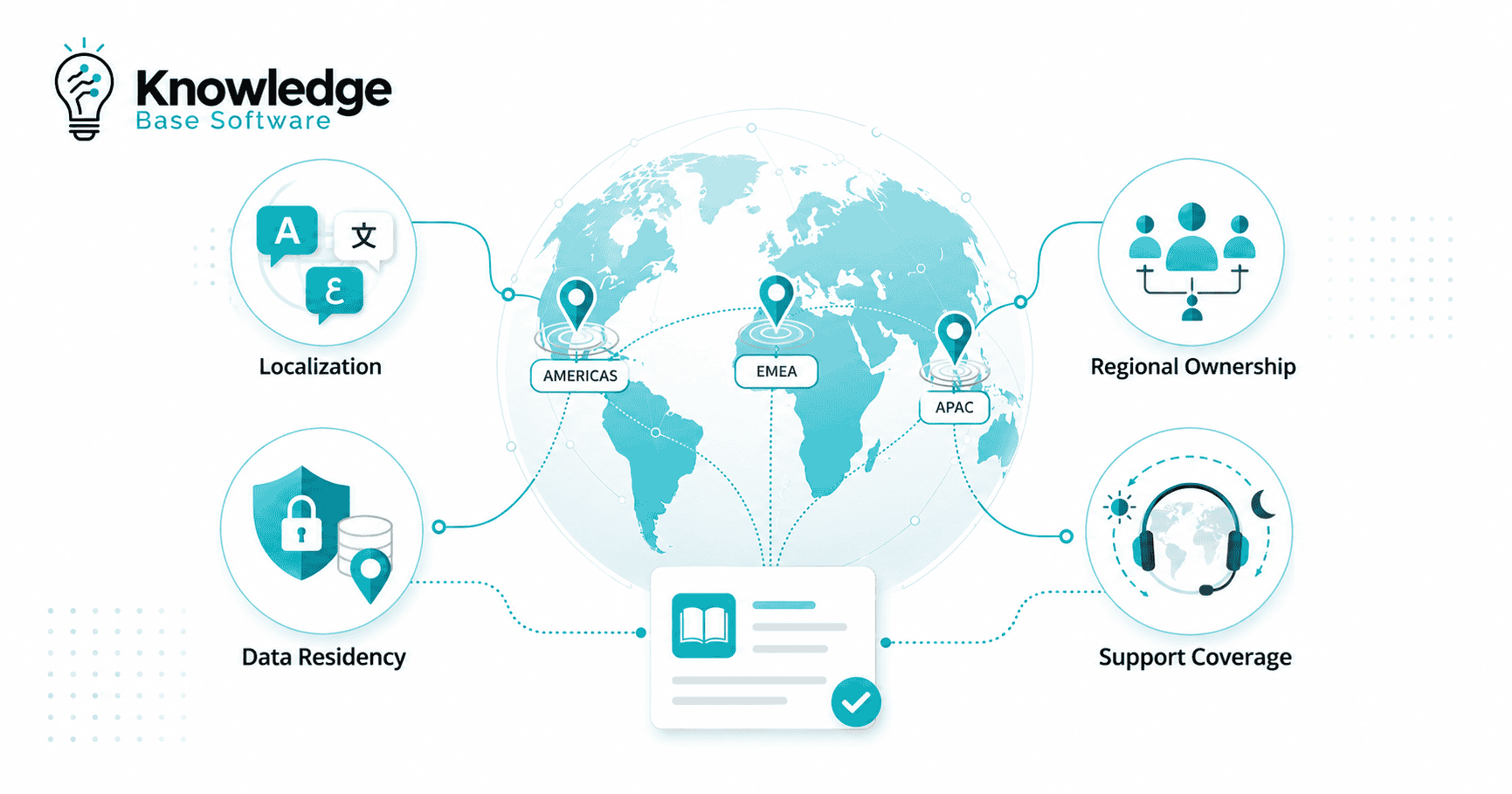
A global knowledge base strategy defines which answers your organization publishes, who can change them, how they vary across markets, and how every supported version stays accurate as products and policies evolve. It gives customers and support teams a way to find guidance that applies to their language, situation, and access rights.
Last verified: November 17, 2026.
Start with the decisions behind the content: which audiences to serve, what to standardize, where local differences are necessary, and who will maintain each version. Then choose workflows and technology that can carry out those decisions.
This guide focuses on customer-facing help content and the internal knowledge agents need to support it. The goal is a practical operating plan: clear ownership, manageable language coverage, dependable updates, and evidence that readers can complete their tasks.
Define the global scope before adding languages
A multilingual knowledge base publishes content in several languages. A global strategy also establishes how that content applies to different markets, product versions, customer groups, and support arrangements. Translation is one part of the operating model.
Separate language from market. A Spanish-speaking customer may use a product sold in the United States, Mexico, or another country, with different availability or procedures. A language preference alone does not establish which commercial terms or legal requirements apply.
Google distinguishes multilingual sites from multi-regional sites: one concerns languages, while the other concerns geographic audiences. Use that distinction in your planning even when the knowledge base is private and search-engine indexing is irrelevant.
Define your initial scope using four questions:
- Who needs the answer? Identify customers, agents, administrators, or partners and the tasks each group must complete.
- Where does the procedure apply? Record relevant markets, product editions, versions, and account permissions.
- Which languages can you maintain? Confirm both initial review capacity and someone responsible for future corrections.
- What outcome matters? Choose a concrete result, such as completing account setup or resolving a recurring configuration problem.
Audit the existing material against that scope. Mark articles to keep, merge, rewrite, localize, or retire. Check support contacts, screenshots, downloadable files, and frequently used agent replies as well as article text.
Finish with a short scope statement. For example: “Support administrators setting up the current product in our first two launch markets, through public setup guides and restricted agent procedures.” This is an illustrative planning statement; replace its boundaries with the audiences and tasks your organization actually supports.
Choose who controls global standards and local exceptions
Decide who has authority over the answer before assigning translation work. A linguistically accurate article can still describe the wrong product behavior, and a technically correct source may need adaptation for a particular market.
APQC’s knowledge base governance guidance emphasizes content ownership, approval, review triggers, and follow-through. Apply those principles through explicit decision rights and a process for resolving disagreements.
Use the following comparison as a planning aid. The best fit depends on how much your products and regional operations differ, how quickly content changes, and where expertise is available.
| Ownership model | Useful when | Tradeoff to manage |
|---|---|---|
| Centralized | A small central team understands a largely shared product and can handle the review workload. | Regional corrections may wait for central approval; designate local reviewers. |
| Decentralized | Regional businesses operate substantially different products or procedures and have capable local teams. | Shared answers may diverge; define common discovery, access, and quality requirements. |
| Federated | Teams can share standards while regional owners maintain local applicability and language quality. | Overlapping authority can delay changes; document which role makes each decision. |
Make accountability specific
For each content area, assign a role responsible for the final decision and a backup for absences. In a small organization, one person may fill several roles. Separate the responsibilities even when the names repeat.
- Knowledge lead: owns the operating standards, shared content structure, prioritization process, and unresolved ownership disputes.
- Product or process owner: approves the underlying instructions and identifies changes that affect their accuracy.
- Regional owner: approves market applicability, local examples, support routes, and documented exceptions.
- Localization lead or reviewer: manages terminology, translation quality, assignments, and the update backlog.
- Publisher or platform owner: manages publication states, access settings, distribution, and technical release checks.
Give contributors a direct way to flag or correct problems within their authority. The KCS principle of collective ownership places responsibility on people using knowledge to assess its accuracy in context. A named owner can resolve disputes while routine improvements remain accessible to qualified contributors.
Give local exceptions an owner and a review trigger
Record the affected market, reason for divergence, approving role, related source article, and the event that will trigger another review. An exception might remain valid until a regional product launch or a process change; a temporary workaround needs an explicit expiration or reassessment point.
When regional and global owners disagree, resolve the product or policy facts with the responsible subject-matter expert. Escalate funding or scope decisions to the program sponsor. Keep the approved decision with the article so the next reviewer can understand it.
Connect source articles, translations, and market variants
Treat the source of truth as a clear relationship between an answer, its authority, and its approved versions. That relationship can span several repositories. The practical requirement is knowing which version applies and what must be reviewed when it changes.
Use three content patterns deliberately:
- Shared procedure with translations: the task and product behavior are equivalent, so language versions follow the same approved instructions.
- Market-specific variant: a real difference in availability, process, or support arrangement requires different instructions. Link it to the shared topic and record its scope.
- Restricted companion procedure: agents need additional steps or information that should remain available only to authorized staff. Maintain an explicit relationship to the public guidance.
A separate regional knowledge base is justified when there is a concrete requirement for independent administration, access boundaries, operations, or content scope. First verify whether your platform can support the required locales, ownership, and publication workflows within a shared system. Before separating systems, define how shared corrections, article relationships, and search access will work across them.
Choose metadata that supports an actual action. A workable starting set is an article identifier, intended audience, applicable product or version, locale or market, access classification, owner, publication state, and the source revision each translation was reviewed against.
Keep “published” and “current” as distinct concepts in the workflow. A translation may be publicly available while awaiting an impact assessment. Conversely, a source wording edit may leave the approved translation accurate. Record the review result instead of assuming either condition.
Allow regional teams to originate useful knowledge. If a local team discovers a recurring issue, have the product owner assess its applicability, then add it to shared guidance where appropriate. Choose the authoritative source language according to available expertise and review capacity, then document how other versions depend on it.
Schedule periodic checks for missing owners and overlooked changes, with frequency based on content risk and volatility. Plan retirement at the same time. When a procedure is replaced, review its translations, related agent replies, attachments, and links. Preserve older instructions only where they still apply, with a clear version boundary.
Prioritize content you can keep current
Choose the first articles and locales from evidence about customer work. Review support requests, unsuccessful searches, product onboarding steps, regional feedback, and planned launches. Ask regional teams what those records miss, including issues customers resolve through channels you do not measure.
Use the following decision rules to organize the backlog:
- High demand and shared product behavior: prepare a strong source article and localize it for the audiences most affected.
- Low frequency but serious consequences: give the content a risk review even if traffic is modest. Account recovery or destructive administration steps may warrant careful treatment.
- Different local procedure: have a regional expert author or adapt the instructions, then verify the differences with the process owner.
- Obsolete, duplicated, or unclear source content: repair or retire it before adding more versions.
- No qualified reviewer or maintenance owner: reduce the launch scope or arrange coverage before presenting the locale as fully supported.
Every article does not need translation. An obsolete feature, an agent-only process, or a product unavailable in a market may not belong in that locale’s public library. Make exclusions deliberate and provide a useful route for readers who encounter a coverage gap.
Budget for the next update
Estimate recurring workload from source changes as well as the initial word count. As a planning calculation, multiply the expected material changes by the affected locales and the average effort for translation, review, and publication checks. Add time for locally authored content, urgent corrections, coordination, and maintenance of media.
Use your own measured effort as the pilot develops. A short procedure with changing screenshots may need more attention than a longer, stable explanation. Keep translation-service or software charges separate from internal review time so the budget shows both.
Assign ongoing capacity across source maintenance, linguistic review, subject-matter review, search testing, and analytics. APQC’s operating-model guidance distinguishes knowledge and adoption responsibilities from the technical work of configuring and operating the platform.
If review capacity is the constraint, simplify the first release: fewer tasks, fewer locales, or a narrower product scope. Confirm that existing coverage stays current before adding another maintenance commitment.
Build localization into the content change workflow
Document the full update path, including what happens to content already in use. A practical workflow starts when a product or process owner identifies a change and ends when the affected published experiences have been checked.
- Approve the source change. Record the affected task, product/version, effective release, and meaning of the change.
- Assess the impact. Identify translations, regional variants, screenshots, attachments, and agent instructions that may need revision.
- Assign the work. Give each affected locale an owner, a review requirement, and a priority based on customer impact.
- Translate and validate. Check terminology and language, then confirm technical or market accuracy with the appropriate expert.
- Publish and verify distribution. Check the article, navigation, related links, search results, and any approved AI delivery channel.
- Close the change. Record the reviewed source revision, remove temporary notices, and resolve or escalate outstanding locales.
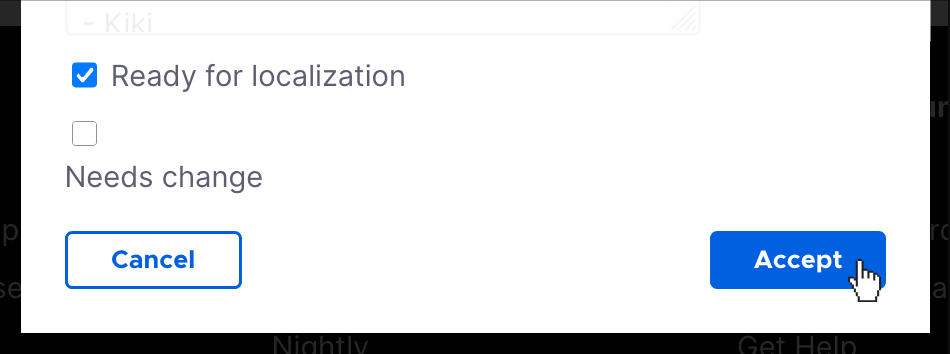
The trigger must be verified in the actual platform. For example, Zendesk states that its AI-generated article translations do not automatically update after an English-source change. Its documented process requires opening the translations and using Translate again. Other tools or integrations may behave differently.
Match review urgency to the change
Distinguish a source typo from a changed instruction. Mozilla’s article review guidelines separate minor edits, changes that do not immediately invalidate translations, and major changes that make older translations inaccurate. That is a useful model for assigning review urgency without retranslating every cosmetic edit.
Maintain an approved glossary for product terms and a translation memory for reusable language. Provide translators with the task context, relevant interface, and changed passages. For AI-assisted drafts, decide the review requirement from the consequences of an error and the ability to test the result.
Define what readers see while an update is pending. Keep a previous version only if it remains accurate for its stated scope. If instructions have become misleading, use an approved temporary notice, an explicitly labeled current-language alternative, a suitable support route, or withdrawal of the affected instructions. Choose an option the platform actually supports and check direct links as well as navigation.
Example: a product release arrives before one translation is ready
Illustrative scenario: a fictional B2B application changes its project-export workflow. The team uses an English source article with French and German versions. The French update passes review; the German update is still pending. Some customers continue using the older product interface.
The product owner first confirms which interface uses each procedure. The content owner updates the source and links the change to the affected translations and agent guidance. Instructions for the older interface remain available with an explicit applicability label.
The publisher releases the reviewed French instructions for the new interface. For German readers, the team replaces the inaccurate new-interface instructions with a reviewed German notice explaining the temporary gap and linking to the current English guidance and an appropriate support option. This fallback is a choice for the scenario, not a universal requirement.
The next support shift receives the article identifier, affected product interface, pending locale, approved temporary response, and next responsible owner. Agents can then answer from the same documented decision while translation work continues.
Before closing the release, the platform owner checks that search and any AI assistant stop presenting the superseded procedure for the new interface. After German review finishes, the team tests the export task, publishes the update, removes the notice, and records the time between source release and localized publication.
The acceptance test is whether each reader can identify applicable guidance throughout the change. A publication timestamp alone cannot establish that.
Test the complete experience in each locale
Ask a representative reader or qualified reviewer to complete an actual task, starting from the same entry points customers use. Include direct article links, navigation, search, and in-product help where available.
Use a compact locale acceptance check:
- Find the topic: search with local terminology, product labels, and realistic error messages.
- Reach the article: check categories, sections, breadcrumbs, and links from related content.
- Confirm applicability: verify that the reader can identify the relevant product, version, market, and permissions.
- Follow the instructions: test the procedure against the actual interface, including screenshots and downloads.
- Change language: check the equivalent article when available and a clear explanation when it is missing.
- Get help: verify the contact route, supported language, and operating hours rather than assuming they match the article’s locale.
Platform details can determine whether an article is reachable. Zendesk requires translated parent sections and categories for translated articles to appear in its help center. Publishing the article alone does not complete that localized path.
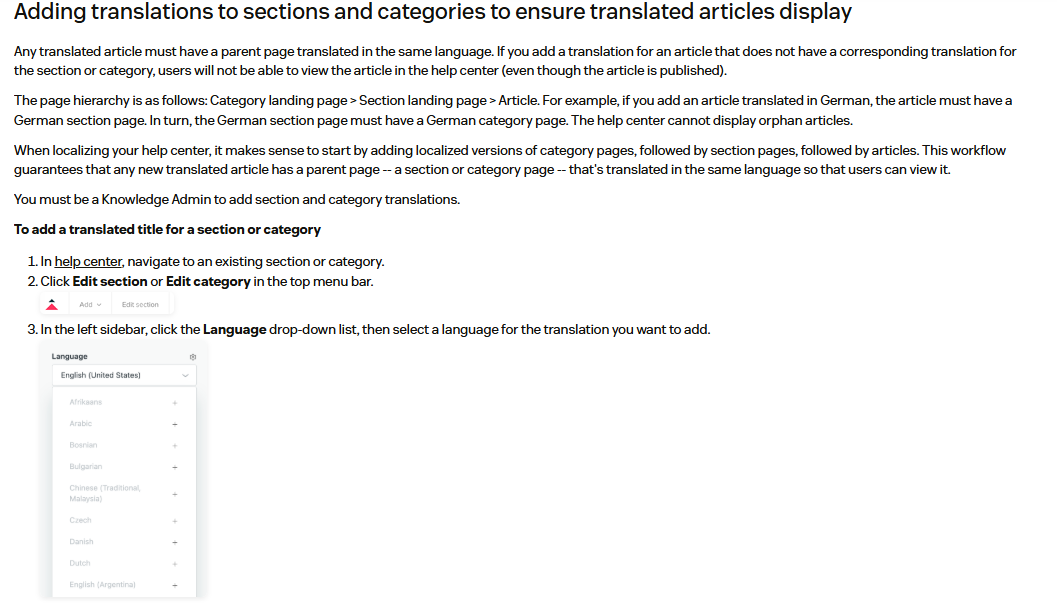
Test search independently in every supported locale. Zendesk’s search documentation specifies that the help center locale must match the article translation’s language for the documented behavior. Use your platform’s current documentation and observed results to set expectations.
Include accessibility in the checks: meaningful link labels, usable headings, keyboard access, and understandable media alternatives. For Arabic or other right-to-left scripts, test mixed-direction text, forms, and product identifiers. W3C guidance distinguishes language declarations from text direction; selecting a language does not itself establish the correct direction.
Add international SEO for public help content
For public articles intended to appear in search engines, Google recommends separate URLs for language versions and links that let users choose another language. Check that the published URLs expose the intended content without relying solely on inferred location or browser settings.
Use Google’s localized-page guidance to configure appropriate hreflang relationships. Keep editorial source ownership separate from SEO canonicalization: Google does not consider fully translated main content duplicate merely because it is a translation. Do not point every translation’s canonical tag to English just because English is the source.
For a private knowledge base, focus the equivalent effort on authenticated discovery and correct access. Public indexing is outside that use case.
Protect internal knowledge across every delivery channel
Classify the content before deciding where it can travel. Public product instructions, restricted agent procedures, and customer-specific case records need different handling.
The KCS v6 article-structure guidance separates reusable knowledge from requestor-specific information kept in the case or incident system. Apply that distinction when converting a solved ticket into an article: preserve the reusable problem and resolution, and remove unnecessary identifying details.
Map the complete workflow with the platform, privacy, and security owners. Include article bodies, attachments, translation exports, feedback, search logs, backups, and any AI processing. For each relevant data category, establish:
- Which system stores it, where processing occurs, and which organizations or teams can access it.
- Whether translation providers and other processors receive the content, and under what approved terms.
- How access changes, corrections, retention, and deletion propagate to downstream copies.
- Which legal, contractual, or organizational requirements apply to that specific information and use.
A hosting-region setting answers one part of this review. Have the responsible teams verify processing locations and cross-border access separately. Record the evidence and approved configuration instead of treating a region label as a complete compliance assessment.
Include search and AI in permission testing
If you copy content into an external index or an AI retrieval system, include that channel in the authorization design. Microsoft’s Azure AI Search documentation describes different document-level access approaches depending on the source and identity model, with some capabilities marked as preview. Verify the chosen integration rather than assuming permissions transfer automatically.
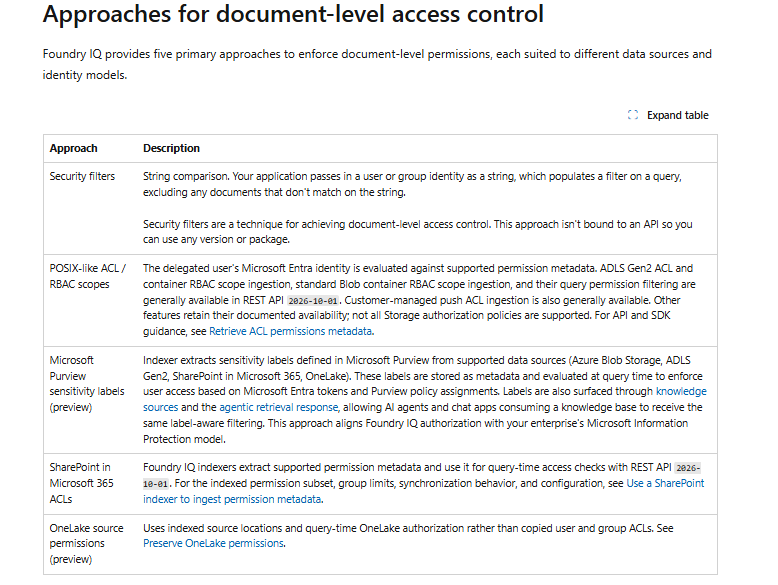
Test representative accounts against public, customer-restricted, and staff-only material. Check result titles and snippets, generated answers, and linked sources. Repeat the test after a permission change and after withdrawing an article.
For multilingual AI answers, include questions with ambiguous product versions, missing translations, and conflicting regional procedures. Require an applicable, approved source and a useful escalation path when the answer cannot be supported. Fluent output alone is insufficient evidence that the advice fits the reader’s situation.
Measure whether readers complete their tasks
Define success before the pilot so that you can compare equivalent tasks and audiences over time. Keep content readiness, user experience, and business outcomes visible as separate measures.
The Consortium for Service Innovation’s self-service measurement guidance explains why searches, page views, and sessions do not map directly to resolved issues. It recommends combining behavioral data, feedback, and observation.
The following is an example measurement plan. Adapt its definitions and reporting cadence to your system, and keep those definitions stable while comparing results.
| Measure | Example definition and evidence | How to interpret it |
|---|---|---|
| Priority-task coverage | Per locale at each release checkpoint: priority tasks with current, approved local guidance divided by all in-scope priority tasks. | A readiness measure. Coverage does not prove that readers can complete the task. |
| Translation lag | For each material change: elapsed time from source release until the approved local update is live; zero if already current. Use workflow records. | Report unfinished updates separately so overdue work is not hidden by completed items. |
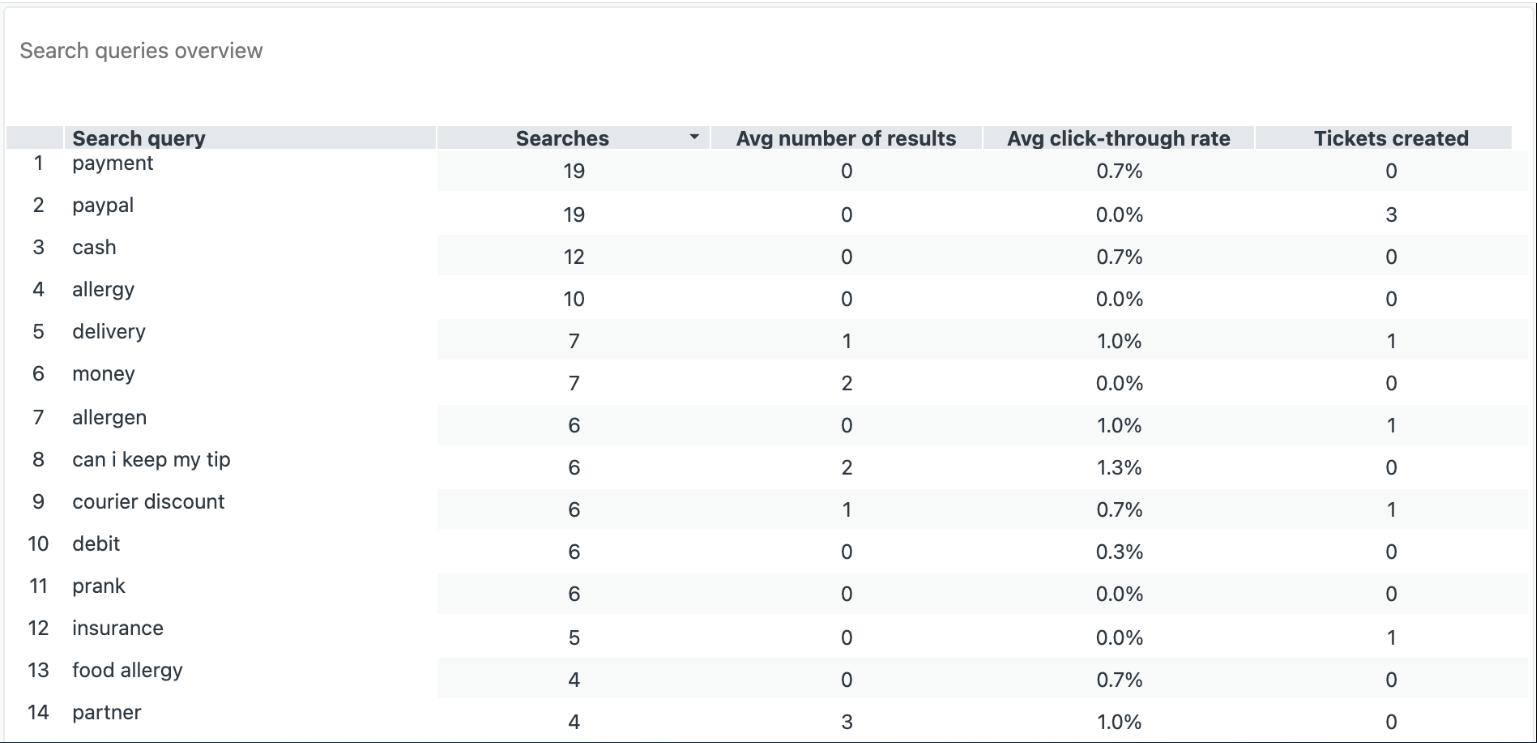
| Zero-result search rate | Weekly: recorded searches returning no results divided by all eligible recorded searches, using locale-specific search logs. | Investigate terms and missing content. A result being returned does not establish relevance. |
| Observed task completion | During each test round: successful completions divided by attempted tasks among participants, using a defined success criterion. | Report the participant count and task mix. A small test is diagnostic, not a population estimate. |
| Reported resolution | Monthly: responses confirming resolution divided by all responses to the same resolution question. | Report response count and response rate: responses divided by displayed survey invitations. Respondents may differ from other readers. |
Assign an owner to investigate changes in each measure. Segment by locale, audience, and product where data supports it. Compare a locale with its own baseline before interpreting differences between regions that have different customers or product mixes.
Use findings to select work. Good coverage with poor task completion suggests a problem beyond missing translations: investigate instructions, navigation, or applicability. Increasing translation lag calls for a review of assignment, capacity, and approval delays. High zero-result searches need inspection of the actual queries.
Do not equate an article visit without a ticket with proven ticket deflection. A reader may abandon the task, use another channel, or already have an open case. If you report savings, state the observation window, attribution assumptions, and costs included.
For low-volume locales, show counts alongside percentages and review individual failures. A few additional responses can change a rate sharply; use those signals to investigate rather than declaring a regional program successful or unsuccessful.
Pilot the operating model before expanding
Select a bounded customer task, product area, and set of locales. Include a real maintenance challenge in the pilot, such as a changing procedure or an approved regional variation. Assign the people who will operate the process after launch.
Use evidence-based readiness gates instead of promising that every organization can complete the work on the same schedule:
- Scope is agreed. The team knows the audience, applicable product, prioritized tasks, supported locales, and excluded content.
- Ownership works. Source approval, regional review, publication, urgent corrections, and backup coverage have named responsible roles.
- The local experience works. Representative users can find the guidance, recognize its applicability, complete the task, and reach the correct support route.
- The update process works. A source-change exercise identifies affected versions, assigns work, and produces the intended behavior while a locale is pending.
- Controls work. Restricted information stays restricted across enabled channels, and withdrawn instructions stop appearing where they should not.
- Maintenance is funded. The recurring workload fits available capacity, and unresolved issues have owners before expansion.
Train agents on the published process: how to locate the approved version, record an applicability problem, and submit a correction. For teams handing work between time zones, include the affected article, current decision, pending action, and next owner in the handoff. Define staffed support coverage separately.
Review the pilot with regional owners and actual users. Decide whether to expand, adjust the workflow, or narrow the commitment. Adding a language should follow evidence that the organization can maintain its priority tasks and handle changes reliably.
Your first working session can be simple: choose one important customer task, list every version of its guidance, identify who can approve a correction, and walk through what happens when the procedure changes. Any unanswered decision becomes an assigned item in the global knowledge base strategy.