Independent knowledge base software guide Evidence-led Updated 2026


Ecommerce knowledge base: Setup and testing guide
An ecommerce knowledge base is a searchable, governed source for product, delivery, order, payment, return, warranty, and account questions. It should give a shopper the answer that applies to the exact product, variant, destination, order state, and policy—not a generic paragraph that creates a new question.
The strongest design connects stable explanatory content to live commerce data. The knowledge base explains rules and tasks; the catalog remains authoritative for product and variant facts; the order system remains authoritative for a customer’s status; and the policy system owns return, shipping, warranty, and payment rules. This guide shows how to connect those sources without creating stale copies and includes an original retrieval test with a disclosed failure.
Reviewed: July 30, 2026. Google Merchant Center, Google Search Central, and Shopify examples were verified against official documentation on that date.
Quick answer
Build the first release around the highest-volume and highest-risk shopper tasks:
- choose the correct product or variant;
- check compatibility, dimensions, ingredients, materials, or care;
- understand price, availability, delivery, and pickup;
- track or change an order through a secure account workflow;
- start a return, exchange, refund, cancellation, or warranty claim;
- resolve account, checkout, payment, promotion, or gift-card problems; and
- reach human support with the required context when self-service cannot complete the task.
For every answer, state the scope: product or category, region, sales channel, item condition, order state, effective date, and exceptions. If any variable comes from a live system, retrieve or link to it instead of hard-coding it in an article.
Define the system of record for each fact
A common ecommerce failure is publishing the same price, stock value, delivery promise, or return window in several places. Copies drift. The answer may look complete while being wrong for the selected variant or destination. Create a source map before writing.
| Fact | Authoritative source | Knowledge base role | Update approach |
|---|---|---|---|
| Name, SKU, variant, dimensions, material | Product information or catalog system | Explain selection and use | Reference structured catalog fields |
| Price, sale price, stock | Commerce platform or inventory service | Explain how to check; avoid static values | Render live data |
| Order and shipment status | Order management and carrier data | Guide the secure tracking workflow | Authenticated lookup |
| Shipping rule | Shipping policy or rate service | Explain destinations, methods, cutoffs, and exceptions | Versioned policy plus live estimate |
| Return eligibility | Return policy and order/item state | Explain conditions and start the workflow | Rules evaluated against the order |
| Warranty decision | Warranty policy and claim system | Explain evidence and next steps | Policy version tied to purchase |
This separation also supports consistent external data. Google’s official Merchant Center structured-data guidance says landing-page structured data must match what the customer sees and can be used for automatic item updates, but it is not a replacement for regular product-data updates. The same principle helps onsite support: do not let search retrieve a stale article when a current catalog field exists.
Organize around the shopping journey
Categories should match customer tasks, not internal ownership. A useful top level is:
| Journey stage | Questions to cover | Useful context |
|---|---|---|
| Before purchase | Fit, compatibility, ingredients, size, availability, delivery, payment | Product, variant, location |
| Checkout | Promotion, address, payment failure, tax, pickup | Cart, market, payment method |
| After purchase | Confirmation, changes, cancellation, tracking, delay | Authenticated order state |
| Product use | Setup, care, maintenance, troubleshooting | Exact model and purchase date |
| Returns and warranty | Eligibility, method, fee, deadline, evidence, outcome | Item, condition, region, order state |
| Account and privacy | Sign-in, saved details, data request, security | Authenticated account and jurisdiction |
Add product-family landing pages when many questions share a model or category. Maintain one canonical policy explanation and link to it from relevant product guidance. Breadcrumbs should show both the task and product context when possible.
Use article patterns that expose scope and exceptions
Product and compatibility article
- Applies to: product family, models, variants, and markets.
- Direct answer: the compatible or incompatible combination.
- How to identify your model: label, order record, or serial location.
- Constraints: size, connector, software version, material, or safety limit.
- Alternatives: approved compatible option when one exists.
- Source and review trigger: product data owner and catalog change.
Return-policy article
- Applies to: country, channel, item condition, product exclusions, and purchase window.
- Eligibility: clear conditions evaluated against the order where possible.
- Method and costs: mail, store, drop-off, return shipping, and restocking fee.
- Outcome: refund, exchange, store credit, repair, or rejection.
- Steps: secure action to begin, required evidence, and expected status updates.
- Exceptions: damaged, incorrect, personalized, final-sale, hygiene, or regulated items.
Google Merchant Center’s current returns attribute documentation illustrates why return content needs structured scope: country, window, item condition, method, shipping cost, fee, outcome, and policy URL can all vary. Your customer-facing wording and structured data must agree with the policy actually offered.
Troubleshooting article
Lead with safety or stop conditions, then the smallest diagnostic sequence. Ask for observable evidence, not conclusions. Separate steps by model or symptom, state the expected result after each step, and provide an escalation route with the information support will need. Never suggest a procedure that conflicts with the approved product manual or warranty.
Treat variants as distinct answer contexts
Color may be cosmetic, but size, voltage, material, connector, capacity, region, and bundle can change compatibility, stock, price, delivery, care, or returns. Preserve the selected variant when a shopper opens help from a product page. Search and AI retrieval should filter or rank using that context rather than answering from a neighboring variant.
Google Search Central’s current product variant documentation, last updated May 20, 2026, uses ProductGroup and Product to identify groups and variants and requires distinct identifiers. It also explains single-page and multi-page variant designs. That markup is for search understanding, not an onsite knowledge model, but the underlying discipline—stable IDs and explicit variant relationships—is equally valuable for support content.
Connect articles to secure order self-service
An article can explain where to track an order, but only the order system can show a customer’s current status. Link directly to an authenticated status page while avoiding order details in public URLs, search indexes, or analytics payloads. Shopify’s official order-status documentation describes the order status page as the post-checkout place where customers can track orders and view shipping updates; the exact features and login behavior depend on store configuration.
Design escalation so context travels safely. If a shipment appears delayed, the support form can carry an internal order reference and the troubleshooting path already attempted, while the visible article remains free of personal data.
Design search for shopper language
Customers may search “send it back,” “wrong size,” “where is my parcel,” or “does this fit A20” rather than your policy and product terminology. Add synonyms, model aliases, regional terms, common misspellings, and exact error messages. Keep the canonical model or policy name visible in the answer.
- Boost exact model, SKU, and error-code matches.
- Filter results by market, language, product, variant, and access state.
- Show scope and last review in the result snippet for high-risk policies.
- Prevent archived pages and expired promotions from ranking.
- Use “no confident answer” when the evidence does not support a response.
- Log zero-result and reformulated queries without collecting unnecessary personal data.
The knowledge base search design guide covers result presentation and query evaluation in more detail.
Keep product and policy answers current
Use event triggers, not only annual review dates. A catalog change should flag dependent compatibility and care articles. A shipping-carrier, warehouse, cutoff, or destination change should flag delivery guidance. A policy deployment should update the canonical rule, structured data, workflow validation, translations, templates, and cached search content as one controlled release.
| Change event | Items to review | Validation |
|---|---|---|
| New variant or SKU | Fit, compatibility, size, care, schema, search synonyms | Variant-specific queries and links |
| Price or availability integration change | Widgets, feed mapping, fallback wording | Displayed data matches source |
| Return-policy change | Policy page, product exceptions, workflow, structured data | Eligible and ineligible order fixtures |
| Carrier or fulfillment change | Methods, estimates, cutoffs, tracking instructions | Destination and order-state tests |
| Product safety notice | Affected model guidance and escalation | Priority review and prominent delivery |
Assign an owner and approver to each dependency. The knowledge base content audit guide can help find orphaned, duplicated, and outdated material.
Build the first release in six steps
1. Select journeys, not article counts
Use search logs, support contacts, return reasons, checkout errors, product reviews, and usability sessions to identify tasks. Remove personal data and distinguish a frequent question from a task that customers fail to complete.
2. Build the source map
For every fact, record its system of record, identifier, owner, update event, fallback behavior, and audience. Resolve conflicts before drafting.
3. Publish task-focused patterns
Use consistent product, policy, order, and troubleshooting templates. Put the direct answer and scope before background explanation.
4. Connect contextual entry points
Link product help from the matching product page, order help from the authenticated status view, and return guidance from the item-level order action. Preserve product and market context.
5. Test answer retrieval and workflows
Freeze a query set with expected answers. Test generic wording, product identifiers, exceptions, and near-matches. Then complete the linked task using test orders for eligible, ineligible, cancelled, shipped, damaged, and region-specific cases.
6. Launch with safe escalation
Offer human help when the task cannot be completed. Carry only the minimum needed context, explain expected response behavior, and make it easy to report a wrong or outdated answer.
Original test: product-specific content beat generic FAQs
We ran a deterministic local retrieval test on July 30, 2026. The synthetic store fixture contained 14 documents: five generic articles for shipping, returns, tracking, warranty, and payments, plus nine product- or exception-specific cards for a shoe, filter, linen shirt, desk, battery restriction, personalized return, size rule, final-sale exception, and backorder status. We froze 13 shopper queries and one expected document for each.
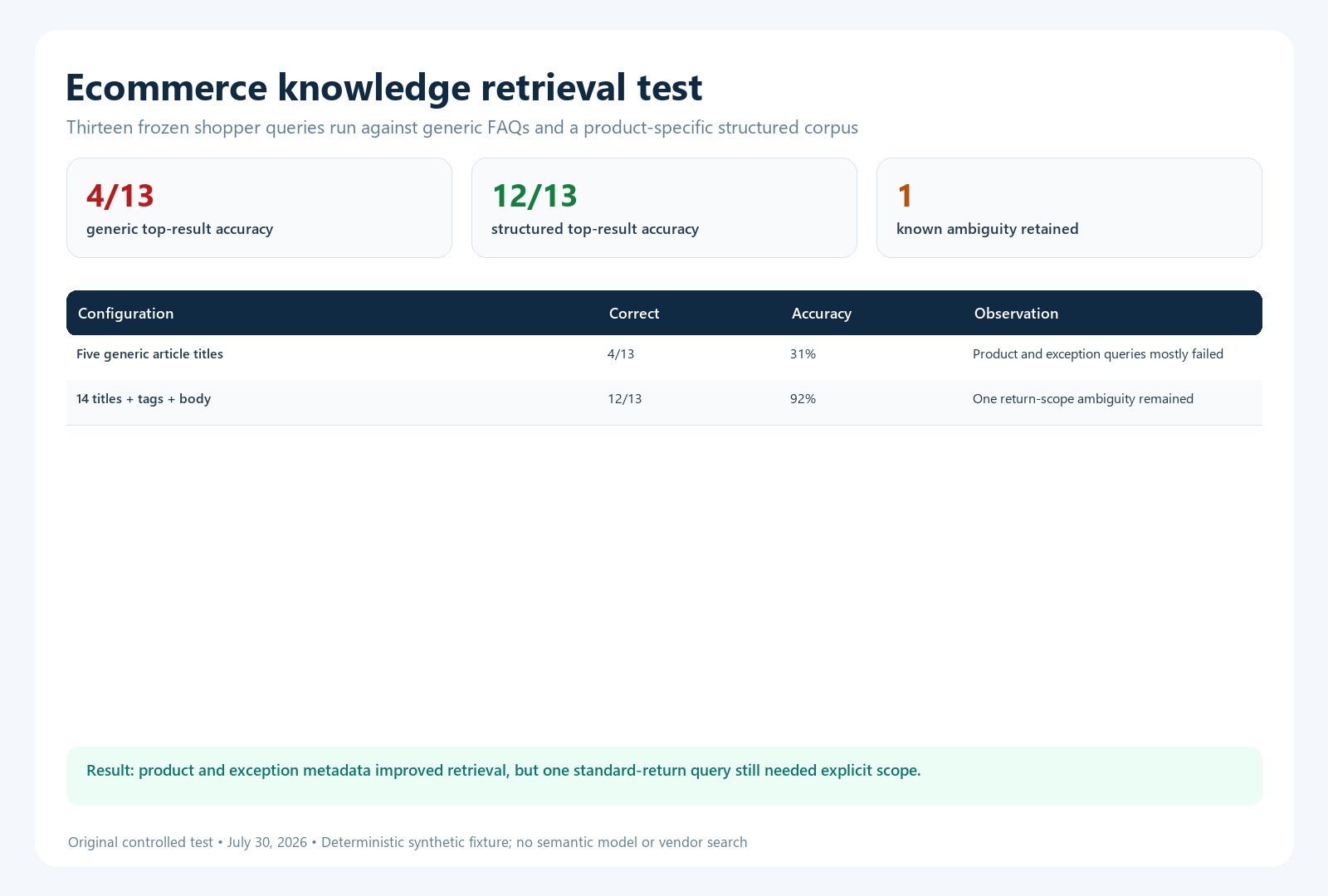
| Configuration | Documents searched | Top-result accuracy | Result |
|---|---|---|---|
| Generic baseline | Five article titles | 4/13 (31%) | Could not resolve most product and exception questions |
| Structured set | 14 titles, bodies, and tags | 12/13 (92%) | Resolved model, care, dimension, battery, exception, size, and stock queries |
The tokenizer and weighting matched the sales test: lowercase alphanumeric tokens, a fixed stop-word list, minimal plural normalization, and weights of 3 for title, 2 for tags, and 1 for body. It used no semantic model or vendor search.
The failure matters
The structured system still failed one query: “Can I return an unused regular item after 20 days?” It ranked the personalized-item exception above the general returns policy because both shared strong “return” and “item” terms. More content created a new ambiguity.
A defensible fix is not to declare the test passed after editing the same query. Add explicit scope metadata such as standard-item, personalized, final-sale, product category, market, and order attributes; then test on a separate holdout set. For a live return decision, the workflow should evaluate the actual item and policy version rather than depend only on text ranking.
How to reproduce the test
- Create 14 rows with
id,title,body, andtags. - Freeze the 13 queries and expected IDs before scoring.
- Run title-only retrieval against the five generic rows.
- Run weighted title, tag, and body retrieval against all 14 rows.
- Record top result, score, expected result, and pass or fail for every query.
- Keep the failed query in the regression suite and use unseen queries for the next evaluation.
Limitations: this is a small synthetic English fixture. It does not measure a commerce platform, production search, customer behavior, conversion, latency, typo tolerance, multilingual retrieval, or policy-engine correctness. The low baseline partly reflects its intentionally generic coverage. The result demonstrates the need for product-specific scope and regression testing, not a universal 69-point improvement.
Measure completed tasks, not assumed ticket prevention
| Metric | Definition | Limit |
|---|---|---|
| Retrieval success | Expected useful result found under a documented query test | Does not prove the shopper completed the task |
| Task completion | Explicit completion of tracking, return, setup, or another defined workflow | Instrument the success event |
| Escalation signal | Eligible self-service journey followed by assisted contact within a stated window | No contact does not prove resolution |
| Policy accuracy | Test orders receive the expected eligibility and outcome | Cover regions and exceptions |
| Content freshness | Dependencies reviewed after source changes and before due dates | Review completion does not guarantee correctness |
| Customer feedback | Reader reports that an answer was useful or wrong | Helpful is not identical to solved |
A ticket-deflection signal estimates journeys that did not lead to assisted contact under a defined event rule and time window. Do not label those journeys “solved” or “prevented tickets” without an explicit success signal or causal evidence. See the benchmarking guide for measurement design.
Ecommerce knowledge base checklist
- Can content reference stable product, variant, policy, order, and market identifiers?
- Can live price, availability, delivery, and order data stay outside static article copies?
- Can search filter by product, variant, region, language, and content status?
- Can return and warranty workflows evaluate test-order attributes and exceptions?
- Can editors see dependencies and trigger review after source changes?
- Can the experience preserve product context from product page to help article?
- Are account and order details protected from public URLs, indexes, and analytics?
- Can customers escalate with safe context when self-service fails?
- Can structured data, visible content, product feeds, and policies be checked for agreement?
- Can content and metadata be exported without losing product relationships?
Frequently asked questions
Should an ecommerce knowledge base show live stock and prices?
It may display them, but the values should come from the authoritative commerce or inventory source. Avoid manually maintaining volatile values in articles.
How is a knowledge base different from product pages?
Product pages primarily support evaluation and purchase. The knowledge base supports cross-product decisions, policies, order tasks, setup, care, troubleshooting, returns, and escalation. Link the two using stable product context.
Does product structured data replace help content?
No. Structured data helps systems interpret product and offer facts. Customers still need clear explanations and workflows, and all representations must agree with the visible, current offer.
How often should return articles be reviewed?
Review them immediately after policy, fee, region, channel, product-exception, or workflow changes, with a scheduled review as a backstop. Test both eligible and ineligible orders.
Sources and methodology
Current examples use official Google Merchant Center structured-data and return-attribute documentation, Google Search Central product and variant documentation, and Shopify order-status guidance. Google’s 2026 product-data specification update was also checked for current changes and the January 31, 2027 image-resolution enforcement date. The original retrieval test is a disclosed local fixture, not a platform benchmark.