Independent knowledge base software guide Evidence-led Updated 2026

A Knowledge Base Software RFP Template is a structured procurement document that gives shortlisted vendors the same project context, requirements, response rules, evidence requests, pricing questions, and evaluation criteria. Its purpose is to make proposals comparable before a buyer selects knowledge base, help center, documentation, or knowledge-management software.
The template on this page is designed for direct reuse. It covers business requirements, authoring, governance, search, permissions, security, privacy, artificial intelligence, accessibility, integrations, migration, implementation, total cost of ownership, contract exceptions, data portability, demonstrations, references, and proposal scoring.
Quick guidance: Define the business problem and test scenarios before listing features. Require vendors to identify the exact product edition, current availability, evidence, limitations, dependencies, implementation effort, and cost for every important requirement.
This is a buyer-side software-selection template. It is different from an RFP response knowledge base, which is a repository a seller uses to store approved proposal answers, policies, evidence, and past responses.
Contents
- What the RFP template should accomplish
- RFI vs RFP vs RFQ
- What to decide before issuing the RFP
- How to use the template
- Copyable Knowledge Base Software RFP Template
- Vendor response format and status codes
- Functional requirements
- Security and privacy requirements
- AI requirements
- Accessibility requirements
- Integration and API requirements
- Migration requirements
- Implementation and change management
- Reliability and support requirements
- Pricing and total cost of ownership
- Contract, data portability, and exit
- Demo, trial, and proof-of-concept plan
- Evaluation scorecard
- Common RFP mistakes
- Final issue-readiness checklist
- Frequently asked questions
What Should a Knowledge Base Software RFP Accomplish?
A useful RFP does more than ask vendors whether they support a list of features. It explains the buyer’s operating context and forces each vendor to respond in a consistent, evidence-based format.
The RFP should enable the buyer to determine:
- Whether the software supports the buyer’s actual knowledge use cases.
- Which capabilities are available in production today.
- Which capabilities require configuration, services, custom development, or another product.
- Which edition, package, or add-on includes each capability.
- How search, permissions, governance, accessibility, and AI work in realistic scenarios.
- What can and cannot be migrated from the existing platform.
- How implementation responsibilities are divided.
- What the full cost will be over the buyer’s planning period.
- Which contractual, security, data, or exit risks remain.
- How written claims will be verified through documentation, demonstrations, trials, references, and acceptance testing.
For federal negotiated acquisitions, FAR 15.203 states that an RFP describes the government’s requirement, anticipated contract terms, information required in the proposal, and evaluation factors with their relative importance. Private companies are not automatically governed by that rule, but the structure is a useful discipline for any buyer seeking comparable proposals.
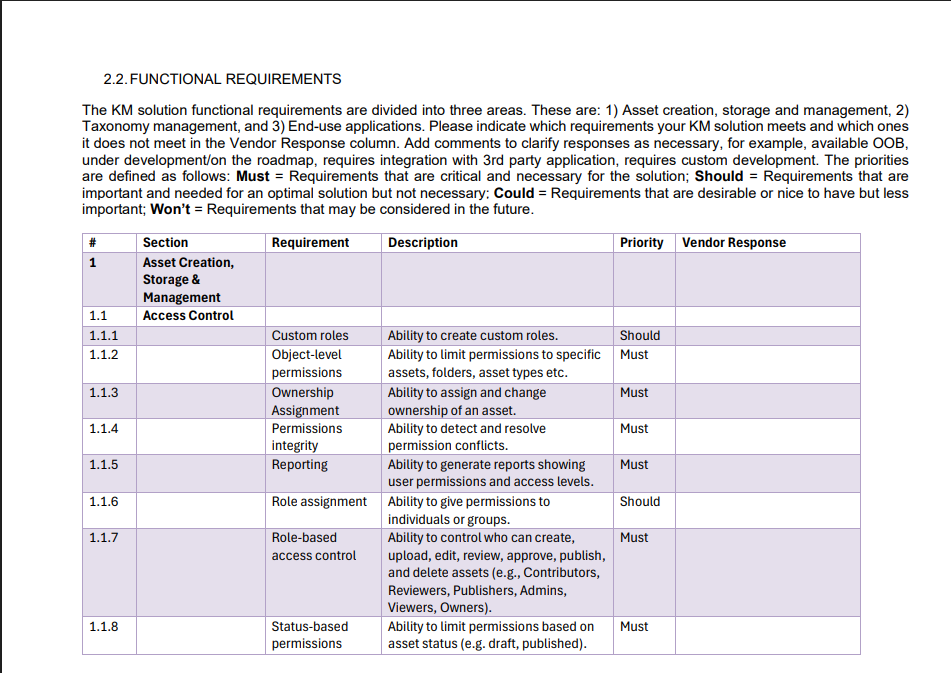
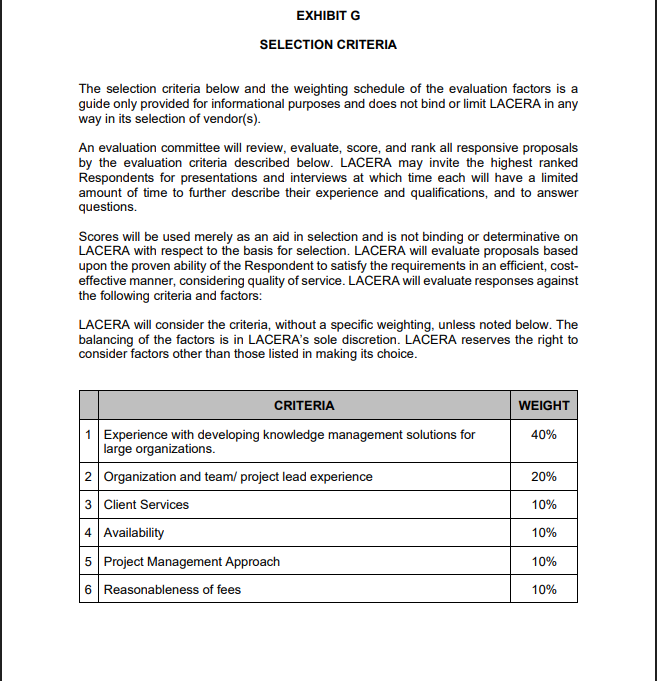
A public LACERA knowledge-management RFP illustrates why a specialized template is necessary: its scope includes taxonomy, search, review and approval workflows, classification, integration, prioritized requirements, AI access, and sensitivity-based permissions.
RFI vs RFP vs RFQ for Knowledge Base Software
| Document | Use it when | Typical output |
|---|---|---|
| Request for Information | The buyer is still learning what solutions, architectures, services, and commercial models exist. | Market information, capability summaries, indicative costs, and a shortlist. |
| Request for Proposal | The buyer can describe its problem, use cases, requirements, response rules, and evaluation method, but vendors may propose different solutions. | Comparable technical, implementation, commercial, and contractual proposals. |
| Request for Quote | The specification and scope are sufficiently fixed and the remaining comparison is mainly commercial. | A price or quotation for a clearly defined product or service. |
These are practical distinctions, not universal legal definitions for every organization. Public-sector buyers must follow the statutes, regulations, solicitation formats, approval thresholds, and evaluation rules that apply to their jurisdiction.
Use an RFI before the RFP when the team cannot yet answer basic questions such as whether it needs a standalone documentation platform, a help-desk knowledge module, an employee knowledge system, an enterprise search layer, or an AI-enabled support platform.
What to Decide Before Issuing the RFP
The buyer should complete an internal brief before asking vendors to respond. Otherwise, vendors will make different assumptions and produce proposals that cannot be compared reliably.
Assemble the evaluation team
- Executive or project sponsor
- Knowledge-management owner
- Customer Support, IT, HR, documentation, or other business owner
- Procurement and vendor management
- Enterprise architecture and integration
- Identity and access management
- Security and privacy
- Accessibility
- Legal and compliance
- Finance
- Migration and implementation leads
- Representative authors, reviewers, administrators, agents, and readers
Define the use cases
Select only the use cases the new platform must support:
- Public customer help center
- Authenticated customer portal
- Internal employee knowledge base
- Support-agent knowledge base
- IT service knowledge base
- HR or employee-service knowledge base
- Product documentation
- Developer or API documentation
- Partner knowledge base
- Marketplace knowledge base
- Multi-brand or multi-product documentation
- Multilingual knowledge base
- Regulated or high-security content
- AI or chatbot knowledge source
- Agent-assist knowledge source
- Enterprise search across multiple repositories
Document the current content estate
Record the approximate volume, formats, languages, hierarchy, metadata, permissions, URLs, attachments, integrations, analytics, version history, review states, and migration risks. Vendors cannot provide a credible migration approach or estimate without this information.
Separate outcomes from features
“Support AI” and “improve search” are not sufficient objectives. Define observable outcomes such as enabling a permitted user to find an authoritative answer through a known set of queries, while preventing an unauthorized user from discovering the title, snippet, attachment, API result, export, or AI answer.
How to Use This RFP Template
- Replace every bracketed field with buyer-specific information.
- Delete requirements that do not support a defined use case.
- Add requirements that arise from the organization’s architecture, policies, risks, and content model.
- Classify requirements before vendors see them.
- Approve disqualifying gates with the responsible stakeholders.
- Define evidence and acceptance expectations.
- Issue the same core response format and test scenarios to every vendor.
- Keep buyer-only scores and risk notes separate from the vendor-facing version when appropriate.
- Follow the organization’s procurement, legal, security, accessibility, and fairness rules.
The bracketed fields below are intentional customization fields inside the reusable template. They are not unfinished editorial notes.
Copyable Knowledge Base Software RFP Template
1. RFP Cover and Document Control
| Field | Buyer entry |
|---|---|
| Organization | [Organization Name] |
| RFP title | [Project Name] Knowledge Base Software RFP |
| RFP reference | [Reference Number] |
| RFP owner | [Name and Title] |
| Procurement contact | [Name, Email, and Approved Communication Channel] |
| Issue date | [RFP Issue Date] |
| Vendor question deadline | [Question Deadline] |
| Response deadline | [Response Deadline and Time Zone] |
| Demo or workshop period | [Dates] |
| Target selection date | [Date] |
| Target contract date | [Date] |
| Target implementation period | [Target Period] |
| Proposal validity | [Required Validity Period] |
| Confidentiality instructions | [Instructions] |
2. Organization and Project Overview
Organization overview: [Describe the organization, its mission, operating model, locations, primary audiences, and relevant regulatory or policy context.]
Project summary: [Organization Name] is evaluating knowledge base software to support [selected use cases]. The selected solution is expected to provide [summary of required outcomes] and integrate with [current systems].
Current situation: [Describe the current platform, fragmented repositories, search problems, governance issues, permission limitations, migration deadline, contract expiration, accessibility concerns, AI goals, and other material context.]
3. Business Problem and Objectives
The organization is seeking a solution to address the following problems:
[Problem 1][Problem 2][Problem 3][Problem 4]
The project objectives are:
[Observable Objective 1][Observable Objective 2][Observable Objective 3][Observable Objective 4]
Current baselines: [Document known baselines without estimating missing data.]
Target measures: [Define buyer-approved targets and measurement windows.]
Non-goals: [List work and outcomes that are explicitly outside this procurement.]
4. Scope and Non-Scope
| In scope | Out of scope |
|---|---|
[Use cases, audiences, brands, products, languages, integrations, migration, services] | [Excluded business units, content, custom development, workflows, or systems] |
5. Audiences and Use Cases
| Audience | Primary tasks | Content sensitivity | Access model |
|---|---|---|---|
[Audience 1] | [Tasks] | [Public, internal, confidential, regulated] | [Anonymous, authenticated, role-based, attribute-based] |
[Audience 2] | [Tasks] | [Classification] | [Access model] |
[Audience 3] | [Tasks] | [Classification] | [Access model] |
6. Current Environment and Content Estate
| Item | Current state |
|---|---|
| Knowledge platforms and repositories | [Systems] |
| Help desk or service platform | [System] |
| CRM, LMS, CMS, portal, and collaboration tools | [Systems] |
| Identity provider | [System and protocols] |
| Approximate articles or documents | [Count or range] |
| Source formats | [HTML, Markdown, Word, PDF, XML, database, API, other] |
| Languages and regional variants | [Languages] |
| Authors, reviewers, administrators, readers | [Approximate counts] |
| Hierarchy, tags, and metadata | [Description] |
| Permissions | [Description] |
| Legacy URLs and redirects | [Description] |
| Attachments and media | [Types and volume] |
| Version and audit history | [Description] |
| Analytics history | [Available data] |
| Known migration risks | [Risks] |
7. Project Governance and Stakeholders
| Role | Owner | Responsibility |
|---|---|---|
| Executive sponsor | [Name or Team] | [Responsibility] |
| Business owner | [Name or Team] | [Responsibility] |
| Technical owner | [Name or Team] | [Responsibility] |
| Procurement | [Name or Team] | [Responsibility] |
| Security and privacy | [Name or Team] | [Responsibility] |
| Accessibility | [Name or Team] | [Responsibility] |
| Legal and contract | [Name or Team] | [Responsibility] |
| Finance | [Name or Team] | [Responsibility] |
| Migration and implementation | [Name or Team] | [Responsibility] |
8. RFP Schedule
| Milestone | Date |
|---|---|
| RFP issued | [Date] |
| Intent to respond, if required | [Date] |
| Vendor questions due | [Date] |
| Buyer answers issued | [Date] |
| Proposals due | [Date] |
| Shortlist notification | [Date] |
| Demonstrations or workshops | [Dates] |
| Trial or proof of concept | [Dates] |
| Reference checks | [Dates] |
| Selection and contracting | [Dates] |
| Target implementation | [Period] |
9. Proposal Submission Instructions
- Submit proposals through
[approved method]. - Use the section order and requirement IDs provided in this RFP.
- Identify the exact legal entity submitting the proposal.
- Identify the exact product, edition, package, SKU, and optional add-ons proposed.
- State all assumptions, dependencies, exclusions, and third-party requirements.
- Do not substitute marketing links for required responses.
- Mark confidential information according to
[buyer instructions]. - Submit detailed security materials through
[approved secure channel]. - State the proposal-validity period.
- Identify the authorized commercial and contract contacts.
Vendor Response Format and Status Codes
For every numbered requirement, the vendor must provide:
- Requirement ID
- Capability status code
- Product and exact edition or package
- Current production availability
- Native capability, configuration, custom development, professional services, or third-party dependency
- Current documentation or evidence reference
- Known limitations and exclusions
- Dependencies and assumptions
- Implementation effort
- One-time, recurring, and usage-based costs
- Demo or trial method
- Vendor comments
Capability status codes
| Code | Meaning |
|---|---|
| GA | Currently available as a standard production feature in the proposed edition. |
| CONFIG | Available through supported standard configuration. |
| CUSTOM | Requires custom development. |
| PS | Requires vendor professional services. |
| 3P | Requires a third-party product or integration. |
| BETA | Available only in preview or beta. |
| ROADMAP | Planned but not currently available. |
| NO | Not available. |
| NA | Not applicable; explanation required. |
| ND | Vendor declined to disclose. |
Roadmap, preview, and beta capabilities must not be represented as generally available. The vendor must state the exact edition, additional cost, current limitations, and evidence date.
Requirement priorities
| Priority | Definition |
|---|---|
| GATE | A pass-or-fail condition. Failure may remove the proposal from further consideration. |
| MUST | A required capability or commitment with high decision importance. |
| SHOULD | Important and expected, but a documented alternative may be considered. |
| COULD | Useful but not essential to the core outcome. |
| INFO | Requested for context, risk review, planning, or contract discussion. |
The buyer must assign priorities before reviewing vendor responses. A failed security, privacy, accessibility, permission, migration, or data-portability gate must remain visible and must not disappear inside a weighted average.
Observable requirement format
Write important requirements using the following elements:
- Actor: Who performs the task?
- Starting condition: What data, role, or content exists first?
- Action: What does the actor do?
- Expected result: What must happen?
- Evidence: How will the result be shown?
- Acceptance rule: What result is sufficient?
- Exception: Which limits are allowed?
Illustrative search requirement: A representative user enters the buyer-supplied exact-title, natural-language, synonym, and typo queries. The agreed target content appears according to the buyer’s predefined success rule, and unauthorized content does not appear in results or generated answers.
Functional Requirements
Customize the priority column. Delete requirements that do not support an approved use case.
Authoring and content creation
| ID | Requirement | Priority |
|---|---|---|
| A-01 | Support the buyer’s required rich-text, Markdown, structured, code, table, callout, media, attachment, and embedded-content formats. | [Priority] |
| A-02 | Support reusable templates, snippets, variables, or components without creating uncontrolled duplicate content. | [Priority] |
| A-03 | Support drafts, autosave, preview, comments, suggested changes, and collaborative authoring as required. | [Priority] |
| A-04 | Support bulk import, bulk update, bulk metadata changes, and bulk movement of content. | [Priority] |
| A-05 | Identify broken links and provide tools for correction, redirection, or replacement. | [Priority] |
| A-06 | Support scheduled publication, effective dates, expiration, and controlled archival. | [Priority] |
Governance and publishing workflow
| ID | Requirement | Priority |
|---|---|---|
| G-01 | Assign named owners, authors, reviewers, approvers, and administrators with configurable responsibilities. | [Priority] |
| G-02 | Support buyer-defined review and approval workflows, including multiple stages where required. | [Priority] |
| G-03 | Preserve version history, approval history, comments, compare-version capability, and authorized rollback. | [Priority] |
| G-04 | Support review reminders, verification status, event-based review, and owner reassignment. | [Priority] |
| G-05 | Provide governance reporting for missing owners, overdue reviews, expired content, drafts, and archived content. | [Priority] |
| G-06 | Maintain an auditable history of material content and configuration changes. | [Priority] |
Taxonomy, metadata, and content relationships
| ID | Requirement | Priority |
|---|---|---|
| T-01 | Support the required categories, nested hierarchy, collections, spaces, tags, metadata, and custom fields. | [Priority] |
| T-02 | Support related content, parent-child relationships, product versions, regional variants, and audience relationships. | [Priority] |
| T-03 | Support controlled taxonomy changes, bulk reorganization, redirects, and impact reporting. | [Priority] |
| T-04 | Provide governance controls for metadata values, synonyms, labels, and duplicate categories. | [Priority] |
Search and discovery
| ID | Requirement | Priority |
|---|---|---|
| S-01 | Support the buyer’s required keyword, semantic, hybrid, natural-language, typo, and synonym search behavior. | [Priority] |
| S-02 | Support filters, facets, boosting, exclusions, ranking controls, and search tuning where required. | [Priority] |
| S-03 | Enforce content permissions before displaying titles, snippets, attachments, metadata, or answers. | [Priority] |
| S-04 | Support multilingual, version-aware, audience-aware, and product-aware search where required. | [Priority] |
| S-05 | Provide search suggestions, related results, and a configurable zero-result experience. | [Priority] |
| S-06 | Provide query, click, refinement, zero-result, abandonment, and search-performance analytics. | [Priority] |
| S-07 | Support search through an API and federated search across approved repositories where required. | [Priority] |
Publishing experiences and localization
| ID | Requirement | Priority |
|---|---|---|
| P-01 | Support the required public, authenticated, internal, agent-facing, embedded, or in-product experiences. | [Priority] |
| P-02 | Support the required brands, sites, domains, products, navigation models, and audience segments. | [Priority] |
| P-03 | Provide responsive presentation and the buyer’s required theming and customization controls. | [Priority] |
| P-04 | Support the required canonical URLs, sitemaps, redirects, metadata, robots controls, and structured publishing behavior. | [Priority] |
| P-05 | Support locales, regional variants, translation workflow, language relationships, fallback, and status tracking. | [Priority] |
| P-06 | Support buyer-required right-to-left languages, translation exports, glossaries, and human review. | [Priority] |
Permissions and administration
| ID | Requirement | Priority |
|---|---|---|
| PA-01 | Support public, authenticated, internal, restricted, and organization-segmented content. | [Priority] |
| PA-02 | Support buyer-required role-based, group-based, attribute-based, inherited, and item-level permissions. | [Priority] |
| PA-03 | Enforce permissions consistently in navigation, direct links, search, APIs, exports, notifications, and AI. | [Priority] |
| PA-04 | Provide permission reports and a safe method to preview or test the experience of a defined user or role. | [Priority] |
| PA-05 | Support administrative role separation and delegated administration within approved boundaries. | [Priority] |
| PA-06 | Support required test, staging, sandbox, and production environments with controlled promotion. | [Priority] |
Analytics and reporting
| ID | Requirement | Priority |
|---|---|---|
| AN-01 | Provide article, audience, search, feedback, content-freshness, ownership, and localization analytics. | [Priority] |
| AN-02 | Support filters and segmentation by the buyer’s required site, audience, product, language, region, or channel. | [Priority] |
| AN-03 | Provide standard reports, configurable dashboards, scheduled delivery, and role-based access. | [Priority] |
| AN-04 | Provide raw data export, API access, or event delivery at the required granularity and retention. | [Priority] |
| AN-05 | Document the definitions and limitations of reported self-service, contact, resolution, and AI metrics. | [Priority] |
Identity, Security, and Privacy Requirements
The vendor must provide current evidence appropriate to the buyer’s risk profile. Certifications and reports are evidence inputs; they do not guarantee that the proposed implementation is secure or compliant.
| ID | Requirement | Priority |
|---|---|---|
| SEC-01 | Support the buyer’s required authentication, SSO, MFA, SAML, OIDC, provisioning, and deprovisioning model. | [Priority] |
| SEC-02 | Support least-privilege administrative, authoring, reviewing, reading, and API permissions. | [Priority] |
| SEC-03 | Describe tenant isolation, content isolation, data-access enforcement, and denied-access testing. | [Priority] |
| SEC-04 | Describe encryption in transit, encryption at rest, key management, secrets management, and backup protection. | [Priority] |
| SEC-05 | Provide the required audit events, retention, administrative visibility, and log-export capability. | [Priority] |
| SEC-06 | Describe vulnerability management, secure development, testing, remediation, and security-update practices. | [Priority] |
| SEC-07 | Describe incident detection, response, notification, communication, and customer responsibilities. | [Priority] |
| SEC-08 | Identify data locations, subprocessors, transfer mechanisms, retention, deletion, and backup-deletion practices. | [Priority] |
| SEC-09 | Provide the buyer-requested security, privacy, resilience, and software-supply-chain evidence through an approved channel. | [Priority] |
| SEC-10 | Describe business continuity, disaster recovery, restore testing, dependencies, and recovery commitments offered. | [Priority] |
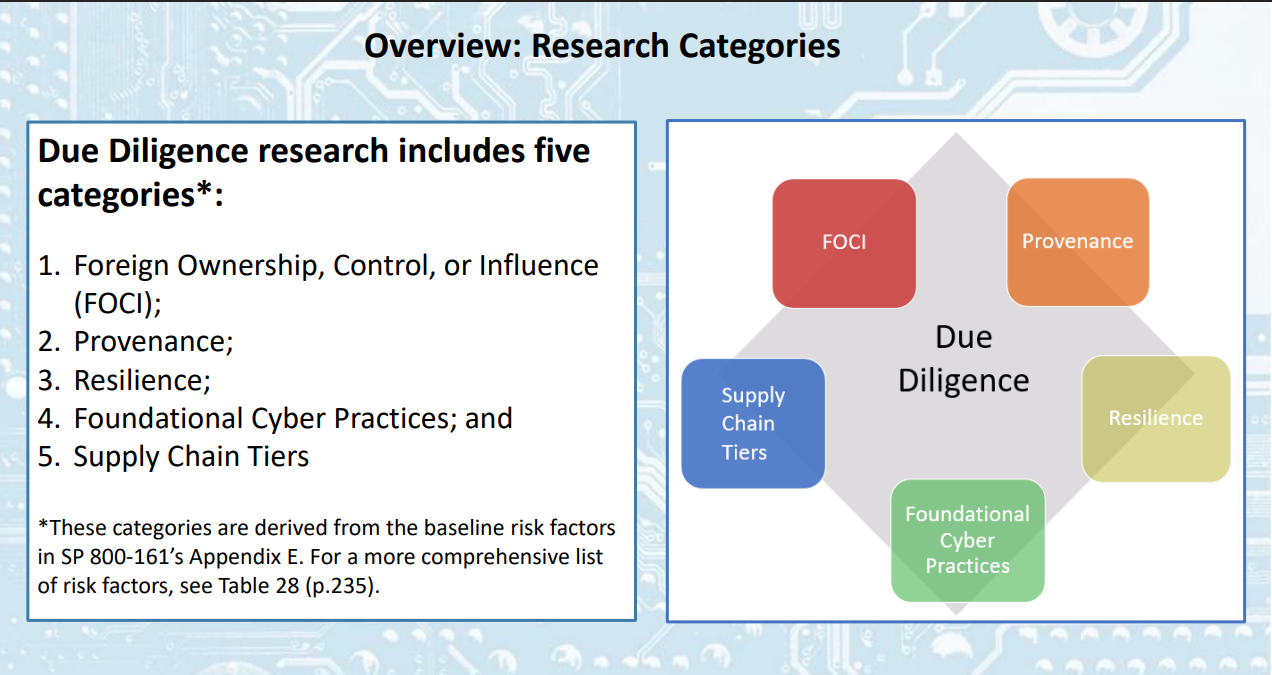
NIST’s Cybersecurity Supply Chain Management Due Diligence Assessment Quick-Start Guide frames supplier due diligence as research used to make informed acquisition decisions. Buyers should adapt the depth of supplier assessment to their risk and procurement process.
AI and Data-Use Requirements
Require the vendor to distinguish search, semantic search, generative answers, article recommendations, agent assist, chatbots, autonomous agents, drafting, translation, summarization, and content-gap detection. These are not interchangeable capabilities.
| ID | Requirement | Priority |
|---|---|---|
| AI-01 | Identify every proposed AI capability, current production status, exact edition, model provider, dependency, and cost. | [Priority] |
| AI-02 | Describe which customer content, prompts, queries, outputs, feedback, metadata, and logs are transmitted, stored, and retained. | [Priority] |
| AI-03 | State whether customer content is used to train or improve shared, vendor, or third-party models and identify available controls. | [Priority] |
| AI-04 | Identify model providers, subprocessors, processing locations, data locations, and material model changes. | [Priority] |
| AI-05 | Enforce content permissions before retrieval and prevent unauthorized titles, snippets, attachments, sources, or answers from being revealed. | [Priority] |
| AI-06 | Describe source selection, citation generation, conflicting-source behavior, draft exclusion, expiration handling, and no-answer behavior. | [Priority] |
| AI-07 | Provide controls for disabling AI by tenant, site, audience, content source, feature, or workflow where required. | [Priority] |
| AI-08 | Describe evaluation, feedback, traceability, monitoring, correction, human review, and escalation capabilities. | [Priority] |
| AI-09 | Provide usage, quality, cost, source, and incorrect-answer reporting at the required level. | [Priority] |
| AI-10 | Describe export and deletion of prompts, answers, logs, feedback, configurations, embeddings, or other customer-associated AI data. | [Priority] |
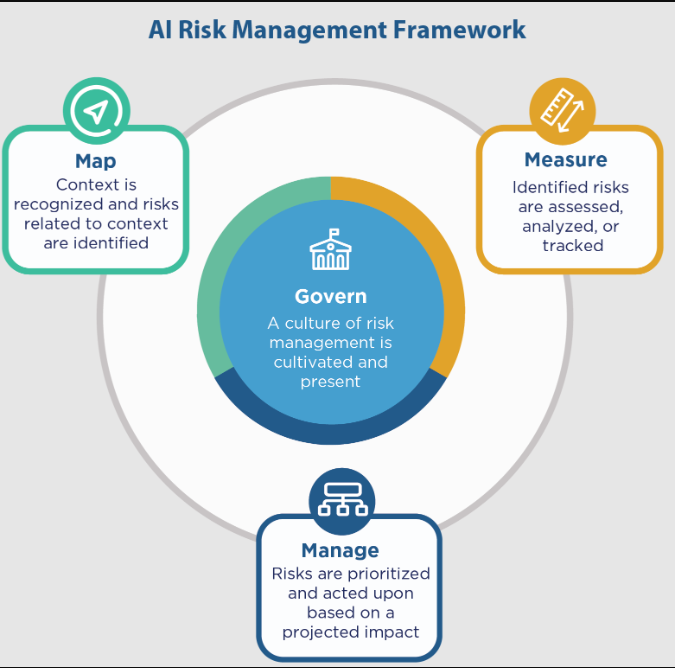
The NIST AI Risk Management Framework is a voluntary framework for managing AI risks. Its Generative AI Profile highlights third-party risk, transparency, data privacy, information security, procurement due diligence, testing, and contractual controls. Do not describe any vendor system as hallucination-free.
Accessibility Requirements
The buyer should define the accessibility standards, laws, organizational policies, user workflows, and testing methods that apply. Section 508 requirements apply to covered U.S. federal ICT acquisition; they are not automatically universal requirements for every private organization.
| ID | Requirement | Priority |
|---|---|---|
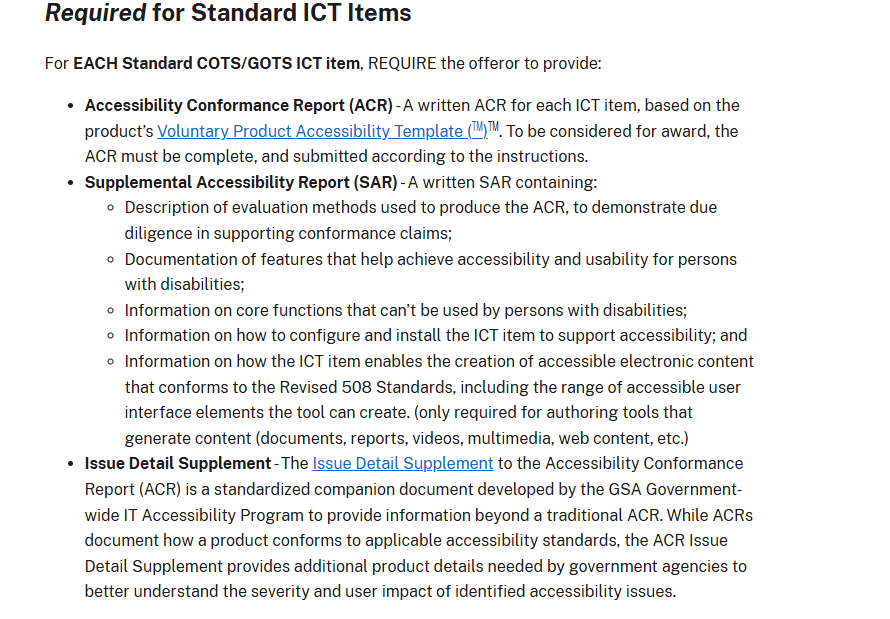
| ACC-01 | Provide a current Accessibility Conformance Report for the proposed product version and identify the VPAT edition used. | [Priority] |
| ACC-02 | Describe the ACR scope, exclusions, testing methods, assistive technologies, known issues, and workarounds. | [Priority] |
| ACC-03 | Describe keyboard, focus, screen-reader, zoom, reflow, contrast, forms, errors, captions, and mobile accessibility. | [Priority] |
| ACC-04 | Describe accessibility of the authoring, reviewing, administrative, reader, search, and support experiences. | [Priority] |
| ACC-05 | Explain how authors can create and validate accessible articles, documents, media, tables, and embedded content. | [Priority] |
| ACC-06 | Identify third-party components, themes, customizations, or integrations that can change accessibility. | [Priority] |
| ACC-07 | Provide the remediation process, accessibility contact, regression-testing approach, and product-change communication. | [Priority] |
| ACC-08 | Support buyer-defined accessibility demonstrations and hands-on testing using representative workflows. | [Priority] |
Section508.gov’s vendor-information guidance recommends defining accessibility requirements and requesting appropriate supporting information, including an Accessibility Conformance Report for applicable federal ICT acquisitions. Buyers should evaluate the report’s product version, scope, methods, exceptions, and known issues rather than treating possession of an ACR as proof of complete accessibility.
Integration and API Requirements
| ID | Requirement | Priority |
|---|---|---|
| INT-01 | Support required integrations with help desk, CRM, portal, LMS, collaboration, contact-center, analytics, identity, or other named systems. | [Priority] |
| INT-02 | For each integration, identify business purpose, data direction, authoritative system, data elements, frequency, ownership, and monitoring. | [Priority] |
| INT-03 | Identify whether each integration is native, configured, custom, vendor-delivered, customer-delivered, or third-party. | [Priority] |
| INT-04 | Provide APIs for the required content, taxonomy, search, users, groups, permissions, analytics, exports, and administrative operations. | [Priority] |
| INT-05 | Document API authentication, authorization, pagination, rate limits, bulk operations, errors, webhooks, events, and versioning. | [Priority] |
| INT-06 | Describe sandbox access, test credentials, developer documentation, deprecation policy, and notice periods offered. | [Priority] |
| INT-07 | Identify additional licenses, third-party contracts, usage charges, services, or operational dependencies. | [Priority] |
| INT-08 | Describe monitoring, alerting, retry behavior, failure handling, reconciliation, and support ownership. | [Priority] |
Migration Requirements
| ID | Requirement | Priority |
|---|---|---|
| MIG-01 | Assess the supplied content inventory and identify native migration, transformation, manual work, and unsupported items. | [Priority] |
| MIG-02 | Describe migration of hierarchy, categories, tags, metadata, owners, reviewers, states, dates, languages, and custom fields. | [Priority] |
| MIG-03 | Describe migration of text, tables, code, attachments, images, embedded media, internal links, and external links. | [Priority] |
| MIG-04 | Describe treatment of permissions, groups, audiences, article-level restrictions, and tenant or organization segmentation. | [Priority] |
| MIG-05 | Describe preservation or mapping of versions, comments, audit history, review dates, analytics, synonyms, and AI configurations. | [Priority] |
| MIG-06 | Provide an approach for legacy URLs, redirect mapping, canonical URLs, link validation, and search-engine impact. | [Priority] |
| MIG-07 | Provide migration validation, reconciliation, defect handling, rollback, cutover, hypercare, and decommissioning methods. | [Priority] |
| MIG-08 | State vendor, buyer, and third-party responsibilities, assumptions, services, effort, limitations, and costs. | [Priority] |
Do not request a fixed migration schedule without supplying the source inventory and complexity. Vendors should explain what cannot migrate and which metadata or history would be lost.
Implementation and Change-Management Requirements
| ID | Requirement | Priority |
|---|---|---|
| IMP-01 | Provide the proposed discovery, design, configuration, integration, migration, testing, pilot, launch, and hypercare approach. | [Priority] |
| IMP-02 | Provide a work plan with milestones, deliverables, dependencies, risks, assumptions, and change control. | [Priority] |
| IMP-03 | Identify vendor, buyer, implementation-partner, and third-party roles and responsibilities. | [Priority] |
| IMP-04 | Provide administrator, author, reviewer, agent, analyst, developer, and end-user enablement where applicable. | [Priority] |
| IMP-05 | Provide documentation, knowledge transfer, configuration records, operating procedures, and post-launch handoff. | [Priority] |
| IMP-06 | Connect material deliverables to buyer-approved acceptance criteria. | [Priority] |
Reliability, Support, and Service Requirements
| ID | Requirement | Priority |
|---|---|---|
| SRV-01 | Describe service-availability measurement, exclusions, maintenance, status communication, and offered commitments. | [Priority] |
| SRV-02 | Describe support channels, hours, severity definitions, response process, escalation, and named support options. | [Priority] |
| SRV-03 | Describe performance monitoring, capacity management, incident communication, and problem management. | [Priority] |
| SRV-04 | Describe backup, restore, recovery testing, business continuity, and disaster-recovery processes. | [Priority] |
| SRV-05 | Describe release management, material change notices, deprecations, end-of-life policy, and customer preparation. | [Priority] |
| SRV-06 | Identify customer success, technical account management, implementation support, and premium services offered. | [Priority] |
Pricing and Total Cost of Ownership
Vendors must provide pricing over [Buyer-Selected Planning Period]. The buyer will not evaluate advertised subscription price alone.
| Cost item | One-time | Recurring or usage-based | Assumption and dependency |
|---|---|---|---|
| Base subscription | [Amount] | [Amount and billing basis] | [Details] |
| User, author, reviewer, agent, reader, or external-user licenses | [Amount] | [Amount] | [Quantities and metric] |
| Brands, sites, domains, products, and languages | [Amount] | [Amount] | [Included allowance] |
| Storage, bandwidth, search, API, and overages | [Amount] | [Amount] | [Allowance and overage] |
| AI capabilities and usage | [Amount] | [Amount] | [Query, token, user, or other metric] |
| SSO, provisioning, audit logs, sandbox, and environments | [Amount] | [Amount] | [Details] |
| Analytics and reporting | [Amount] | [Amount] | [Details] |
| Implementation and configuration | [Amount] | [Amount] | [Scope] |
| Migration and validation | [Amount] | [Amount] | [Assumptions] |
| Integrations and custom development | [Amount] | [Amount] | [Scope] |
| Training and change management | [Amount] | [Amount] | [Scope] |
| Support and customer success | [Amount] | [Amount] | [Service level] |
| Security or accessibility services | [Amount] | [Amount] | [Scope] |
| Data export, transition, and exit assistance | [Amount] | [Amount] | [Scope] |
For every cost, state the pricing metric, quantity, unit price, included allowance, overage rate, discount, discount expiration, renewal basis, annual uplift, price-protection period, optional items, excluded items, and taxes where applicable.
Contract, Data Portability, and Exit Requirements
| ID | Requirement | Priority |
|---|---|---|
| COM-01 | Identify material exceptions to the buyer’s proposed agreement and provide alternative language separately. | [Priority] |
| COM-02 | Describe contract term, renewal, price changes, suspension, termination, and post-termination access. | [Priority] |
| COM-03 | Describe ownership and permitted use of buyer content, metadata, analytics, feedback, prompts, outputs, and configurations. | [Priority] |
| COM-04 | Provide the proposed data-processing, subprocessor, security, confidentiality, incident, and audit terms. | [Priority] |
| COM-05 | Describe export of content, hierarchy, metadata, attachments, users, permissions, languages, redirects, analytics, logs, and AI configurations. | [Priority] |
| COM-06 | Identify export format, timing, assistance, limitations, dependencies, and cost. | [Priority] |
| COM-07 | Describe transition services, read-only access, knowledge transfer, and support available during exit. | [Priority] |
| COM-08 | Describe deletion, backup deletion, deletion evidence, and handling of legally required retained data. | [Priority] |
This template is not legal advice. Contract remedies, liability, indemnity, governing law, accessibility commitments, audit rights, payment conditions, and acceptance terms require qualified legal and procurement review.
Vendor qualifications and references
- Legal entity, ownership, and relevant operating locations
- Product history and current strategy
- Implementation and support organization
- Key subcontractors and subprocessors
- Release and deprecation process
- Relevant security, privacy, accessibility, and resilience evidence
- Experience with comparable use cases, migrations, integrations, permissions, languages, and AI requirements
[Number]references matching the buyer’s most important characteristics
Use the same core questions for every reference. A vendor-selected reference is useful context, but it is not independent proof of every product or implementation claim.
Demo, Trial, and Proof-of-Concept Plan
Provide all shortlisted vendors with substantially the same personas, content samples, queries, workflow scenarios, permission model, migration sample, and scoring rules.
| Scenario | Buyer-defined pass condition | Evidence retained |
|---|---|---|
| Create, review, revise, approve, publish, and inspect the history of an article. | [Pass Condition] | [Evidence] |
| Assign ownership, schedule a review, and reassign the owner. | [Pass Condition] | [Evidence] |
| Restrict a collection to one audience and confirm a denied audience cannot discover it. | [Pass Condition] | [Evidence] |
| Run exact-title, natural-language, synonym, typo, and zero-result searches. | [Pass Condition] | [Evidence] |
| Test multilingual or product-version search. | [Pass Condition] | [Evidence] |
| Generate an answer from an approved source with an authorized citation. | [Pass Condition] | [Evidence] |
| Ask an unsupported and an unauthorized AI question. | [Required Abstention or Denial Behavior] | [Evidence] |
| Import a representative content set and verify hierarchy, metadata, assets, links, language, status, and permissions. | [Pass Condition] | [Reconciliation Report] |
| Create and validate a redirect from a legacy URL. | [Pass Condition] | [Evidence] |
| Export content and required metadata. | [Pass Condition] | [Export Sample] |
| Demonstrate the required identity and deprovisioning flow. | [Pass Condition] | [Evidence] |
| Retrieve search, governance, and content-gap analytics. | [Pass Condition] | [Evidence] |
| Demonstrate API authentication, content retrieval, permission enforcement, and webhook behavior. | [Pass Condition] | [Evidence] |
| Show administrative audit history and recovery or restore behavior. | [Pass Condition] | [Evidence] |
Define the test owner, test period, allowed configuration, allowed professional services, failure treatment, retest rules, security restrictions, and data-deletion process before testing begins. Do not allow each vendor to replace the buyer’s scenarios with an unrelated polished demonstration.
Acceptance criteria template
| Deliverable or capability | [Item] |
|---|---|
| Test owner | [Owner] |
| Environment | [Environment] |
| Test data | [Data] |
| Pass condition | [Condition] |
| Required evidence | [Evidence] |
| Defect classification | [Method] |
| Remediation and retest | [Process] |
| Required before go-live or payment | [Yes or No; Buyer to Define] |
Proposal Evaluation and Scorecard
FAR 15.304 requires federal evaluation factors to represent important areas and support meaningful comparison among proposals. Other buyers can apply the same general principle while following their own procurement rules.
Evaluation categories
| Category | Gate? | Buyer-approved weight | Evaluator owner |
|---|---|---|---|
| Functional fit | [Yes/No] | [Weight] | [Owner] |
| Authoring and governance | [Yes/No] | [Weight] | [Owner] |
| Search and discovery | [Yes/No] | [Weight] | [Owner] |
| Identity and permissions | [Yes/No] | [Weight] | [Owner] |
| Security and privacy | [Yes/No] | [Weight] | [Owner] |
| AI controls and quality | [Yes/No] | [Weight] | [Owner] |
| Accessibility | [Yes/No] | [Weight] | [Owner] |
| Integration and API fit | [Yes/No] | [Weight] | [Owner] |
| Migration | [Yes/No] | [Weight] | [Owner] |
| Implementation and change | [Yes/No] | [Weight] | [Owner] |
| Reliability and support | [Yes/No] | [Weight] | [Owner] |
| Analytics and reporting | [Yes/No] | [Weight] | [Owner] |
| Total cost of ownership | [Yes/No] | [Weight] | [Owner] |
| Contract, portability, and exit | [Yes/No] | [Weight] | [Owner] |
| Vendor qualifications and references | [Yes/No] | [Weight] | [Owner] |
| Demo or trial evidence | [Yes/No] | [Weight] | [Owner] |
Set and approve weights before final scoring. Do not use universal weights copied from another organization.
Illustrative capability scale
| Score | Illustrative meaning |
|---|---|
| 0 | Unavailable, unacceptable, or no credible response. |
| 1 | Roadmap, preview, major gap, or substantial unsupported custom work. |
| 2 | Partially meets; significant services, third-party dependency, limitation, or risk remains. |
| 3 | Meets through supported configuration and acceptable evidence. |
| 4 | Meets strongly in the proposed production edition and is verified through buyer-accepted evidence. |
This scale is illustrative. The buyer must define scoring anchors that match its evaluation method and procurement rules.
Keep evidence, risk, cost, and contract fit separate
| Dimension | Question |
|---|---|
| Gate result | Did the proposal pass every disqualifying condition? |
| Capability | How well does the proposed solution meet the requirement? |
| Evidence confidence | How strongly is the claim supported by current documentation, demonstration, testing, or contract? |
| Risk | What security, privacy, accessibility, delivery, dependency, or operational risk remains? |
| Cost | What is the complete cost over the selected planning period? |
| Contract fit | Which exceptions or obligations remain unresolved? |
| Implementation complexity | What effort, dependency, or organizational change is required? |
| Recommendation | What decision is supported after considering all dimensions? |
A high weighted average must not hide unauthorized content exposure, missing data export, an unworkable migration, a failed accessibility gate, an unsupported critical integration, an unacceptable contract exception, or unverified AI behavior.
Buyer-only evaluation appendix
The following fields may be kept in an internal evaluation copy, subject to the buyer’s procurement and fairness rules:
- Requirement score
- Evidence confidence
- Risk rating
- Gate status
- Open question
- Evaluation owner
- Required follow-up
- Demo result
- Trial result
- Security-review result
- Accessibility-review result
- Legal-review result
- Reference result
- Cost adjustment
- Contract exception
- Final disposition
Common Knowledge Base Software RFP Mistakes
- Starting with a generic feature list: Requirements should come from audiences, tasks, risks, and desired outcomes.
- Allowing Yes or No answers: A bare confirmation does not identify edition, availability, limitation, dependency, evidence, or cost.
- Treating roadmap as current functionality: Future plans do not satisfy a present requirement unless the buyer explicitly accepts that risk.
- Assigning every feature the same importance: A critical permission control should not carry the same weight as a cosmetic preference.
- Scoring before setting priorities: Weights and gates should be approved before proposals influence stakeholder preferences.
- Ignoring permission behavior in search and AI: Restricting an article page is insufficient if its title, snippet, attachment, source, export, or answer can still be exposed.
- Using an ACR as the only accessibility review: Evaluate scope, methods, known issues, workarounds, product version, and representative workflows.
- Requesting certificates without defining the risk: Security evidence should correspond to the system, data, deployment, and supplier risk.
- Under-describing the migration: Vendors cannot estimate preservation of metadata, permissions, links, languages, history, or redirects without an inventory.
- Letting vendors choose unrelated demos: Comparable scenarios are more useful than polished product tours.
- Comparing subscription price alone: Include services, migration, integrations, AI, identity, support, overages, renewal, and exit.
- Failing to define acceptance: Written claims should connect to testable delivery conditions.
- Ignoring data portability: Confirm what can be exported before the organization becomes dependent on the platform.
- Copying public-sector language without context: Follow the laws and policies that actually apply to the buyer.
- Confusing the procurement template with an RFP response knowledge base: One selects software; the other helps a seller answer proposals.
Final RFP Issue-Readiness Checklist
- The business problem and desired outcomes are documented.
- The knowledge use cases and audiences are defined.
- The current content estate and migration risks are described.
- In-scope and out-of-scope work are separated.
- Stakeholder owners and evaluators are assigned.
- Requirements are tied to scenarios or observable behavior where practical.
- Requirements have buyer-approved priorities.
- Disqualifying gates are explicit.
- Vendor response codes and evidence rules are defined.
- Production, configured, custom, third-party, beta, and roadmap capabilities are separated.
- The exact edition and additional cost must be disclosed.
- Security and privacy have their own review path.
- AI capabilities and data use have their own review path.
- Permission-aware search and AI behavior are tested.
- Accessibility requirements and evidence expectations are defined where applicable.
- Integration purposes and data flows are documented.
- Migration includes metadata, permissions, assets, languages, links, URLs, and redirects where relevant.
- Implementation roles, dependencies, training, and acceptance are defined.
- All vendors receive comparable demo or trial scenarios.
- Total cost includes one-time, recurring, usage-based, renewal, and exit costs.
- Contract exceptions and data-portability requirements are requested.
- Evaluation separates gates, capability, evidence, risk, cost, and contract fit.
- Weights and scoring anchors are approved before final evaluation.
- Qualified procurement, legal, security, privacy, accessibility, finance, and technical reviewers have approved their sections.
Frequently Asked Questions
What is a Knowledge Base Software RFP Template?
It is a reusable procurement document that gives knowledge base software vendors the same buyer context, requirements, response instructions, evidence rules, commercial questions, and evaluation criteria.
How is it different from an RFP response knowledge base?
The software RFP template helps a buyer select a knowledge platform. An RFP response knowledge base helps a seller store and reuse approved proposal answers and evidence.
Should every requirement be mandatory?
No. Use disqualifying gates sparingly, identify true must-haves, and classify other requirements according to business value and risk. Requirements should not all receive equal weight.
Why are Yes or No vendor answers insufficient?
They do not reveal the exact edition, current availability, configuration, custom work, professional services, third-party dependency, limitation, evidence, implementation effort, or cost.
How should roadmap features be scored?
Treat roadmap items as unavailable for current requirements unless the buyer explicitly adopts a different rule. A planned capability does not prove production availability or a contractually committed delivery date.
Should an RFP require an ACR or VPAT?
Request the accessibility evidence applicable to the buyer and product. Covered U.S. federal ICT acquisitions commonly require an Accessibility Conformance Report based on a VPAT. Other buyers should define their applicable standards, policies, evidence, and testing. An ACR should be reviewed rather than accepted as automatic proof of full conformance.
What should the AI section test?
Test current availability, data use, model providers, retention, permission enforcement, source citations, no-answer behavior, conflicting sources, expired content, human review, monitoring, export, deletion, and cost.
How long should the RFP be?
It should be long enough to define the decision without including irrelevant requirements. A smaller buyer can remove sections that do not apply, while a complex enterprise or public-sector procurement may need detailed appendices and mandatory forms.
Should the buyer include a proof of concept?
Use a proof of concept when important claims cannot be verified through current documentation and a comparable demonstration. Define the scenarios, data, configuration rules, pass conditions, evidence, security restrictions, and deletion process before it begins.
What belongs in total cost of ownership?
Include subscriptions, users, sites, languages, storage, APIs, AI, analytics, identity features, environments, support, implementation, migration, integrations, training, services, overages, renewals, export, transition, and exit assistance as applicable.
Sources Checked
- Acquisition.gov: FAR 15.203 Requests for Proposals
- Acquisition.gov: FAR 15.304 Evaluation Factors and Significant Subfactors
- Section508.gov: Buy Accessible Products and Services
- Section508.gov: Request Accessibility Information From Vendors and Contractors
- Section508.gov: Understanding Vendor Claims in Accessibility Conformance Reports
- NIST AI Risk Management Framework
- NIST Generative AI Profile
- NIST Cybersecurity Supply Chain Management Due Diligence Assessment
- NIST Cybersecurity Framework 2.0 C-SCRM Quick-Start Guide
- LACERA Knowledge Management Solution RFP
- OWASP Authorization Cheat Sheet
- Google Search Central Article Structured Data
Sources and product information checked on November 12, 2026.