Independent knowledge base software guide Evidence-led Updated 2026

Global Knowledge Base Strategy: Localization, Regional Ownership, Data Residency, and Support Coverage
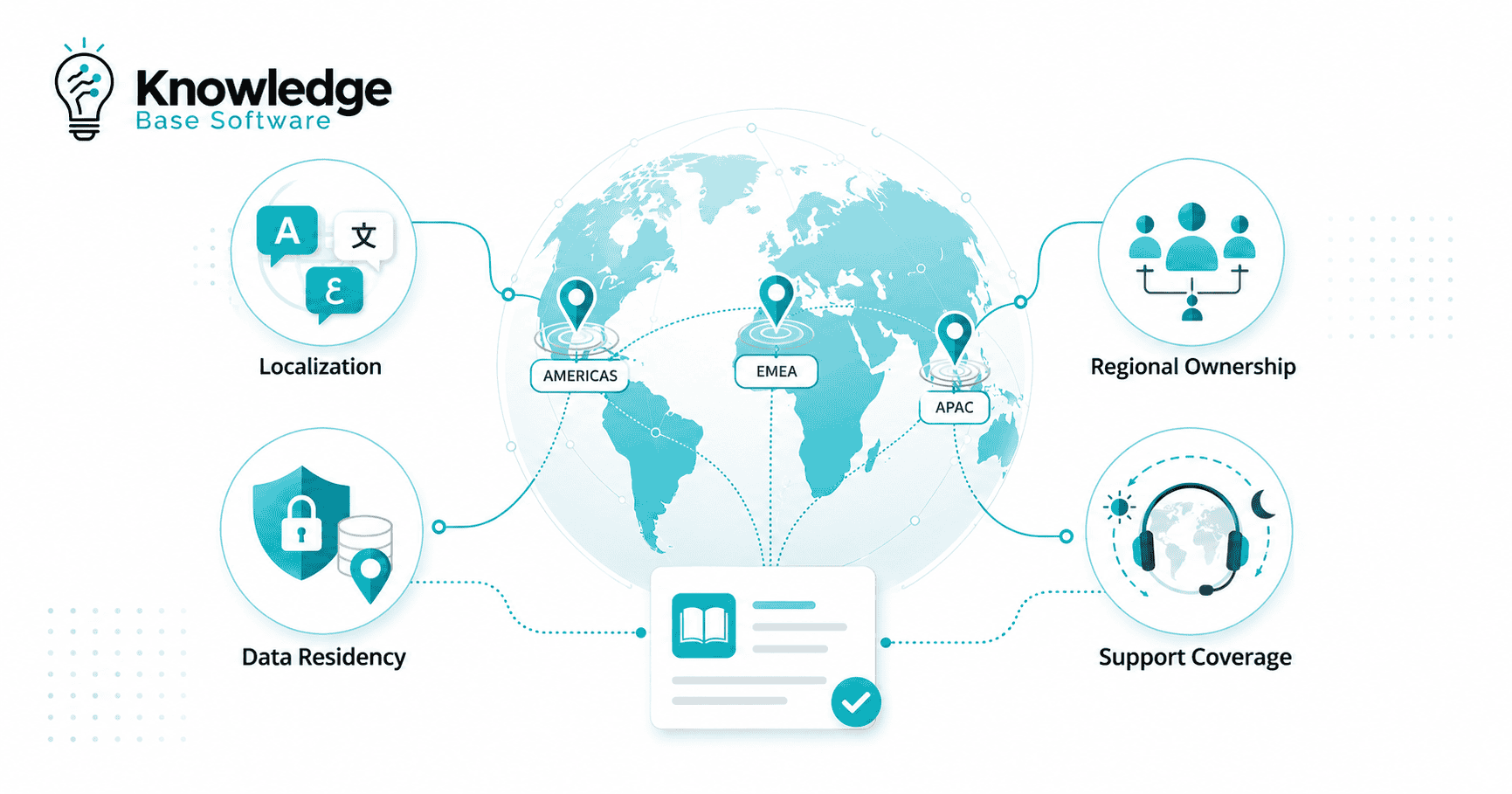
A Global Knowledge Base Strategy is an operating model for creating, governing, localizing, securing, and improving knowledge across regions, languages, compliance environments, and support teams. It turns documentation into a global support system: one source of truth, adapted for local markets, owned by regional experts, aligned with data residency requirements, and connected to follow-the-sun support.
As companies expand globally, a single-language, centrally managed knowledge base eventually breaks down. Customers in Germany may need different privacy wording than customers in the United States. Support agents in Japan may need localized troubleshooting steps. Product availability may differ in the Middle East, Europe, and Latin America. A customer-facing article may be safe to publish publicly, while the internal runbook behind it may contain customer-specific logs, incident notes, or regulated information.
A standard knowledge base is often described as a self-service library of information about a product, service, department, or topic. Atlassian defines a knowledge base as a self-serve online library and notes that knowledge often gets scattered across emails, tickets, social interactions, comments, and individual employees’ minds. A global knowledge base strategy goes further: it defines how that knowledge is structured, localized, owned, reviewed, secured, and used across the entire customer support operation.
Table of Contents
What Is a Global Knowledge Base Strategy?
A Global Knowledge Base Strategy is a structured plan for managing support knowledge across multiple countries, languages, products, customer segments, and compliance requirements.
It differs from a basic knowledge base because it does not only answer, “Where do we store help articles?” It answers deeper operational questions:
Who owns the global source of truth?
Which articles should be localized first?
Who approves regional variations?
Where is user data stored?
How do agents in APAC, EMEA, and the Americas hand off cases without giving conflicting answers?
How do analytics, failed searches, support tickets, and AI-generated answers feed back into the content lifecycle?
It also differs from a generic knowledge management strategy. A knowledge management strategy may cover internal collaboration, organizational learning, documentation, and knowledge sharing across departments. A global knowledge base strategy is more specific: it focuses on customer support knowledge, self-service support, agent enablement, localization workflow, regional governance, data residency, and support coverage.
This article is different from a multilingual knowledge base guide. A multilingual guide focuses on languages, translation workflows, and localized content. A global knowledge base strategy also covers regional ownership, compliance, data residency, support handoffs, and global operating governance.
A mature global knowledge base usually supports both customer-facing and internal use cases. Customer-facing content includes help center articles, FAQs, tutorials, onboarding guides, troubleshooting workflows, and product documentation. Internal knowledge includes macros, escalation paths, runbooks, known-issue notes, compliance guidance, incident summaries, and agent-only troubleshooting steps.
The goal is not to publish more content. The goal is to make the right answer available in the right language, region, channel, and security context.
Why Global Knowledge Bases Fail Without Strategy
Global knowledge bases rarely fail because teams lack effort. They fail because documentation grows faster than governance.
The first failure mode is translation without localization. A translated article may still use the wrong currency, screenshot, legal disclaimer, date format, payment method, product name, or cultural example. W3C describes internationalization as designing products, applications, or content so they can be localized for audiences that vary by culture, region, or language. That distinction matters: localization is not a language task only; it is a market-readiness task.
The second failure mode is central ownership with no regional accountability. A global knowledge team may control article templates and publishing standards, but they cannot always know local regulatory expectations, customer phrasing, regional product gaps, or country-specific edge cases.
The third failure mode is regional silos. When each region creates its own help content independently, customers receive inconsistent instructions. One region may recommend a workaround that another region has already retired. One support team may document a known issue while another team continues escalating the same problem.
The fourth failure mode is ignoring data residency and data exposure. A knowledge base may seem low risk because many articles are public. But risk can appear in search logs, article feedback, support ticket links, attachments, internal notes, translation workflows, AI prompts, analytics events, backups, and subprocessors. Google Cloud defines data residency as the physical location of data and the local regulations that govern how that data is stored, encrypted, and accessed.
The fifth failure mode is poor handoffs between time zones. A global support model depends on consistent documentation. Without shared runbooks, escalation notes, article ownership, and incident-to-article workflows, follow-the-sun support becomes case passing rather than continuity.
The final failure mode is no content lifecycle. Articles are created during launches and incidents, then forgotten. Without review dates, owners, stale-content alerts, and analytics reviews, a knowledge base becomes a liability: it looks complete but gives outdated answers.
The Five Pillars of a Global Knowledge Base Strategy
| Pillar | Goal | Primary Owner | Key Decisions | Success Metric |
|---|---|---|---|---|
| Source of truth and information architecture | Create one trusted knowledge foundation | Global Knowledge Lead | Canonical article structure, taxonomy, metadata, templates, public vs internal content | Article reuse rate, search success rate, stale article rate |
| Localization and multilingual experience | Adapt content for priority markets | Localization Manager + Regional Owners | Language prioritization, translation workflow, glossary, review process, localized assets | Translation lag, localized article coverage, locale-specific CSAT |
| Regional ownership and governance | Balance global consistency with local accuracy | Global Knowledge Lead + Regional Knowledge Owners | RACI, approval rights, regional variations, review cadence | Owner coverage, review completion, reduced duplicate content |
| Data residency and compliance | Reduce risk across regions and workflows | Security, Legal, IT, Compliance | Hosting regions, access controls, data flows, subprocessors, AI and translation vendor handling | Audit completion, residency exceptions, unauthorized access events |
| Support coverage and operational continuity | Ensure consistent answers across time zones | Support Operations | Handoff process, escalation paths, runbooks, macros, incident summaries | First contact resolution, time to resolution, reopen rate |
Pillar 1 — Build a Global Source of Truth
A global knowledge base needs a canonical article model. The canonical article is the authoritative source from which localized versions, internal notes, macros, chatbot answers, and regional variants are derived.
This does not mean every region must use identical wording. It means every region should be anchored to the same verified product logic, support policy, troubleshooting flow, and article lifecycle.
Start with a clear taxonomy. Organize content by product area, user role, task, issue type, region, language, product version, and access level. Metadata should answer practical questions: Which product version does this article apply to? Is it public or internal? Which regions can use it? Who owns it? When was it last reviewed? Which localized versions are out of sync?
Article templates are essential. A troubleshooting article should not look like a billing policy. A launch article should not look like an incident runbook. Common templates include:
How-to article
Troubleshooting article
FAQ
Known issue
Release note
Policy article
Internal runbook
Escalation guide
Incident summary
Localization note
The best global knowledge bases also separate public content from internal knowledge. Public articles should be safe for customers and search engines. Internal articles may include diagnostic steps, agent guidance, risk notes, escalation rules, or customer-specific context. Mixing these two creates security and clarity problems.
For public help-center articles, SEO helps customers discover answers through search engines. Inside the knowledge base, search quality depends on metadata, synonyms, error codes, common misspellings, feature aliases, localized terms, and failed-search analysis. Failed searches should become content requests.
Finally, structure content for AI-readiness. AI knowledge base tools perform better when source articles are clear, modular, current, and well-labeled. Use concise headings, answer-first paragraphs, consistent terminology, clean metadata, and explicit limitations. The Consortium for Service Innovation’s KCS® guidance — now positioned as Knowledge-Centered Success — emphasizes that knowledge should be timely, findable, and usable by the audience being served.
Pillar 2 — Design Localization Beyond Translation
A multilingual knowledge base is not automatically a localized knowledge base.
Translation changes language. Localization adapts the content experience to a specific market. Transcreation goes further by rewriting content to preserve meaning, tone, and persuasion in a local context.
For support knowledge, most companies do not need transcreation for every article. They need controlled localization: accurate translation, local examples, region-specific screenshots, correct product availability, relevant legal disclaimers, and terminology that matches how customers actually describe the issue.
Document360 recommends style guides, glossaries, and translation memory to maintain consistent terminology and writing conventions across localized knowledge base content. Lokalise also distinguishes translation memory from glossary usage: translation memory focuses on sentence-level reuse, while a glossary focuses on approved words, phrases, product names, and terminology consistency.
Do not localize everything at once. Prioritize languages and articles based on:
Ticket volume by language
Revenue by region
Help center traffic by locale
Customer churn risk
Strategic market expansion
Product adoption by country
Legal or regulatory requirements
High-severity support topics
Searches with no successful result
Customer satisfaction by locale
Localization Decision Matrix
| Decision Factor | High Priority Signal | Recommended Action |
|---|---|---|
| Ticket volume | A language or region produces repeated support tickets for the same issue | Localize top self-service articles first |
| Revenue impact | A region represents high ARR, expansion potential, or enterprise accounts | Localize onboarding, billing, admin, and troubleshooting content |
| Legal requirement | Local law or contract terms require specific wording | Route through compliance review before publishing |
| Product availability | Features differ by region | Add region-specific notes, conditional content, or article variants |
| Customer experience | Locale-specific CSAT is below global average | Review translation quality, search terms, and unresolved topics |
| Search behavior | High zero-result searches in one language | Add synonyms, localized terminology, and missing articles |
| Launch readiness | A product or feature is launching in a new market | Localize launch-critical content before release |
| Support complexity | Agents need local troubleshooting guidance | Create internal localized runbooks and macros |
A strong localization workflow should include source article approval, terminology check, machine translation where appropriate, human review, regional SME review, legal review when required, publishing, and post-publication analytics.
Machine translation can speed up production, but it should not be the only quality control for high-risk support topics. Human review is especially important for billing, legal, security, medical, financial, enterprise admin, and outage-related content.
Keeping localized content updated is the hardest part. Every canonical article should have a localization status: up to date, needs review, partially updated, deprecated, or region-specific exception. When the source article changes, the workflow should alert localization owners and show the changed segments.
Pillar 3 — Assign Regional Ownership Without Creating Silos
Global knowledge base governance usually fails when ownership is either too centralized or too decentralized.
A centralized model creates consistency but often moves too slowly. A decentralized model gives regions flexibility but creates duplication and conflicting answers. For most global enterprises, the best model is federated ownership.
In a federated model, the global knowledge team owns standards, structure, tooling, templates, taxonomy, metadata, and lifecycle rules. Regional knowledge owners own local accuracy, market relevance, regional exceptions, and language quality. Product SMEs own technical correctness. Legal and compliance teams own regulated wording and risk review. Support agents contribute feedback from real customer interactions.
Core Roles
Global Knowledge Lead: Owns the knowledge base strategy, governance model, taxonomy, article standards, and global reporting.
Regional Knowledge Owner: Owns regional accuracy, local prioritization, language quality, and market-specific differences.
Support Operations: Connects the knowledge base to ticket workflows, macros, routing, analytics, and support coverage.
Product SME: Validates technical accuracy, release changes, feature behavior, limitations, and known issues.
Localization Manager: Manages translation workflows, linguistic assets, vendor coordination, translation memory, and quality assurance.
Compliance/Legal: Reviews data residency, regulated claims, privacy wording, contract-sensitive statements, and local requirements.
Support Agents: Identify missing content, flag confusing articles, suggest updates, and reuse approved knowledge during case handling.
RACI Table for Global Knowledge Base Governance
| Activity | Global Knowledge Lead | Regional Owner | Support Ops | Product SME | Localization Manager | Legal/Compliance | Support Agents |
|---|---|---|---|---|---|---|---|
| Article creation | A | C | C | R | C | C | R |
| Source article approval | A | C | C | R | C | C | C |
| Localization prioritization | A | R | C | C | R | C | C |
| Translation and linguistic QA | C | C | C | C | A/R | C | C |
| Regional adaptation | C | A/R | C | C | R | C | C |
| Compliance review | C | C | C | C | C | A/R | I |
| Publishing | A | R | C | I | C | C | I |
| Updates and corrections | A | R | C | R | C | C | R |
| Article retirement | A | R | C | R | C | C | C |
| Analytics review | A | R | R | C | C | C | C |
R = Responsible, A = Accountable, C = Consulted, I = Informed.
Pillar 4 — Plan for Data Residency, Sovereignty, and Compliance
This section is educational and should not be treated as legal advice. Data residency, privacy, and cross-border transfer requirements vary by jurisdiction, industry, contract, and data type. Always validate requirements with legal, security, privacy, and compliance teams.
Data residency, data sovereignty, and data localization are related but not identical.
Data residency refers to where data is physically stored and processed. Data sovereignty refers to the legal authority that applies to data. IBM summarizes the difference by explaining that data residency is the geographical location of data, while data sovereignty concerns the legal and regulatory authority over data. Data localization generally refers to requirements that certain data be stored, processed, or retained within a specific country or region.
Knowledge bases can create data exposure in places teams often overlook:
Search logs
Article feedback
Support ticket excerpts
Internal notes
Screenshots and attachments
AI prompts and AI-generated answers
Translation management systems
Analytics platforms
Backups and replicas
Subprocessors
Chatbot training data
Customer-specific troubleshooting records
A public help article may contain no personal data. But an internal troubleshooting article linked to a support ticket may reference customer logs, account IDs, screenshots, or incident timelines. A translation vendor may receive article drafts. An AI knowledge base tool may process prompts and retrieval results. A search analytics tool may store user queries that include personal information.
Separate content into three categories:
Public help content: General product guidance, safe for public access and indexing.
Internal knowledge: Agent-only guidance, runbooks, escalation steps, operational notes, and controlled troubleshooting instructions.
Customer-specific support content: Ticket data, logs, attachments, account details, conversations, and case history.
Each category should have different storage, access, retention, and review rules.
Data Residency Questions to Ask Before Scaling a Global Knowledge Base
- Where is the knowledge base platform hosted?
- Can hosting regions be selected by workspace, tenant, or data type?
- Where are search logs, analytics events, and article feedback stored?
- Are attachments stored in the same region as article content?
- Are support ticket links or excerpts copied into knowledge articles?
- Which subprocessors can access knowledge base data?
- Are translation vendors processing internal or customer-specific content?
- Are AI prompts, embeddings, or generated answers retained?
- Can sensitive fields be redacted before content enters the knowledge workflow?
- Who can access internal articles across regions?
- Are audit logs available for article views, edits, exports, and permission changes?
- What is the retention policy for drafts, deprecated articles, backups, and logs?
- Are regional legal disclaimers reviewed before publication?
- What happens when a customer requests deletion or export of personal data?
- Are residency exceptions documented and approved?
The safest global knowledge base strategy is not the one that blocks collaboration. It is the one that classifies content clearly, limits unnecessary data movement, and makes risk visible before scale.
Pillar 5 — Align Knowledge Base Strategy With Support Coverage
Support coverage is not only a staffing model. It is a knowledge model.
A follow-the-sun support model shifts work between teams in different regions so support can continue across time zones. Salesforce describes follow-the-sun as a customer service delivery model where companies shift support among teams around the world to keep support flowing and resolve cases faster. Zendesk similarly describes it as a global workflow where issues can be handled and passed between offices in different time zones.
A knowledge base makes that model operational. When APAC hands a case to EMEA, the next team should not need to rediscover the issue. They need the same approved troubleshooting article, known-issue note, escalation path, macro, incident summary, and customer communication guidance.
Support Coverage Model Comparison
| Model | Best For | Knowledge Base Requirement | Risk |
|---|---|---|---|
| Local business-hours support | Small regional teams or early market entry | Localized FAQs and basic escalation notes | Customers wait outside local hours |
| Regional extended coverage | Growing teams across several time zones | Regional runbooks, localized macros, shared ownership | Inconsistent answers between regions |
| Follow-the-sun support | Global SaaS, enterprise support, high-priority SLAs | Global source of truth, handoff notes, incident summaries, standardized workflows | Poor handoffs if documentation is weak |
| 24/7 centralized support | Centralized operations with around-the-clock staffing | Deep internal knowledge base, strong routing, multilingual support resources | Central team may lack regional context |
Language coverage and time-zone coverage are different problems. A company may have 24/7 English support but weak Japanese self-service. Another may have localized articles in Spanish but no Spanish-speaking agents during certain hours. A global knowledge base strategy should map both.
To prevent customers from getting different answers by region, standardize the core answer and localize the surrounding experience. The troubleshooting logic, policy, and product facts should come from the canonical source. The examples, screenshots, compliance notes, language, and availability details can vary by region.
Global Knowledge Base Operating Model
A global knowledge base strategy needs recurring operating rhythms.
Weekly regional review: Regional owners review top ticket drivers, failed searches, urgent content gaps, and recently updated articles.
Monthly content health review: The global knowledge team reviews stale articles, owner gaps, articles with low helpfulness ratings, high-exit pages, and search terms with no successful result.
Quarterly localization prioritization: Localization leaders, support operations, regional owners, and revenue teams decide which languages, markets, and article groups deserve investment.
Compliance review cadence: Legal and compliance teams review regulated content, data residency assumptions, vendor changes, AI usage, and regional disclaimers.
Product launch content workflow: No global launch should ship without source articles, internal runbooks, localized launch-critical content, macros, known limitations, and escalation guidance.
Incident-to-article workflow: Every major incident should produce or update at least one internal article, one customer-facing explanation if appropriate, and one post-incident learning note.
Feedback loop from tickets and failed searches: Support tickets reveal what customers cannot solve. Failed searches reveal what customers cannot find. Both should feed the content backlog.
Metrics That Prove Your Global Knowledge Base Strategy Is Working
A global knowledge base should be measured by outcomes, not content volume.
Self-Service Metrics
Article views
Search success rate
Zero-result searches
Click-through from search results
Article helpfulness rating
Self-service completion rate
Support deflection rate as one signal among several
Top unanswered queries
Support Metrics
First contact resolution
Time to resolution
Escalation rate
Reopen rate
Case handoff quality
Macro usage
Agent article reuse
Tickets linked to knowledge gaps
Localization Metrics
Translation lag
Localized article coverage
Locale-specific CSAT
Localized search success
Regional article helpfulness
Out-of-sync localized articles
Language-specific ticket reduction
Governance Metrics
Review overdue rate
Stale article rate
Articles without owners
Duplicate article count
Retired content volume
Approval cycle time
Content backlog age
Compliance Metrics
Residency exceptions
Unauthorized access events
Audit completion
Sensitive content findings
Vendor review completion
Retention policy adherence
AI and translation workflow exceptions
AI Readiness Metrics
Grounded answer rate
Source coverage
Hallucination reports
Articles used in AI answers
Unanswered AI queries
Content chunks with missing metadata
Escalations caused by AI-generated responses
The best metric is not “more pageviews” or deflection alone. A heavily viewed article may be successful, or it may be confusing enough that customers keep returning to it. Pair traffic and self-service signals with resolution outcomes, customer satisfaction, search success, and support quality metrics.
Implementation Roadmap
Days 1–30: Audit and Strategy
Start by auditing the current knowledge base. Identify article owners, stale content, duplicate regional articles, untranslated high-volume topics, failed searches, and articles linked to unresolved tickets.
Map your current regions, languages, support queues, products, customer segments, and compliance constraints. Identify which content is public, internal, and customer-specific.
Define the canonical article model, priority taxonomies, metadata standards, and article templates. Select the first pilot market or product area.
Days 31–60: Governance, Localization Model, and Residency Review
Create the RACI model. Assign global and regional owners. Define review cadence, publishing workflow, escalation process, and retirement rules.
Build the localization workflow. Create or update the glossary, style guide, translation memory, machine translation policy, human review standards, and source-change notification process.
Run a data residency and compliance review. Map where article content, logs, feedback, analytics, AI prompts, translation files, and attachments are stored and processed.
Days 61–90: Pilot, Publish, Measure, Iterate
Pilot the model with one product area, one support queue, or one high-value region. Publish the canonical articles, localize the highest-priority content, train support agents, and connect knowledge workflows to ticket handling.
Measure search success, article helpfulness, translation lag, ticket reduction, handoff quality, and agent adoption. Use the results to refine templates, workflow rules, ownership, and localization priorities.
6–12 Month Maturity Roadmap
Over the next six to twelve months, expand from pilot to operating model. Add more regions, automate stale-content alerts, integrate article suggestions into ticket workflows, connect failed searches to backlog creation, improve AI retrieval quality, and formalize quarterly governance reviews.
At maturity, the knowledge base becomes a global operating layer for customer experience, not a static documentation library.
Common Mistakes to Avoid
Do not translate every article equally. Localize based on demand, value, risk, and support impact.
Do not let regions duplicate content without governance. Regional flexibility is useful, but uncontrolled duplication creates conflicting answers.
Do not leave stale articles without owners. Every article should have a named owner and review cadence.
Do not use AI translation without human QA for high-risk content. Machine translation can accelerate workflow, but it should not replace review for legal, security, billing, or enterprise-critical topics.
Do not ignore data in search logs and support attachments. These can contain sensitive information and may fall under privacy, retention, or residency requirements.
Do not treat support coverage as staffing only. Follow-the-sun support requires shared knowledge, clear handoffs, and consistent runbooks.
Do not measure pageviews without resolution outcomes. A knowledge base is successful when it helps customers and agents solve problems accurately.
Global Knowledge Base Strategy Checklist
Strategy
- Define the business goals for the global knowledge base.
- Identify target regions, languages, products, and customer segments.
- Separate customer-facing, internal, and customer-specific knowledge.
- Connect knowledge goals to support, revenue, compliance, and customer experience.
Content Architecture
- Create a canonical article model.
- Standardize templates by article type.
- Build taxonomy and metadata rules.
- Add region, language, product version, owner, and review-date fields.
- Optimize internal search with synonyms, error codes, and localized terms.
Localization
- Prioritize languages by demand, revenue, risk, and market strategy.
- Maintain a glossary, style guide, and translation memory.
- Define machine translation and human review rules.
- Localize screenshots, examples, currencies, date formats, and disclaimers.
- Track translation lag and out-of-sync localized articles.
Regional Ownership
- Use a federated governance model.
- Assign regional knowledge owners.
- Define RACI for creation, localization, compliance review, publishing, updates, and retirement.
- Schedule weekly regional reviews and monthly content health reviews.
Compliance and Data Residency
- Map where knowledge content and related data are stored.
- Review analytics logs, search logs, attachments, AI prompts, translation workflows, and backups.
- Confirm platform hosting options and subprocessors.
- Apply access controls and audit logs.
- Validate requirements with legal and security teams.
Support Coverage
- Map language coverage and time-zone coverage separately.
- Connect knowledge articles to ticket routing, macros, runbooks, and escalation paths.
- Standardize handoff notes for APAC, EMEA, and Americas.
- Convert incidents and recurring tickets into articles.
- Monitor regional answer consistency.
Analytics
- Track self-service success, not only traffic.
- Review zero-result searches and failed searches.
- Measure support deflection, FCR, TTR, escalations, and reopen rates.
- Monitor localized CSAT and article usefulness.
- Track AI answer quality and grounded source coverage.
FAQs
What is a global knowledge base strategy?
A global knowledge base strategy is an operating model for creating, governing, localizing, securing, and improving knowledge across regions, languages, compliance requirements, and support teams. It ensures customers and agents can access accurate, regionally relevant answers from a trusted source of truth.
How is a global knowledge base different from a multilingual knowledge base?
A multilingual knowledge base provides content in multiple languages. A global knowledge base also includes governance, regional ownership, data residency planning, support coverage alignment, analytics, compliance controls, and content lifecycle management.
Who should own a global knowledge base?
The best model is usually federated. A global knowledge lead owns standards, taxonomy, tooling, and governance. Regional knowledge owners manage local accuracy and prioritization. Product SMEs validate technical correctness, while localization, support operations, legal, and compliance teams own their respective workflows.
How do you prioritize which articles to localize?
Prioritize localization based on ticket volume, revenue impact, help center traffic, strategic markets, churn risk, product adoption, legal requirements, launch readiness, and zero-result searches. Start with high-demand, high-risk, and high-value content rather than translating the entire knowledge base.
What data residency risks apply to a knowledge base?
Risks can appear in article content, internal notes, support ticket excerpts, search logs, feedback, attachments, AI prompts, translation workflows, analytics data, backups, and subprocessors. Public articles may be low risk, but internal and customer-specific knowledge often requires stronger controls.
What is the best governance model for a global knowledge base?
For most global enterprises, a federated model works best. It gives the global team control over structure and standards while giving regional owners responsibility for local accuracy, language quality, market relevance, and regional exceptions.
How does a knowledge base support follow-the-sun customer support?
It gives distributed teams a shared source of truth for troubleshooting, macros, escalation paths, runbooks, incident summaries, and customer communication. This allows APAC, EMEA, and Americas teams to hand off cases without rediscovering context or giving inconsistent answers.
What metrics should be tracked?
Track self-service metrics, support metrics, localization metrics, governance metrics, compliance metrics, and AI readiness metrics. Important examples include search success, zero-result searches, deflection rate, first contact resolution, translation lag, stale article rate, residency exceptions, and grounded AI answer rate.
Conclusion
A Global Knowledge Base Strategy is not just a documentation project. It is a global operating system for customer support, regional collaboration, compliance awareness, and continuous improvement.
The companies that succeed do not simply translate articles into more languages. They build a source of truth, localize intelligently, assign regional ownership, plan for data residency, align knowledge with support coverage, and use analytics to improve every month.
For global enterprises, the strategic question is no longer, “Do we have a knowledge base?” The question is, “Can every customer and every support team trust the answer they find, wherever they are?”
The strongest global knowledge base strategy makes that answer yes.