Independent knowledge base software guide Evidence-led Updated 2026


Ecommerce Knowledge Base: How to Build Customer Self-Service That Actually Works
An Ecommerce Knowledge Base is a governed, searchable system of reusable customer and support knowledge that helps shoppers understand products, make purchase decisions, complete account and order tasks, use products, solve common problems, and reach the correct support workflow when self-service is not enough.
It is more than a long FAQ page. A complete ecommerce knowledge base connects explanatory content with product pages, customer accounts, order tracking, returns, subscriptions, marketplaces, search, support, and authenticated workflows.
The most important design rule is to separate explanatory knowledge from live commerce data. An article can explain how tracking works, but the shopper’s actual shipment status should come from the order-management or carrier system. An article can explain return conditions, but eligibility for a particular item should be evaluated using the applicable policy, product, purchase date, item condition, market, channel, and live order state.
This guide explains how to define the scope, organize content around the shopping journey, connect articles to live systems, protect private data, govern AI answers, manage regional and marketplace differences, align public help content with ecommerce SEO, and measure completed customer tasks without assuming that every missing ticket represents a successful resolution.
What an ecommerce knowledge base should accomplish
The knowledge base should help customers complete a specific decision or task with the minimum necessary friction.
It may support:
- Product selection, comparison, sizing, fit, and compatibility.
- Materials, ingredients, dimensions, specifications, and product limitations.
- Product setup, use, care, maintenance, and troubleshooting.
- Shipping methods, delivery expectations, and tracking guidance.
- Order changes, cancellations, partial shipments, delays, and missing packages.
- Returns, exchanges, refunds, warranties, and damaged-item workflows.
- Checkout, payment, promotion-code, gift-card, and store-credit issues.
- Customer accounts, subscriptions, loyalty, and account security.
- Marketplace-, channel-, language-, and region-specific guidance.
- Clear escalation when a human or authenticated workflow is required.
The goal is not to publish the largest number of articles. The goal is to make the correct answer or workflow easy to find, current, applicable, safe, and measurable.
Ecommerce knowledge base vs. FAQ page, help center, and commerce systems
Several customer experiences may answer questions, but they do not serve the same operational purpose.
| System or experience | Primary purpose | Relationship to the knowledge base |
|---|---|---|
| Ecommerce knowledge base | Provides searchable, reusable, task-oriented customer and agent guidance. | Explains policies, decisions, processes, and troubleshooting while linking to live systems. |
| FAQ page | Answers a short list of common questions. | May be an entry point, but usually lacks the structure, depth, search, ownership, and lifecycle of a full knowledge base. |
| Help center | Provides the broader support destination. | May contain the knowledge base, chat, contact forms, order tools, community, and escalation. |
| Product detail page | Explains and sells a product or variant. | Should link to sizing, compatibility, care, delivery, and support guidance when those topics need more depth. |
| Product information management system | Stores structured product names, attributes, specifications, dimensions, materials, and media. | Should remain the authoritative source for product facts used by knowledge articles. |
| Storefront or commerce platform | Runs the catalog, cart, checkout, customer accounts, and other shopping experiences. | Surfaces help content at relevant moments and provides live commerce context. |
| Order-management system | Stores and processes order, fulfillment, shipment, cancellation, and return states. | Provides live order information that public articles should not attempt to reproduce. |
| Customer account or order-status portal | Provides authenticated access to orders, tracking, returns, reordering, and account details. | Completes personal tasks after the knowledge base explains the process. |
| Returns-management system | Evaluates eligibility and manages labels, methods, exchanges, fees, refunds, and status. | Applies live rules to a specific order while the article explains the general process. |
| Help desk | Manages customer conversations, tickets, channels, routing, and agent work. | Uses knowledge for suggested answers and receives escalations from self-service. |
| CRM | Stores customer relationships, interactions, segmentation, and relevant context. | May help personalize support without becoming the public source of policy guidance. |
| Chatbot or AI agent | Retrieves knowledge, asks questions, uses approved tools, and escalates when needed. | Must use current, permission-aware sources and live systems for transactional answers. |
| Blog | Publishes educational, editorial, discovery, and promotional content. | May link to maintained support guidance but should not be the only location for operational instructions. |
A tracking portal is not a knowledge base merely because it answers “Where is my order?” A folder of support macros is not a complete customer knowledge system merely because agents can search it.
Separate explanatory content from live commerce data
Static help content should explain how something works. Live systems should supply values that depend on the customer, product, order, market, time, or inventory state.
| Customer question | Authoritative source | Knowledge-base role |
|---|---|---|
| Which model fits my device? | Product catalog, PIM, technical documentation, and compatibility rules. | Explain how to identify the device and interpret compatibility. |
| What is the current price? | Commerce and pricing systems. | Explain pricing concepts or promotion conditions without hard-coding volatile prices. |
| Is the item in stock? | Inventory and commerce systems. | Explain availability statuses, backorders, or notifications. |
| When will my order arrive? | Checkout estimate, OMS, fulfillment provider, and carrier. | Explain how estimates work and direct the shopper to secure tracking. |
| Where is my order? | OMS, fulfillment provider, carrier, and authenticated order-status page. | Explain shipment statuses and what to do when updates stop. |
| Can I return this item? | Return policy, product rules, market, channel, order date, item condition, and order state. | Explain general eligibility and open the authenticated returns workflow. |
| Has my refund been issued? | Returns, payment, and order systems. | Explain refund stages and direct the customer to the secure status view. |
| Is my warranty valid? | Warranty policy, product, market, purchase record, and claim system. | Explain evidence, scope, exclusions, and the claim process. |
| Can I skip my next subscription order? | Subscription-management system and applicable plan rules. | Explain the available controls and link to the authenticated account action. |
| What is my loyalty balance? | Loyalty platform and customer account. | Explain how points are earned, used, and viewed. |
Shopify provides one current example of this separation. Its customer accounts can let shoppers view and manage orders, reorder, and take actions such as starting a return, while the order-status page provides shipment information and may require identity verification before displaying order details.
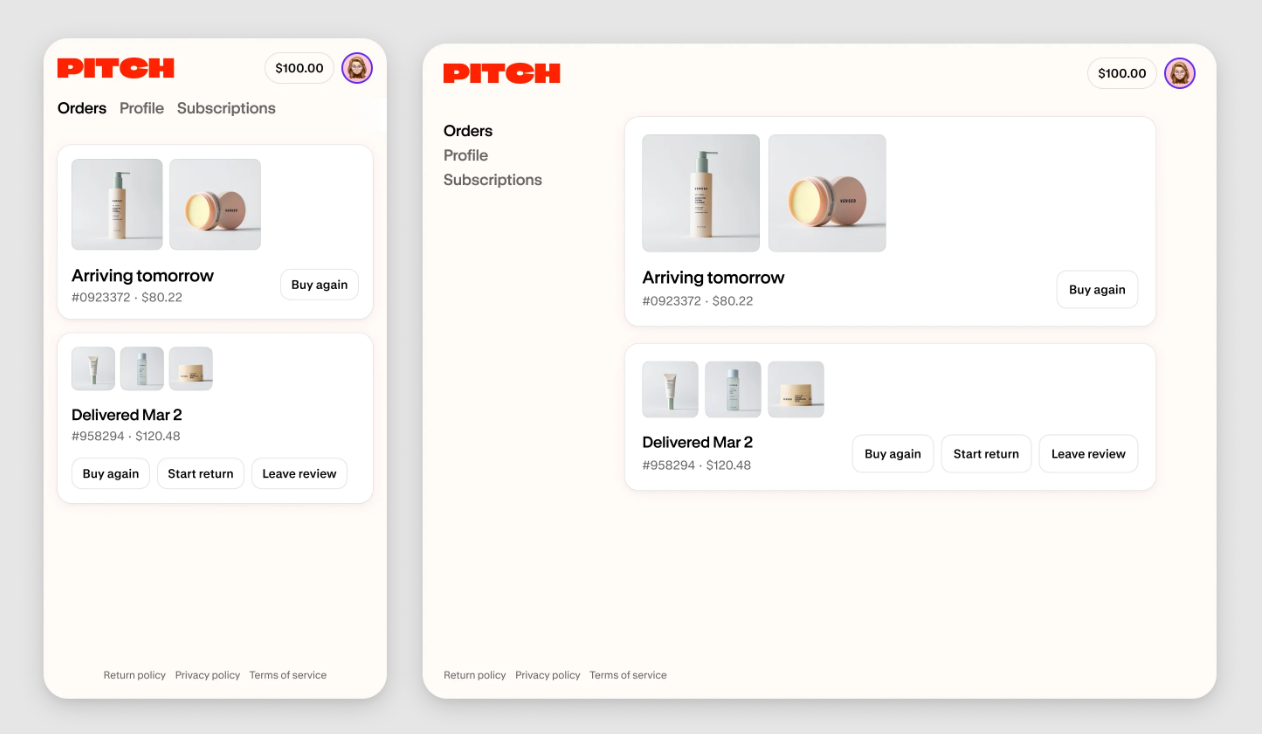
The knowledge article should direct the customer to that secure live experience rather than attempt to display personal order data publicly.
Organize the help experience around the shopping journey
Customers think in tasks, not internal departments. They search for “return item,” not “Reverse Logistics Operations.”
| Journey stage | High-value knowledge categories |
|---|---|
| Before purchase | Product selection, comparison, sizing, fit, compatibility, materials, ingredients, delivery options, payment methods, promotions, and safety limitations. |
| Checkout | Address errors, payment failures, promotion codes, taxes, duties, shipping selection, pickup, fraud checks, and cart errors. |
| After purchase | Confirmation, order changes, cancellation, tracking, delays, missing packages, partial shipments, damaged items, and incorrect items. |
| Product use | Setup, assembly, care, cleaning, maintenance, troubleshooting, consumables, replacement parts, and stop-use conditions. |
| Returns and warranty | Eligibility, windows, condition, methods, fees, labels, exchanges, refunds, claims, and exceptions. |
| Account and relationship | Sign-in, password reset, saved details, loyalty, store credit, gift cards, subscriptions, privacy requests, and account security. |
| Escalation | When to contact support, required information, secure attachments, safety routes, and marketplace-specific contacts. |
A practical top-level navigation might use labels such as “Orders and Delivery,” “Returns and Refunds,” “Products and Sizing,” “Payments and Promotions,” “Subscriptions,” and “Account Help.” Validate the labels through search data and customer testing rather than adopting them mechanically.
Which ecommerce knowledge articles should be created first?
Prioritize articles using a combination of demand, task importance, customer risk, operational impact, and source readiness.
A common first set may cover:
- How to track an order.
- Shipping methods, destinations, and delivery expectations.
- How to change or cancel an order.
- Return, exchange, refund, and damaged-item processes.
- Product sizing, fit, compatibility, or selection.
- Checkout, payment, and promotion-code troubleshooting.
- Customer-account access and password recovery.
- Product setup, care, and common troubleshooting.
- Subscription or loyalty management where applicable.
- When and how to contact support.
Do not prioritize only by contact volume. A low-volume product-safety, payment, privacy, warranty, or legal topic may carry greater risk than a frequent routine question.
Build an ecommerce knowledge inventory before migrating content
Existing answers may be scattered across FAQ pages, shipping policies, return pages, product descriptions, support macros, chatbot responses, marketplace profiles, order emails, blog posts, manuals, and agent documents.
| Inventory field | What to record |
|---|---|
| Customer question | The exact question or task the content addresses. |
| Journey stage | Before purchase, checkout, post-purchase, product use, return, account, or escalation. |
| Context | Product, variant, market, language, channel, customer type, and order state. |
| Current location | FAQ, product page, policy page, macro, chatbot, email, marketplace, portal, or document. |
| Authoritative source | The system, policy, product team, or approved documentation behind the answer. |
| Owner and approver | The teams responsible for accuracy and publication. |
| Access | Public, authenticated, internal agent, partner, or restricted. |
| Risk | The effect of an inaccurate, outdated, or overexposed answer. |
| Demand | Searches, support contacts, reviews, returns, and other evidence. |
| Conflict | Duplicate or contradictory versions. |
| Review trigger | The product, policy, market, channel, or system event that reopens the content. |
| Candidate action | Keep, rewrite, merge, split, convert to workflow, retrieve live data, restrict, localize, archive, delete, or research. |
Do not migrate every historical FAQ or support macro. Preserve content that is current, useful, authoritative, required, or valuable as evidence.
Use real shopper language to define content
Collect questions from:
- Help-desk ticket categories and agent notes.
- Help-center searches and zero-result queries.
- Chat, email, social, and marketplace conversations.
- Product reviews and product-page questions.
- Return and cancellation reasons.
- Failed checkout and payment reports.
- Order-status contacts.
- Subscription-support requests.
- Customer and support-agent interviews.
Record the shopper’s exact wording, intended task, product, region, channel, order state, required account context, risk if the answer is wrong, current workaround, owner, and authoritative source.
Define WISMO as “Where is my order?” when the abbreviation first appears. Do not publish unsupported claims about what percentage of contacts are WISMO requests unless the organization’s data or a reliable source supports the figure.
Practical ecommerce article templates
Order tracking article
- Direct secure tracking route.
- Where to find the order number.
- Common order and shipment statuses.
- Split-shipment behavior.
- Delayed or missing carrier updates.
- Conditions requiring support.
- Information required for escalation.
- Applicable market and sales channel.
- Owner and review trigger.
Shopify’s current order-tracking documentation provides a platform-specific example of using shipment tracking and the order-status experience instead of asking customers to rely on a static article for personal order information.
Shipping and delivery article
- Destination and applicable market.
- Available shipping methods.
- Cutoff and processing rules.
- Estimated versus guaranteed delivery.
- Carrier limitations and delay exceptions.
- International duties and taxes.
- Pickup options.
- Restricted products or destinations.
- Route to the current checkout estimate.
- Policy owner and change trigger.
Do not promise a delivery date in an article when the answer depends on inventory, order time, destination, fulfillment location, carrier, or checkout configuration.
Returns and exchanges article
- Country and sales channel.
- Eligible products and exclusions.
- Required item condition.
- Return window and starting event.
- Return method and shipping responsibility.
- Fees or restocking rules.
- Exchange options.
- Refund method and general stages.
- Evidence required for damaged or incorrect items.
- Authenticated start-return action.
- Marketplace-specific route.
- Owner and authoritative policy.
Shopify’s current self-serve returns and cancellations documentation shows one product-specific model: customers can submit requests through their order-status experience, while the merchant reviews the request according to configured rules and policies.
The article should explain the process; the live returns system should evaluate the particular order.
Product selection and compatibility article
- Products, families, models, and variants covered.
- Direct compatibility answer.
- How the customer identifies the relevant model.
- Dimensions, connectors, materials, or system requirements.
- Compatible and incompatible combinations.
- Alternatives.
- Current product-data source.
- Safety limitations.
- Change trigger.
Do not infer compatibility from similar product names. Link the article to the current product and technical data source.
Sizing and fit guide
- Product category and applicable variants.
- Measurement method.
- Units and conversions.
- Fit notes and product-specific variation.
- Model measurements where approved.
- Return or exchange route.
- Locale and owner.
Checkout or payment troubleshooting article
- Observable error or symptom.
- Affected payment method.
- Safe customer checks.
- Store and payment-provider dependencies.
- Privacy and security warnings.
- Alternative checkout route.
- When to contact the bank, provider, or store.
- Information the customer must not send through public channels.
- Escalation route.
Product setup, care, or troubleshooting article
- Exact product, model, or variant.
- Preconditions and safety warnings.
- Required tools or materials.
- Numbered steps.
- Expected result.
- Symptoms and diagnostic sequence.
- Warranty implications.
- Stop-use and escalation conditions.
- Approved product manual.
- Owner and review trigger.
Do not publish instructions that conflict with approved product, safety, warranty, or manufacturer guidance.
Make content product-, market-, channel-, and order-aware
One generic article may be misleading when policies or tasks depend on context.
Relevant dimensions may include:
- Brand, product family, product, SKU, model, and variant.
- Size, color, material, or product condition.
- Purchase date and order, fulfillment, or shipment state.
- Country, state, province, currency, and language.
- Direct store, marketplace, retail, mobile app, or another channel.
- B2C, B2B, partner, subscriber, or loyalty customer.
Choose among:
- One global article.
- A global article with controlled regional sections.
- A separate regional policy.
- Product- or model-specific guidance.
- A marketplace-specific article.
- A reusable content block.
- A dynamic component using current data.
- An authenticated workflow that evaluates the live order.
Avoid duplicating the complete article for every product when structured product relationships can preserve accuracy. However, do not force one article to hide meaningful differences in policy, compatibility, safety, or workflow.
Connect knowledge to the storefront and customer account
Customers should encounter relevant guidance at the moment it becomes useful.
| Touchpoint | Useful knowledge or action |
|---|---|
| Product page | Sizing, compatibility, materials, care, delivery, warranty, and product-specific questions. |
| Cart | Promotion rules, gift cards, shipping, payment methods, and quantity limitations. |
| Checkout | Address errors, payment problems, shipping selection, duties, taxes, and identity checks. |
| Order confirmation | Next steps, order changes, cancellation rules, and account access. |
| Shipping confirmation | Tracking, carrier statuses, split shipments, and delivery issues. |
| Order-status page | Live tracking, authenticated order details, return, cancellation, reorder, and contact options. |
| Return portal | Live eligibility, methods, fees, evidence, exchange options, and return status. |
| Subscription portal | Pause, skip, swap, frequency, billing, address, payment, and cancellation. |
| Help widget or chat | Contextual articles, AI answers, secure tools, and escalation. |
| Packaging or QR code | Setup, care, troubleshooting, registration, safety, and warranty guidance. |
Keep the canonical source visible. Do not create static copies in every email, widget, product page, and chatbot with no update relationship.
Protect account- and order-specific information
Public help content should explain the process without exposing personal data.
Keep information such as the following behind appropriate authentication and authorization:
- Order and shipment status.
- Customer addresses and contact details.
- Payment information.
- Return and refund status.
- Subscription and loyalty information.
- Personalized pricing and B2B contract terms.
- Customer-specific support history.
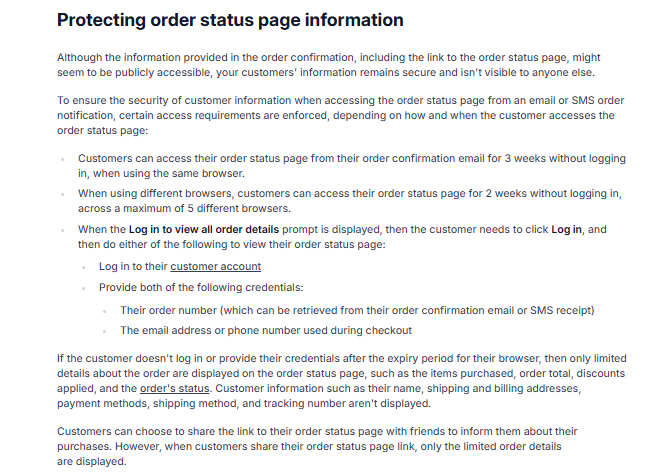
Evaluate session handling, order-ownership verification, rate limiting, search indexing, analytics, URL parameters, cached pages, shared-device behavior, support access, AI access, and export.
Do not ask customers to submit passwords, complete payment details, identity documents, or sensitive order information through public comments or unsecured forms.
Design search for shopper language
Customers may search for:
- Where is my order?
- Track package.
- Return item.
- Refund pending.
- Change address.
- Cancel order.
- Wrong item or damaged item.
- Discount code not working.
- Gift-card balance.
- Will this fit?
- Compatible with.
- Payment declined.
- Cancel subscription.
- Product care.
- Warranty claim.
Evaluate full-text and semantic search, exact error matching, synonyms, misspellings, product aliases, model and SKU lookup, filters, regional context, permissions, mobile use, result snippets, duplicate results, stale-content handling, and escalation after failed search.
Create a stable evaluation set containing exact questions, paraphrases, misspellings, product names, models, region-specific queries, marketplace questions, missing-answer questions, private-account questions, outdated-policy scenarios, and conflicting sources.
An article is not findable merely because it has been published.
Evaluate ecommerce AI answers safely
An AI assistant can help shoppers retrieve guidance and complete tasks, but it must not invent transactional facts.
Verify:
- Eligible and excluded knowledge sources.
- Approved-source filtering.
- Product, variant, market, channel, and language context.
- Authentication and authorization for order tools.
- Source citations and freshness indicators.
- Handling of conflicting policies.
- Safe refusal and human escalation.
- Feedback and correction workflows.
- Prompt and response retention.
- Model provider, training policy, data residency, and administrative controls.
Do not allow AI to invent:
- Prices, discounts, inventory, or delivery dates.
- Order, shipment, return, or refund status.
- Return eligibility without the required order context.
- Compatibility or product-safety instructions.
- Warranty outcomes or legal commitments.
- Marketplace policies.
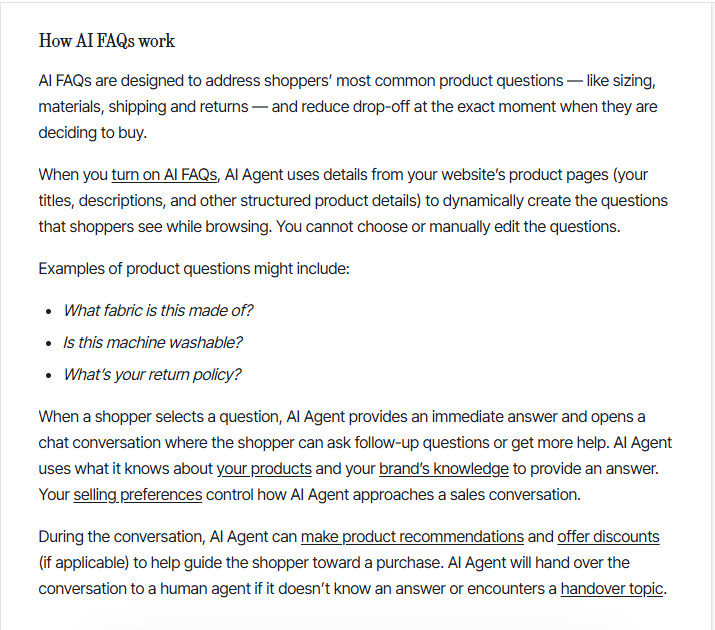
Gorgias provides one current product-specific example. Its AI FAQs can generate product-page questions from product and brand knowledge and can hand the conversation to a human when the AI does not know the answer or reaches a handover topic. This behavior should be evaluated as one vendor implementation, not a universal model.
Preserve human escalation
Every self-service journey should define when and how a customer reaches support.
Include:
- Clear contact criteria.
- Available channels.
- Required information.
- A secure attachment route.
- Order or account verification.
- Safety, payment, privacy, or urgent escalation.
- Marketplace-specific contact instructions.
- The expected next step and confirmation that the request was received.
Safely preserve context such as the search query, article viewed, product, public troubleshooting completed, error message, preferred language, and authenticated order identifier.
Handle direct-store, marketplace, subscription, B2B, and omnichannel differences
| Commerce model | Knowledge considerations |
|---|---|
| DTC or single store | Connect the branded help center directly to the storefront, account, tracking, returns, and support workflows. |
| Multistore or multibrand | Control brand, domain, catalog, language, policy, and queue differences. |
| Marketplace selling | Create channel-specific return, cancellation, communication, and escalation guidance using current marketplace rules. |
| Subscription commerce | Cover pause, skip, swap, quantity, frequency, billing, failed payment, cancellation, and renewal. |
| B2B ecommerce | Account for company roles, purchase orders, payment terms, approvals, reordering, contract-specific content, and personalized pricing. |
| Omnichannel retail | Explain pickup, ship-from-store, retail receipts, in-store returns, location differences, and inventory visibility. |
| Digital products and services | Prioritize access, download, activation, licensing, renewal, cancellation, and usage instead of physical shipping. |
Do not tell marketplace customers to use the direct store’s return or cancellation process when the transaction must be managed through the marketplace.
Localize policies and help content by market
Translation alone does not create a correct regional experience.
Evaluate differences in:
- Language, locale, currency, and units.
- Product availability and restrictions.
- Shipping destinations, methods, duties, and taxes.
- Return locations, windows, methods, and fees.
- Warranty coverage.
- Payment methods.
- Contact channels and business hours.
- Marketplace and legal wording.
Use source-language ownership, locale owners, translation status, terminology rules, localized URLs, language switching, regional fallback, multilingual search, AI evaluation, and right-to-left testing where relevant.
Do not translate one US policy and present it as a universal global policy.
Align help content with ecommerce SEO and structured data
Public support content can help customers and search engines understand the store, but it should not duplicate product pages or expose private account experiences.
Use:
- Crawlable, stable URLs for public articles.
- Descriptive titles and internal links.
- Links from relevant product, policy, account, and support pages.
- Clear help-center navigation.
- Canonical handling and redirects.
- Localized URLs and hreflang where appropriate.
- Indexing controls for private, duplicate, or low-value pages.
Google’s ecommerce site-structure guidance explains that navigation and links help Google understand the relationship and relative importance of pages. Important help articles should therefore be reachable through ordinary links rather than only through an internal search box.
Use structured data only where it accurately represents the page and current commerce data.
Productand merchant-listing markup primarily belong on eligible product or offer pages.MerchantReturnPolicymay describe the organization’s standard return policy.- Product-level return exceptions may require more specific offer-level representation.
- Structured data must agree with visible content, feeds, Merchant Center, and actual policy behavior.
- Structured data does not replace a clear customer-facing policy.
- A visible FAQ does not automatically qualify for FAQ rich-result treatment.
Google’s current MerchantReturnPolicy documentation allows a standard organization-level policy and more specific product-level overrides. Google also states that search enhancements are not guaranteed.
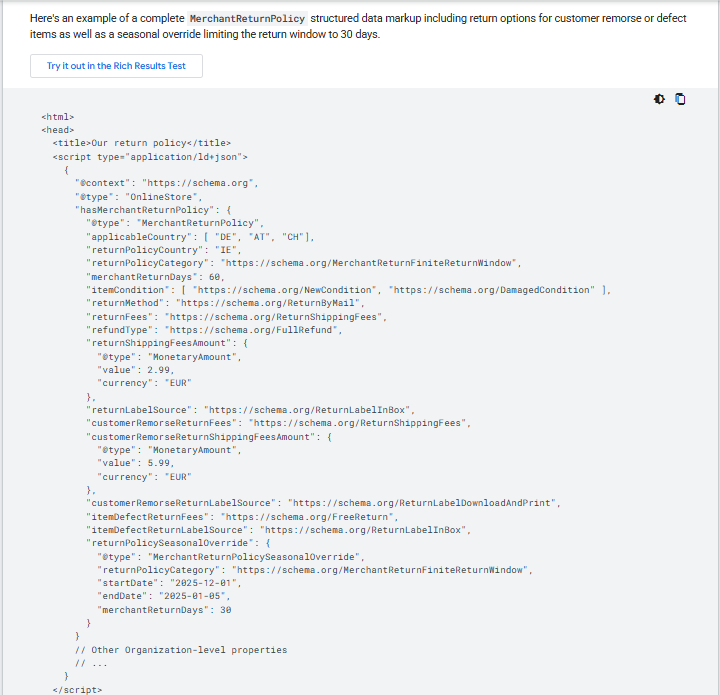
Merchant Center currently requires return information to be clear, accessible without requiring login, and consistent across Merchant Center and the store’s visible pages. Exception policies can be associated with specific product groups through return-policy labels. Review the current Merchant Center return-policy requirements before implementation.
Assign content ownership and review triggers
Potential owners include Ecommerce Operations, Customer Experience, Support, Product Management, Product Content, Merchandising, Logistics, Returns Operations, Payments, Legal, Privacy, Security, Subscription Operations, Loyalty, Marketplace Operations, Localization, and SEO.
Useful content states include:
- Candidate.
- Draft.
- Subject-matter review.
- Legal or policy review.
- Approved.
- Published.
- Needs update.
- Temporarily hidden.
- Superseded.
- Restricted.
- Archived.
Use stronger approval for return, payment, safety, privacy, warranty, regulated-product, and legal guidance than for a low-risk product-care tip.
Trigger review when:
- A product, variant, ingredient, material, package, or manual changes.
- A product is launched, retired, recalled, or subject to a safety notice.
- A shipping carrier, destination, method, rate, or holiday cutoff changes.
- A return, exchange, refund, cancellation, or warranty policy changes.
- A payment, checkout, subscription, loyalty, or customer-account workflow changes.
- A marketplace changes its rules.
- A new market or language is introduced.
- Search, customer feedback, escalation, or AI evaluation reveals a failure.
Scheduled review should be a backstop, not the only maintenance control.
Measure completed tasks, not assumed ticket deflection
| Measurement layer | Useful measures |
|---|---|
| Content health | Named owners, approval state, review completion, expired content, duplicates, broken links, missing sources, and missing translations. |
| Findability | Search success, zero-result queries, correct top result, time to answer, reformulation, mobile retrieval, and competing answers. |
| Task completion | Successful tracking, return request, cancellation, account recovery, subscription change, setup, or warranty escalation. |
| Escalation | Contact after a self-service journey, reason, article used, steps completed, context transferred, and whether escalation was appropriate. |
| Customer feedback | Helpful, incorrect, outdated, missing exception, wrong region, wrong product, confusing, or unable to complete the task. |
| Operations | Content-gap backlog, review backlog, owner response, policy-change propagation, AI correction time, translation lag, and access incidents. |
Article views, searches, AI messages, contact avoidance, and chat abandonment do not prove that the customer completed the task.
If the organization reports ticket deflection, define the eligible self-service session, support-contact event, time window, exclusions, repeat contacts, authenticated versus anonymous journeys, and measurement limitations.
Ecommerce Knowledge Base implementation roadmap
| Phase | Primary work | Evidence before expanding |
|---|---|---|
| 1. Define the operating problem | Identify store model, channels, markets, products, customer groups, high-volume questions, high-risk topics, and systems of record. | The scope addresses defined customer tasks rather than a general desire to publish more FAQs. |
| 2. Audit content and data | Inventory policies, product content, macros, tickets, search logs, account journeys, return workflows, marketplace content, duplicates, and gaps. | Authoritative sources, conflicts, owners, and live-data boundaries are visible. |
| 3. Map sources and architecture | Define journey categories, product relationships, market and channel context, content types, metadata, permissions, owners, and triggers. | Each important fact and task has an accountable source and lifecycle. |
| 4. Build a bounded pilot | Select order tracking, returns, shipping, subscriptions, checkout, one product category, one market, or one channel. | The pilot is small enough to test and maintain. |
| 5. Integrate and test | Connect store navigation, product pages, accounts, order status, returns, help desk, search, AI, mobile, analytics, SEO, and permissions. | Representative customers can complete tasks and private data remains protected. |
| 6. Launch | Publish, train agents, communicate the experience, enable feedback and escalation, and monitor search and tasks. | Customers and agents know where to find authoritative help. |
| 7. Operate and expand | Review search gaps, feedback, support contacts, product and policy changes, new markets, new languages, new channels, and AI evaluations. | The team can keep the pilot current before adding scope. |
Worked example: a fictional apparel store
This example is fictional. Northstar Apparel sells through its direct online store and one marketplace to customers in the United States and Canada. It has customer accounts, order tracking, a returns workflow, seasonal promotions, a loyalty program, and a planned AI assistant.
Shipping, returns, sizing, and promotion information is duplicated across product pages, email macros, policy pages, and chatbot answers.
| Decision area | Northstar’s illustrative approach |
|---|---|
| Purpose | The knowledge base explains customer tasks while live commerce systems provide prices, inventory, orders, eligibility, and status. |
| Question collection | The team uses searches, tickets, returns, reviews, product questions, and checkout issues. |
| Sources | Product facts come from the product system, order status from the OMS, returns from the policy and returns system, and loyalty from the loyalty platform. |
| Architecture | Content follows before-purchase, checkout, delivery, product use, returns, account, and escalation journeys. |
| Templates | The team creates controlled templates for tracking, returns, sizing, checkout, and product care. |
| Channel differences | Marketplace customers receive separate return and cancellation instructions. |
| Workflow integration | Articles link to customer accounts, tracking, and returns instead of asking customers to contact support for every action. |
| Privacy | Order, refund, loyalty, and account information remains authenticated and excluded from public search. |
| AI | The assistant can explain approved content and open authenticated tools, but it cannot invent status or eligibility. |
| SEO | The visible return policy, Merchant Center settings, and structured data are reconciled before launch. |
| Measurement | The pilot tracks search success, completed tasks, appropriate escalation, feedback, and content health. |
Northstar expands to additional product categories and languages only after the initial content and workflows can be maintained reliably.
Common ecommerce knowledge-base failures
| Failure | Corrective action |
|---|---|
| The knowledge base is only a longer FAQ page | Add search, structured content, ownership, workflows, lifecycle governance, and task integration. |
| Content is organized by internal department | Organize primary navigation around shopper questions and journey stages. |
| Prices or stock are hard-coded in articles | Retrieve live values from commerce and inventory systems. |
| Personal order information appears publicly | Use authenticated accounts and order tools. |
| One return policy is presented globally | Model country, channel, product, and market exceptions explicitly. |
| Marketplace customers receive direct-store instructions | Create channel-specific workflows using current marketplace rules. |
| Policies are copied into several pages and bots | Define one authoritative source and controlled reuse. |
| No owner or source exists | Resolve the governance gap before publishing. |
| Several active answers conflict | Select one canonical answer and retire or scope the others. |
| No review follows a product or policy change | Use event-based triggers. |
| Every question links to a long policy page | Create concise task articles linked to the policy. |
| Product-care content exists only on the blog | Publish a maintained support version and link editorial content to it. |
| Order status and customer accounts are disconnected | Link public guidance to authenticated actions. |
| Search is assumed to work automatically | Test real queries, synonyms, models, misspellings, permissions, and zero results. |
| AI invents order or return information | Use authenticated tools, approved sources, citations, and refusal behavior. |
| Success is measured only by views | Measure findability, completed tasks, escalation, feedback, and content health. |
| Ticket deflection is reported without a method | Define the eligible journey, contact event, time window, and measurement limits. |
| Mobile shoppers are ignored | Test search, articles, accounts, returns, and escalation on real mobile journeys. |
| Software is selected before the operating model | Define sources, workflows, permissions, governance, and measurement first. |
What to verify in ecommerce knowledge-base software
- Customer-facing help center and internal agent knowledge.
- Article templates, categories, metadata, and product relationships.
- Product, variant, market, language, and channel segmentation.
- Public and authenticated content.
- Search, synonyms, model lookup, filters, analytics, and zero-result reporting.
- Mobile experience, custom domain, branding, SEO controls, and redirects.
- Customer feedback, ownership, approval, verification, expiration, versioning, review triggers, and archiving.
- Help-desk, commerce-platform, customer-account, order, returns, subscription, and marketplace integrations.
- Agent article suggestions and case-to-knowledge workflows.
- AI citations, approved sources, live-data tools, permissions, and refusal behavior.
- Multilingual support and regional governance.
- APIs, export, migration, data residency, backup, pricing, seat requirements, usage limits, and implementation cost.
Do not select a platform only because it is marketed as an ecommerce knowledge base. A general knowledge tool, help desk, or commerce platform may be appropriate when it supports the required architecture and workflows.
Reusable ecommerce knowledge worksheets
| Customer-question field | What to record |
|---|---|
| Exact question | The customer’s real wording. |
| Context | Journey stage, product, variant, region, language, channel, customer type, and order state. |
| Priority | Frequency, importance, risk if wrong, and strategic value. |
| Current answer | Where the customer or agent currently finds the answer. |
| Expected task | The action the correct answer should enable. |
| Owner and source | The accountable team and authoritative system or policy. |
| Source-of-authority field | What to record |
|---|---|
| Fact | The product, order, policy, or customer information being used. |
| Authoritative system | PIM, commerce platform, inventory, OMS, returns, subscription, policy, or another source. |
| Knowledge-base role | Explain, compare, troubleshoot, route, or provide context. |
| Live or static | Whether the value must be retrieved at request time. |
| Authentication | Whether personal or order context is required. |
| Update and fallback | How changes propagate and what happens if the source is unavailable. |
| Owner and trigger | The accountable team and event that causes review. |
| Article-governance field | What to record |
|---|---|
| Article and content type | The page and its operational purpose. |
| Applicability | Product, variant, market, language, channel, customer, and order state. |
| Audience | Public, authenticated customer, agent, partner, or restricted. |
| Authority | Source, owner, approver, status, and version. |
| Lifecycle | Last review, event trigger, expiration, and retirement condition. |
| Eligibility | Whether the article may be indexed publicly or used by AI. |
| Retrieval-test field | What to record |
|---|---|
| Customer query | The exact question, paraphrase, misspelling, product name, or model. |
| Context | Market, channel, product, account state, and permissions. |
| Expected result | The canonical article and live workflow. |
| Actual result | The search result, AI answer, or failure. |
| Outcome | Task completion, escalation, permission result, and error. |
| Owner and next action | The accountable person and required improvement. |
The operating principle
A successful Ecommerce Knowledge Base does not attempt to replace product, inventory, order, returns, payment, subscription, or account systems. It explains customer decisions and tasks, then connects shoppers to the correct live workflow.
Start with real shopper questions, organize content around the shopping journey, identify an authoritative source for every fact, protect personal data, account for product and market context, test search and AI with realistic queries, preserve human escalation, and measure whether customers complete the intended task.
Sources verified: November 12, 2026.