Independent knowledge base software guide Evidence-led Updated 2026


Multilingual knowledge base: localization workflow and testing
A multilingual knowledge base is a governed system for publishing accurate help in more than one language or locale. It is not a folder of translated copies. Each localized article needs an identifiable source, a supported locale, a stable URL, a review owner, a freshness state, and a deliberate fallback rule. The platform must also preserve search, navigation, permissions, analytics, and accessibility when the language changes.
Editorial scope: This guide covers the localization operating model, technical delivery, governance, and testing. For deeper implementation detail, use the separate guides to multilingual knowledge base SEO and right-to-left knowledge base design.
Last tested: July 31, 2026. The original evidence below is a controlled local synthetic fixture, not a SaaS trial or a claim about production user behavior.
What a multilingual knowledge base must control
A reliable implementation separates four concerns that are often collapsed into the word “translation.”
| Concern | Decision to record | Failure if it is ignored |
|---|---|---|
| Content | Which source article and version a translation represents | A translated answer remains published after the source changes |
| Locale | Which language-and-region combinations are supported | Users receive the wrong legal terms, currency, screenshots, or product availability |
| Delivery | URL, language selector, fallback, direction, and alternate-page annotations | A correct translation is hard to reach, rendered incorrectly, or mapped inconsistently |
| Operations | Owner, reviewer, service level, release trigger, and retirement rule | Localization becomes an unowned publishing queue |
A platform can support many languages and still fail this operating model. Feature availability matters, but the practical question is whether your team can trace a localized answer back to its source and prove that the delivery rules still work after an update.
How we tested
We created a local synthetic fixture with four fictional support tasks and ten article variants across en-US, ar-EG, and fr-FR. The script sent 12 locale requests and checked exact routing, declared fallback, translation version parity, Arabic direction, and reciprocal hreflang clusters.
| Check | Result | What it exposed |
|---|---|---|
| Route resolved correctly | 12 of 12 | Ten exact routes and two declared English fallbacks with a language notice |
| Translation matched source version | 4 of 6 | Two translated pages were one version behind |
| Arabic direction declared correctly | 2 of 3 | One Arabic page incorrectly used left-to-right direction |
Complete reciprocal hreflang cluster | 1 of 4 | Three clusters omitted an alternate or reciprocal reference |
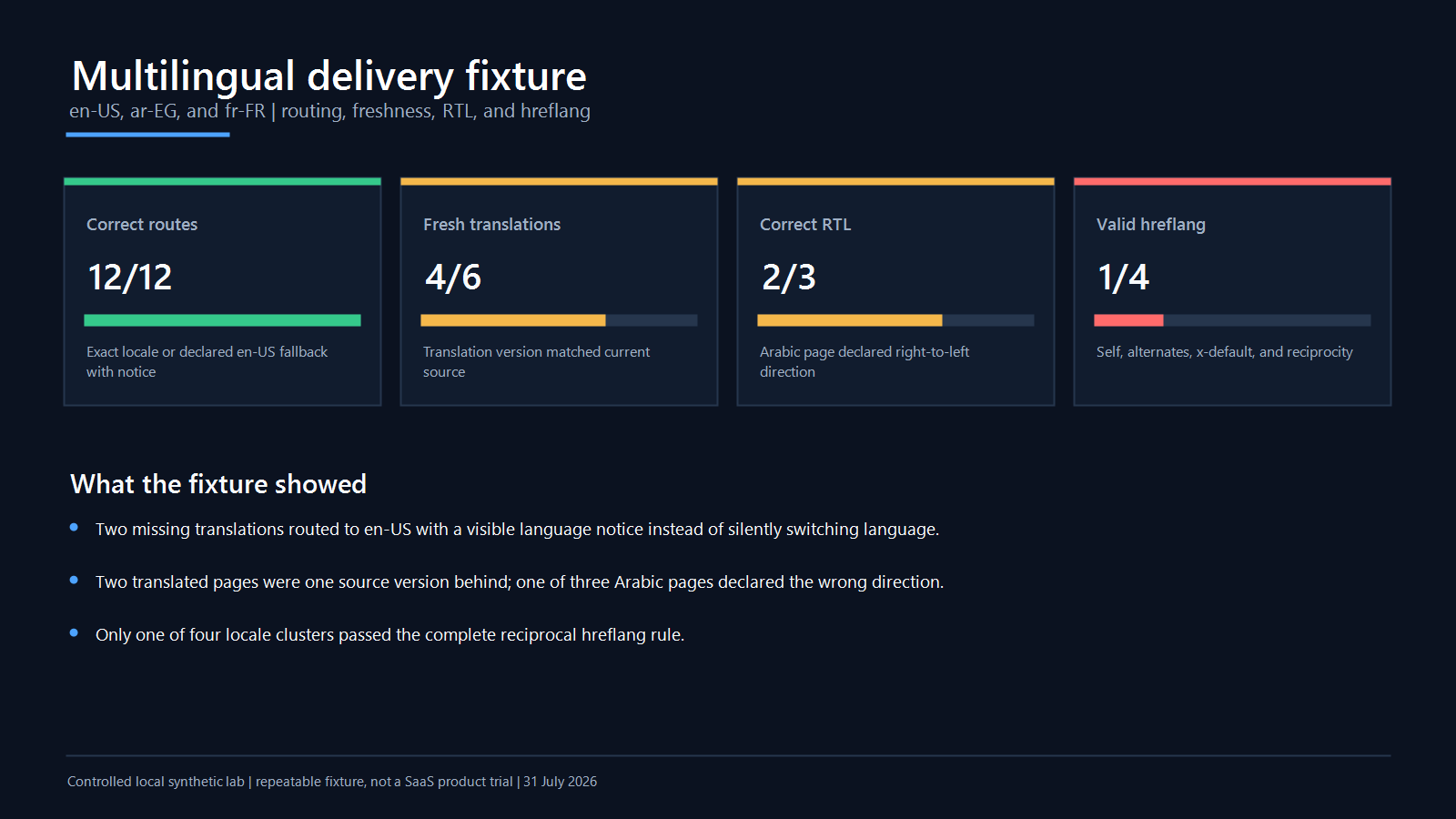
The result demonstrates why “the page loaded” is a weak localization test. Every request returned an answer, yet the same fixture contained stale translations, an RTL defect, and incomplete alternate-page annotations. The full method, input CSV files, and machine-readable results are retained with the evidence image.
Limitations
This was a local synthetic test of rules and data, not a trial of any knowledge base platform. It did not involve production users, a search-engine crawl, human translation-quality scoring, browser visual regression, analytics, or support contacts. The figures show only how the published fixture behaved.
Define languages, locales, and fallback separately
A language tag can identify a language alone, such as fr, or a more specific locale, such as fr-FR or fr-CA. The IETF language-tag specification defines the structure. Use the narrowest tag your content actually supports; do not add a region merely to make a URL look precise.
Document three decisions for every locale:
- Coverage: which article types must be localized and which may remain in the source language.
- Fallback: what happens when a localized version is absent, withdrawn, or awaiting review.
- Risk: which content cannot fall back because policy, safety, billing, or product behavior differs by region.
A fallback should be visible and reversible. Label the language being served, keep the language selector available, and offer the localized index or support route. Do not silently present an English page under an Arabic or French URL. For high-risk topics, “translation unavailable—contact support” may be safer than serving a source-language answer whose rules do not apply.
Use stable URLs and reciprocal hreflang
Give every indexable language version its own crawlable URL. Common patterns include locale folders such as /en-us/, /ar-eg/, and /fr-fr/. Pick one pattern and keep it consistent across articles, hubs, search results, and sitemaps.
Google’s localized-page guidance says each language version should list itself and the other localized versions, and the references should be reciprocal. An optional x-default can identify a neutral selector or fallback page. Google treats HTML, HTTP-header, and sitemap implementations as equivalent; choose one maintainable method rather than maintaining three sources that can drift.
<link rel="alternate" hreflang="en-US" href="https://example.com/en-us/reset-password/">
<link rel="alternate" hreflang="ar-EG" href="https://example.com/ar-eg/reset-password/">
<link rel="alternate" hreflang="fr-FR" href="https://example.com/fr-fr/reset-password/">
<link rel="alternate" hreflang="x-default" href="https://example.com/language/reset-password/">
Use a self-referencing canonical on a genuinely localized page. Pointing every translation’s canonical to the English source can tell search systems to prefer the source URL, undermining the locale structure. A translated shell with substantially untranslated main content is a different case and should not be treated as a finished localization.
Treat RTL as a functional requirement
Arabic localization is not complete when only the words change. The W3C recommends declaring page direction in markup—for example, <html lang="ar" dir="rtl">—because direction is part of the document structure. Its bidirectional text guidance also explains that direction is a property of the script, not a safe inference from a language label.
Test the complete task, not a static paragraph:
- navigation order, breadcrumbs, tables, pagination, and icons;
- search fields, filters, form inputs, validation, and support escalation;
- mixed Arabic and Latin product names, email addresses, URLs, dates, and version numbers;
- keyboard focus order, screen-reader names, zoom, and narrow mobile layouts;
- screenshots whose UI language and reading direction match the article.
For implementation patterns and test cases, use the dedicated RTL knowledge base design guide.
Build translation freshness into publishing
A “last updated” date cannot prove that a translation matches the source. Track a source version or content revision for every locale. When the source changes, calculate the affected blocks, change the translation state, and apply a risk-based service level.
| State | Meaning | Reader behavior |
|---|---|---|
| Current | Translation was reviewed against the published source version | Publish normally |
| Review required | Source changed; impact is not yet confirmed | Keep published only if the change is non-critical and policy allows it |
| Stale | Translation is behind a material source change | Show a warning, replace with an approved fallback, or unpublish |
| Locale-specific | Approved content intentionally differs by market | Maintain its own owner, evidence, and review schedule |
Connect this state machine to the broader knowledge base content lifecycle. A product release should create translation work for affected locales; it should not depend on someone remembering to email translators.
Use a source-to-locale workflow
1. Select content by demand and risk
Prioritize locales using customer distribution, search queries, support contacts, product availability, contract obligations, and content risk. Do not translate the entire archive merely to announce broad language coverage.
2. Stabilize the source
Remove ambiguity, reuse approved terminology, separate locale-specific facts, and structure procedures into testable steps. Legacy KCS v6 guidance, published when KCS meant Knowledge-Centered Service, treated consistency and translatability as content-design concerns, not final-stage cleanup.
3. Translate, review, and validate
Machine translation can accelerate a draft, but a human reviewer should validate terminology, task accuracy, links, screenshots, regional rules, and safety-sensitive language. Record who approved the locale and which source version they reviewed.
4. Test delivery before release
Test direct URLs, language switching, fallback, search, permissions, canonical and hreflang output, directionality, links, structured data, and analytics segmentation. Include a missing-translation case deliberately; otherwise the fallback path remains untested.
5. Monitor and retire deliberately
Monitor freshness by locale, failed searches, unresolved tasks, broken links, fallback frequency, and support feedback. When a source article is merged or retired, update every locale, alternate-page cluster, internal link, and redirect as one change set.
Evaluate multilingual knowledge base software
Ask vendors to demonstrate your workflow using the same small content pack. Marketing checkmarks cannot show whether permissions, translation states, or exports behave as expected.
- Can one source article map to locale variants without duplicating ownership?
- Does a source update mark affected translations for review?
- Can critical locales block publication until approval?
- Can search be tuned and measured per locale?
- Can roles be assigned by locale, category, and publication state?
- Does the rendered page expose correct
lang,dir, canonical, and alternate annotations? - Can readers switch language without losing their current task?
- Can content, relationships, redirects, and locale metadata be exported?
- Do AI translation or answer features disclose processors, retention, permissions, and source citations?
Add these scenarios to a structured knowledge base software RFP and use the same pass/fail evidence for every shortlisted platform.
Measure outcomes without claiming causation
Separate delivery health from reader outcomes. Coverage, freshness, broken links, and valid locale annotations measure the publishing system. Search reformulation, task completion, an explicit “solved” event, and escalation after viewing an article describe reader journeys.
A ticket-deflection signal estimates journeys that did not lead to assisted contact under a defined event rule and time window. It does not prove prevented tickets without an explicit success signal or causal comparison. Compare locales only after accounting for audience size, available content, product mix, and support-channel differences.
Multilingual launch checklist
- Define locale coverage and risk-based fallback rules.
- Choose one stable URL convention.
- Assign a source owner and a reviewer for every locale.
- Track source and translation versions.
- Validate self-referencing canonicals and reciprocal
hreflang. - Test Arabic or other RTL tasks with structural direction markup.
- Test missing, stale, restricted, and retired translations.
- Segment search and outcome metrics by locale.
- Connect releases to translation review work.
- Export the content and locale relationships before signing a contract.
Frequently asked questions
Should every article be translated?
No. Translate according to audience demand, task importance, product availability, legal or contractual requirements, and maintenance capacity. Publishing a smaller current set is usually safer than publishing a large stale set.
Can AI translate knowledge base articles?
AI can draft or suggest translations. It does not remove the need to review terminology, task accuracy, locale-specific facts, screenshots, links, permissions, and safety-sensitive content. Evaluate data processing and retention before sending restricted articles to a model.
Should an untranslated page redirect to English?
Use a declared fallback rather than a silent redirect. Preserve the user’s locale context, state which language is being served, and provide a way back. Block fallback where regional differences make the source-language answer unsafe or incorrect.
Does hreflang replace a language selector?
No. hreflang helps search systems understand localized alternatives. Readers still need a visible, accessible language selector that keeps them on the equivalent task where possible.
How often should translations be reviewed?
Use event-driven review when the source, product, policy, or screenshot changes, plus a risk-based scheduled review. A fixed annual date alone cannot keep a frequently changing troubleshooting or billing article current.
Sources and further reading
- Google Search Central: localized versions of pages
- Google Search Central: managing multi-regional and multilingual sites
- W3C: authoring HTML for right-to-left scripts
- W3C: internationalization quick tips
- RFC 5646: tags for identifying languages
- Consortium for Service Innovation: legacy KCS v6 content-standard guidance