Independent knowledge base software guide Evidence-led Updated 2026

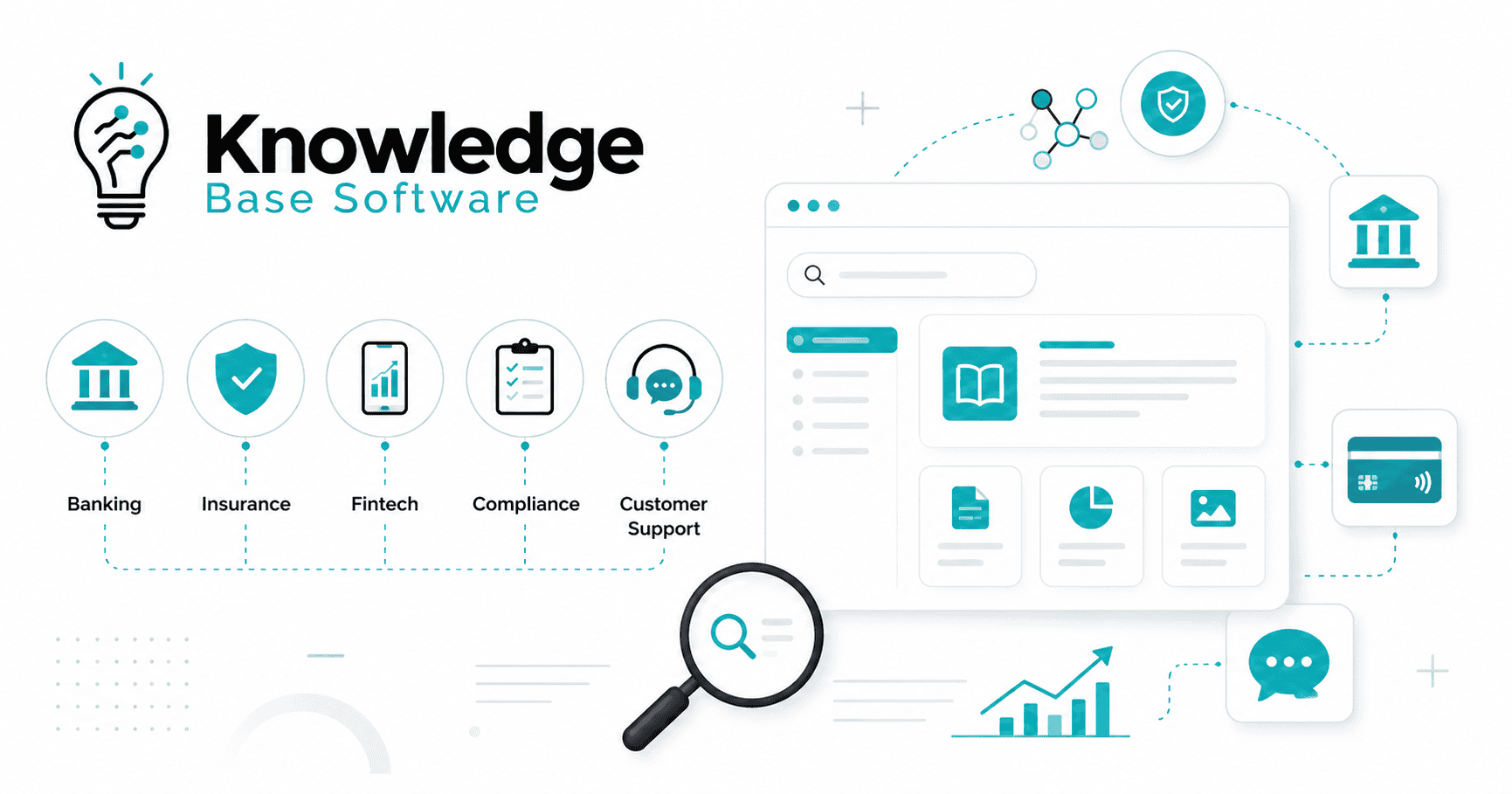
Financial Services Knowledge Base: Banking, Insurance, Fintech, Compliance, and Customer Support
Financial firms handle complex products, sensitive customer data, strict regulations, fast-changing policies, and high customer expectations. A Financial Services Knowledge Base helps solve that challenge by centralizing approved, searchable, and governed answers for customers, employees, advisors, support agents, compliance teams, and AI systems.
Unlike a basic help center, a financial services knowledge base must support accuracy, security, version control, review workflows, audit trails, role-based access, and clear ownership. In banking, insurance, fintech, payments, lending, and wealth management, a single outdated answer can create customer confusion, operational errors, regulatory exposure, or unnecessary escalations.
What Is a Financial Services Knowledge Base?
A financial services knowledge base is a structured library of trusted answers, policies, procedures, product explanations, troubleshooting guides, compliance guidance, and operational playbooks used by financial institutions and their customers.
In financial services knowledge management, the goal is not simply to store documents. The goal is to make the right answer available to the right audience at the right time, with the right level of approval, security, and context. In practice, this means capturing, organizing, governing, sharing, and improving knowledge so teams can deliver consistent service, support compliance operations, make better decisions, and reduce operational risk.
A mature financial services knowledge base usually includes five connected layers:
- Public customer help center
Customer-facing articles that explain account access, claims, card disputes, payments, fees, coverage, onboarding, app features, and common troubleshooting steps. - Internal employee knowledge base
Private articles for branch teams, operations teams, support agents, relationship managers, underwriters, claims handlers, fraud teams, and back-office staff. - Advisor or agent knowledge base
Guidance for insurance agents, brokers, wealth advisors, call-center representatives, and field teams who need approved scripts, product rules, suitability reminders, escalation paths, and disclosure language. - Compliance and policy knowledge base
Controlled content for policies, procedures, regulatory change management, approvals, records retention, complaints handling, data classification, and internal attestations. - AI/RAG-ready knowledge layer
Structured, current, and approved knowledge that AI assistants, agent-assist tools, search systems, and retrieval-augmented generation workflows can safely retrieve from.
Example: A digital bank may publish a customer article titled “How to dispute a card transaction,” an internal agent playbook titled “Card dispute investigation workflow,” a compliance note covering approved disclosure language, and an AI-ready article summary that tells the chatbot when to answer and when to escalate.
Why Financial Services Organizations Need a Knowledge Base
Financial services teams answer thousands of repetitive questions: “Why was my card declined?” “How long does a claim take?” “What documents are required for identity verification?” “How do I update my beneficiary?” “Why is my transfer pending?”
Without a governed knowledge base, answers spread across PDFs, Slack threads, email chains, intranet pages, training decks, and individual employee memory. That creates inconsistent support, slow onboarding, compliance risk, and poor customer experience.
A financial services knowledge base helps organizations:
- Reduce repetitive support questions through self-service.
- Improve answer consistency across branches, apps, chat, email, call centers, and advisors.
- Train new employees faster with approved processes and product explanations.
- Help agents resolve questions faster with searchable playbooks.
- Reduce compliance risk from outdated or inconsistent customer communications.
- Preserve institutional knowledge when experienced employees leave.
- Improve audit readiness through version history, ownership, and approval records.
- Support digital transformation by giving customers and employees trusted answers in real time.
In regulated environments, this is operational infrastructure. It is not just documentation.
Financial Services Knowledge Base vs. General Knowledge Base
A general knowledge base may work for a software company or ecommerce store. A financial services knowledge base needs stronger governance because the content can affect money movement, customer identity, claims, disclosures, fraud handling, privacy, and regulatory obligations.
| Feature | General Knowledge Base | Financial Services Knowledge Base | Why It Matters |
|---|---|---|---|
| Content governance | Basic authoring and publishing | Defined owners, reviewers, approval paths, and review cycles | Prevents unapproved or outdated financial guidance |
| Approval workflows | Optional | Usually expected for compliance-sensitive content | Helps product, legal, compliance, and risk teams review high-impact answers before use or publication |
| Version control | Useful | Essential | Supports audit readiness and rollback when policies change |
| Audit trails | Limited or optional | Detailed logs of edits, approvals, publishing, and archiving | Helps demonstrate who changed what, when, and why |
| Role-based access | Often basic | Granular RBAC by team, role, market, product, and jurisdiction | Reduces exposure of confidential internal guidance |
| Data security | General access controls | Encryption, SSO/MFA, least privilege, logging, monitoring, and data retention | Protects customer and institutional information |
| Regulatory mapping | Rare | Mapped to policies, obligations, disclosures, and jurisdictions | Helps compliance teams manage change |
| Customer-facing content | Mostly support articles | Approved public guidance with controlled language | Reduces misleading or inconsistent customer communication |
| Agent-assist content | Optional | Integrated with CRM, ticketing, call center, and escalation workflows | Improves first-contact resolution |
| AI readiness | Often unstructured | Curated, tagged, reviewed, and citation-ready | Reduces AI hallucination and outdated-answer risk |
Core Content Types to Include
A strong banking, financial services, and insurance (BFSI) knowledge base should combine customer education, employee enablement, operational procedures, and compliance governance.
Core content types include:
- Product FAQs for accounts, cards, loans, insurance policies, investment services, wallets, payments, and subscriptions.
- Account and billing procedures, including updates, statements, payment failures, fees, refunds, and closures.
- Claims and policy explanations for coverage, deductibles, exclusions, evidence, timelines, and appeals.
- Loan and credit documentation, including eligibility, document checklists, underwriting stages, repayment options, and hardship support.
- Card and payment support, including declines, chargebacks, disputes, card replacement, wallets, and transfer status.
- KYC/AML onboarding guidance, including identity verification, beneficial ownership, sanctions screening, and enhanced due diligence triggers.
- Fraud and dispute workflows for suspicious activity, account takeover, scams, unauthorized transactions, and escalation rules.
- Escalation playbooks for complaints, vulnerable customers, regulatory issues, legal threats, fraud risk, and media inquiries.
- Compliance policies, internal SOPs, customer communication templates, and records retention guidance.
- Training materials for new hires, agents, advisors, operations teams, and outsourced support vendors.
- Incident response and outage communication templates for downtime, delayed transfers, claims system issues, app incidents, and security notifications.
The best knowledge bases separate customer-facing explanations from internal operational instructions. A customer may need a simple explanation of why a transfer is delayed. An operations analyst may need a detailed workflow with investigation steps, risk flags, system codes, and escalation contacts.
Banking Knowledge Base Use Cases
A banking knowledge base supports retail banking, commercial banking, credit unions, digital banking, lending, mortgages, cards, payments, branch operations, and fraud teams.
For retail banking, customer-facing articles should explain everyday tasks: opening an account, resetting online banking access, replacing a debit card, disputing a transaction, setting travel alerts, understanding overdraft fees, or downloading statements.
For commercial banking, internal articles may cover treasury services, ACH files, wire approvals, business account onboarding, cash management, authorized signers, and client documentation.
For digital banking, the knowledge base should support mobile app troubleshooting, biometric login, device registration, transfer limits, card controls, digital statements, and accessibility support.
For lending and mortgages, content should explain document requirements, application stages, rate locks, escrow, repayment, hardship options, and payoff requests. Internal content should distinguish between educational explanations and advice that requires licensed or regulated staff.
For fraud and dispute resolution, a banking knowledge base should include clear escalation paths, evidence requirements, customer scripts, investigation queues, and incident severity definitions.
Practical banking article examples include:
- “How to Report a Lost or Stolen Debit Card”
- “Why Is My Bank Transfer Pending?”
- “How to Dispute a Card Transaction”
- “Documents Needed to Open a Business Account”
- “Internal Workflow: ACH Return Investigation”
- “Branch Guide: Escalating Suspected Elder Financial Exploitation”
- “Agent Script: Explaining Overdraft Fees Clearly”
Banking content should be plain-language, accurate, and reviewed regularly because financial communications can affect customer trust and complaint risk.
Insurance Knowledge Base Use Cases
An insurance knowledge base supports policyholders, claims teams, underwriters, agents, brokers, call centers, renewal teams, and compliance reviewers.
For policy explanations, articles should define coverage types, deductibles, exclusions, waiting periods, endorsements, riders, premium changes, cancellation rules, and renewal terms. Customer-facing explanations should avoid legal jargon and make clear when policy documents control.
For claims support, the knowledge base should explain how to file a claim, what evidence is needed, what happens during review, how payment works, how to appeal a decision, and how to contact an adjuster.
For underwriting guidance, internal articles can document eligibility rules, risk indicators, required documents, referral triggers, and underwriting authority levels.
For agent and broker enablement, the knowledge base should include approved product summaries, comparison guides, sales conduct reminders, disclosure language, objection-handling guidance, and escalation rules.
Practical insurance article examples include:
- “How to File an Auto Insurance Claim”
- “What Is a Deductible?”
- “What Documents Do I Need for a Property Claim?”
- “How Policy Renewals Work”
- “Agent Guide: Explaining Exclusions Without Misleading Customers”
- “Internal SOP: Escalating a Coverage Complaint”
- “Underwriting Checklist: Small Business Liability Policy”
Insurance knowledge bases should be especially careful with wording. A help article should educate customers, not rewrite the policy, overpromise coverage, or imply claim approval before review.
Fintech Knowledge Base Use Cases
A fintech knowledge base supports fast-moving digital products where customers expect instant answers inside the app, on the website, through chat, and from support teams.
For onboarding and identity verification, articles should explain why information is required, how long verification may take, acceptable documents, failed verification reasons, and when manual review is needed. In the United States, FinCEN’s CDD Rule clarifies and strengthens customer due diligence requirements for covered financial institutions such as banks, broker-dealers, mutual funds, futures commission merchants, and introducing brokers in commodities. Teams should also monitor FinCEN updates: in February 2026, FinCEN issued exceptive relief from identifying and verifying beneficial owners every time a legal entity customer opens a new account, while preserving other applicable AML/CFT obligations.
For payments, wallets, and transfers, customers need clear guidance on pending transfers, failed payments, limits, chargebacks, fees, refunds, settlement times, and wallet security.
For embedded finance, the knowledge base should distinguish between platform responsibilities, partner bank responsibilities, card network rules, customer support ownership, and escalation paths.
For neobanking, product-led support should answer questions about account access, cards, deposits, transfers, direct deposit, app security, transaction alerts, and account restrictions.
For BNPL or lending platforms, content should clearly explain repayment schedules, late fees, credit reporting, eligibility, refunds, disputes, and hardship support where applicable.
For developer/API documentation, fintech companies should maintain separate technical docs for authentication, API keys, webhooks, error codes, sandbox testing, rate limits, and incident communication.
Practical fintech article examples include:
- “Why Is My Identity Verification Still Pending?”
- “How Instant Transfers Work”
- “Understanding Card Authorization Holds”
- “How to Secure Your Account”
- “Developer Guide: Webhook Retry Logic”
- “Internal Playbook: Manual Review for High-Risk Onboarding”
- “Support Guide: Escalating Account Restriction Complaints”
Fintech content changes quickly, so review cycles, ownership, and product-version labels are essential.
Compliance and Regulatory Considerations a Financial Services Knowledge Base Should Support
A compliance-ready financial services knowledge base should support approval workflows, version history, audit logs, records retention, access control, separation of public and internal information, policy attestation, regulatory change management, and customer communication review.
For example, the FTC Safeguards Rule requires covered financial institutions to develop, implement, and maintain an information security program with administrative, technical, and physical safeguards to protect customer information. The FTC also notes change management, authorized-user activity logs, and monitoring for unauthorized access as part of safeguards expectations.
Payment-related content may also need alignment with PCI DSS when cardholder data, sensitive authentication data, or systems that can affect the cardholder data environment are involved. PCI DSS provides a baseline of technical and operational requirements designed to protect payment account data. Knowledge base teams should avoid storing cardholder data or sensitive authentication data in articles, screenshots, attachments, or internal notes unless an approved compliance process explicitly allows it.
Broker-dealers, registered investment advisers, investment companies, funding portals, and certain transfer agents may need to consider SEC Regulation S-P obligations. SEC amendments require covered institutions to adopt written policies and procedures for incident response programs addressing unauthorized access to or use of customer information, including procedures for timely customer notification where required. As of July 2026, the SEC’s tiered compliance dates for the amendments have passed for larger entities and smaller entities, so covered institutions should confirm the current status of their Regulation S-P implementation with qualified compliance counsel.
FINRA-regulated firms should also consider supervisory procedures. FINRA Rule 3110 requires firms to establish and maintain supervisory systems reasonably designed to achieve compliance with applicable securities laws, regulations, and FINRA rules; FINRA materials also discuss written supervisory procedures and review of customer complaints, internal communications, and business activities.
| Compliance Need | Knowledge Base Capability | Example in Practice |
|---|---|---|
| Approval control | Multi-step review workflow | Product drafts, compliance approves, legal reviews sensitive claims |
| Version history | Full record of edits and publishing | Shows which fee explanation was live on a specific date |
| Audit logs | Track user actions | Records who edited, approved, archived, or restored an article |
| Records retention | Retain content by policy | Archived articles remain accessible for audit and complaint review |
| Access control | RBAC and least privilege | Fraud procedures visible only to fraud and risk teams |
| Public/internal separation | Audience-based visibility | Customer article excludes internal risk indicators |
| Regulatory mapping | Link articles to obligations | KYC article tagged to AML policy and jurisdiction |
| Policy attestation | Employee acknowledgment | Agents confirm they reviewed updated claims scripts |
| Communication review | Approved templates | Public disclosures and scripts reviewed before publication |
| Vendor risk documentation | Third-party knowledge controls | Outsourced support teams access only approved content |
| Data classification | Label sensitive content | Internal articles tagged confidential, restricted, or public |
Security and Data Governance Features
Financial services knowledge base software should be evaluated as part of the organization’s broader information security, privacy, and operational risk environment.
Important security and governance features include:
- RBAC: Role-based access control by department, function, jurisdiction, content type, and sensitivity.
- SSO/MFA: Single sign-on and multi-factor authentication to reduce credential risk.
- Encryption: Encryption in transit and at rest, where supported and appropriate.
- Least-privilege access: Users should only access what they need.
- Data retention: Retention policies for drafts, published articles, archived content, logs, and exports.
- PII redaction: Avoid storing unnecessary customer personal information in articles, comments, or screenshots.
- Secure search: Search should respect permissions and not expose restricted content in previews.
- Approval permissions: Only authorized reviewers should approve compliance-sensitive content.
- Private vs. public content controls: Internal articles must not accidentally publish externally.
- Logging and monitoring: Track access, edits, approvals, exports, and suspicious activity.
- Backup and disaster recovery: Maintain access to critical procedures during incidents.
- Data residency: Consider regional data hosting and regulatory expectations where relevant.
NIST’s Cybersecurity Framework 2.0 organizes cybersecurity outcomes around Govern, Identify, Protect, Detect, Respond, and Recover, which is a useful model for evaluating knowledge base security controls. ISO/IEC 27001 defines requirements for an information security management system and emphasizes managing risks related to data handled by an organization. AICPA’s Trust Services Criteria are also used in SOC 2 engagements to evaluate controls over security, availability, processing integrity, confidentiality, and privacy.
For privacy programs, ICO guidance on the UK GDPR highlights principles such as accuracy, storage limitation, integrity and confidentiality, and accountability. The ICO’s separate data security guidance also emphasizes appropriate technical and organizational measures, encryption or pseudonymization where appropriate, access controls, and resilience measures that help restore availability after incidents.
How a Knowledge Base Improves Customer Support
A financial services knowledge base improves customer support by making approved answers easy to find and reuse.
For customers, it supports self-service. A customer can search “pending transfer,” “claim documents,” “card dispute,” or “identity verification failed” and get a clear answer without opening a ticket.
For agents, it supports agent assist. Instead of searching old tickets or asking a senior colleague, an agent can open the approved article, follow the workflow, use the correct script, and escalate when required.
Key support benefits include:
- Ticket deflection for repetitive questions.
- Faster first-contact resolution.
- Lower average handle time.
- Consistent answers across phone, chat, email, branch, mobile app, and chatbot.
- Fewer escalations caused by unclear processes.
- Faster onboarding for new support agents.
- Better complaint handling through approved language and escalation paths.
- Greater customer trust because answers are clear, current, and consistent.
Contact-center example: A customer contacts a bank because a wire transfer is delayed. The agent searches “wire transfer pending,” sees the approved article, confirms the transfer type, checks whether additional verification is required, uses the approved explanation, avoids making timing promises, and escalates to operations if a risk flag appears. The customer receives a consistent answer, the agent follows policy, and the case is documented correctly.
AI, RAG, and Knowledge Bases in Financial Services
AI can make a financial services knowledge base more useful, especially when the underlying content is accurate, current, approved, permission-aware, and well governed.
Retrieval-augmented generation, or RAG, allows an AI assistant to retrieve relevant knowledge base content before generating an answer. In financial services, RAG can be safer than letting an AI model answer from general model memory, but only when retrieval respects permissions, uses approved sources, keeps citations visible, and escalates sensitive or account-specific questions to humans.
However, AI should not be treated as a compliance shortcut. NIST’s AI Risk Management Framework is intended for voluntary use and helps organizations manage AI-associated risks to individuals, organizations, and society. NIST’s Generative AI Profile, NIST AI 600-1, can also help teams identify risks unique to generative AI and select risk management actions that fit their goals and priorities.
A financial services AI knowledge base should include:
- Approved source articles.
- Clear content ownership.
- Last-reviewed dates.
- Jurisdiction and product labels.
- Customer vs. internal audience labels.
- Citations back to source articles.
- Confidence thresholds.
- Escalation rules.
- Human review for sensitive answers.
- Restrictions against answering from unapproved drafts.
- Monitoring for outdated, incomplete, or misleading responses.
AI-ready articles should be written in plain language, use clear headings, avoid duplicate answers, include definitions, and state when a human should intervene. For example, an AI assistant may answer “How do I reset my password?” but should escalate “Why was my account restricted?” if the answer involves fraud, sanctions, legal review, or personalized account decisions.
How to Structure the Knowledge Base
A financial services knowledge base needs a clear taxonomy. Without one, even good content becomes hard to find.
Use the following structure:
- Categories: Banking, Insurance, Fintech, Compliance, Security, Customer Support, Developer Docs.
- Subcategories: Payments, Cards, Claims, Loans, KYC, AML, Fraud, Disputes, Account Access.
- Tags: Product, jurisdiction, customer type, channel, risk level, owner, review date.
- Article templates: FAQ, how-to, policy summary, SOP, troubleshooting, escalation playbook, disclosure note.
- Metadata: Audience, product, region, owner, reviewer, effective date, last reviewed, next review, related policy.
- Ownership: Each article must have a named business owner.
- Review cycles: High-risk content may need quarterly or event-driven review; lower-risk content may follow a longer cycle.
- Jurisdiction labels: U.S., UK, EU, MENA, APAC, or country-specific labels where needed.
- Product/version labels: Current account, premium card, mortgage v2, claims platform, API v3.
- Audience labels: Customer, agent, advisor, compliance, developer, operations, fraud, legal.
Example taxonomy:
| Main Category | Subcategories | Example Articles |
|---|---|---|
| Banking | Accounts, cards, payments, lending, branch support | “How to Replace a Debit Card” |
| Insurance | Claims, policies, renewals, underwriting, brokers | “What Documents Are Needed for a Claim?” |
| Fintech | Onboarding, wallets, transfers, APIs, app support | “Why Identity Verification Failed” |
| Compliance | KYC, AML, disclosures, complaints, records | “Internal KYC Escalation Workflow” |
| Support | Scripts, escalation, outages, complaints | “Agent Script for Payment Delays” |
| Security | Authentication, fraud, incident response | “Account Takeover Escalation Playbook” |
Governance Workflow: From Draft to Approved Answer
A reliable governance workflow turns scattered knowledge into controlled, approved answers.
Recommended workflow:
- Identify a content gap from support tickets, search analytics, complaints, product launches, incidents, or regulatory changes.
- Assign a content owner.
- Draft the article using the correct template.
- Send to a subject-matter expert for accuracy review.
- Send to compliance or legal review where required.
- Publish to the correct audience.
- Monitor search performance, helpfulness, ticket volume, and agent feedback.
- Update after policy, product, pricing, regulatory, or operational changes.
- Archive outdated content while preserving audit history.
| Task | Support | Product | Compliance | Legal | Knowledge Manager |
|---|---|---|---|---|---|
| Identify content gap | Responsible | Consulted | Consulted | Consulted if high risk | Accountable |
| Draft article | Responsible | Responsible for product content | Consulted | Consulted if needed | Accountable |
| SME accuracy review | Consulted | Accountable | Consulted | Consulted | Responsible |
| Compliance review | Consulted | Consulted | Accountable | Consulted | Responsible |
| Legal review | Consulted | Consulted | Consulted | Accountable | Responsible |
| Publish | Consulted | Consulted | Approves where required | Approves where required | Accountable |
| Monitor analytics | Responsible | Consulted | Consulted | Informed | Accountable |
| Archive/update | Consulted | Responsible | Approves where required | Consulted | Accountable |
30-60-90 Day Implementation Roadmap
| Timeline | Goal | Actions | Deliverables | Success Metrics |
|---|---|---|---|---|
| Days 1–30 | Build the foundation | Audit existing content, identify high-volume support questions, define taxonomy, assign owners, select templates | Content inventory, governance model, priority backlog, article templates | Inventory completion, owner assignment rate, top search topics identified |
| Days 31–60 | Publish priority content | Create and review top customer and agent articles, configure RBAC, set approval workflows, connect help desk or CRM | First 50–100 approved articles, public/internal separation, review workflow | Search success rate, ticket deflection, agent adoption, time to publish |
| Days 61–90 | Improve and scale | Analyze zero-result searches, update weak articles, add compliance tags, prepare AI/RAG-ready content, train teams | Analytics dashboard, content freshness report, AI-ready article set, training materials | Article helpfulness, reduced escalations, review overdue rate, first-contact resolution |
Metrics to Track
Measure the knowledge base as both a customer experience asset and a risk-control asset.
Track:
- Search success rate.
- Zero-result searches.
- Article helpfulness ratings.
- Ticket deflection.
- First-contact resolution.
- Average handle time.
- Escalation rate.
- Time to publish.
- Review overdue rate.
- Content freshness.
- Compliance exceptions.
- Complaint references to unclear information.
- Article ownership coverage.
- AI answer accuracy where applicable.
- AI escalation accuracy for high-risk questions.
The most useful metric is not page views alone. A high-view article with poor helpfulness scores may indicate confusing content, an unresolved product issue, or a process that needs redesign.
Software Evaluation Checklist
When selecting financial services knowledge base software, evaluate both usability and control.
Checklist:
- Public and private knowledge bases.
- Strong search with synonyms and typo tolerance.
- Approval workflows.
- Version control and rollback.
- Audit logs.
- RBAC and least-privilege access.
- SSO and MFA.
- Analytics for searches, articles, gaps, and feedback.
- API and integration support.
- CRM and help desk integration.
- Omnichannel support for chat, email, phone, app, and web.
- AI/RAG support with source citations.
- Data residency options.
- Exportability and backup access.
- Content lifecycle management.
- Compliance review workflow.
- Records retention support.
- Secure permissions for outsourced teams.
- Developer documentation support if needed.
- Clear vendor security documentation, including SOC 2 or similar assurance where relevant.
Do not choose software based only on a clean editor or chatbot feature. In financial services, governance and security are as important as authoring speed.
Common Mistakes to Avoid
Many knowledge base projects fail because they treat content as a one-time upload instead of a governed operating model.
Avoid these mistakes:
- Treating the knowledge base as a document dump.
- Publishing articles without a named owner.
- Having no review schedule.
- Mixing public and internal content.
- Letting AI answer from unapproved content.
- Publishing compliance-sensitive answers without review.
- Using no taxonomy or inconsistent tags.
- Ignoring search analytics.
- Creating no escalation paths.
- Overusing legal or product jargon.
- Failing to update articles after product, pricing, policy, or regulatory changes.
- Allowing duplicate answers to compete.
- Using screenshots that expose personal data.
- Failing to archive outdated content properly.
- Assuming a knowledge base alone guarantees compliance.
A knowledge base can support compliance, but it does not replace a compliance program, legal review, supervision, testing, monitoring, or regulatory obligations.
Financial Services Knowledge Base Best Practices
Use these best practices to build a knowledge base that supports banking, insurance, fintech, compliance, and customer support teams:
- Start with high-volume support questions and high-risk content gaps.
- Use templates for FAQs, SOPs, policy summaries, troubleshooting, and escalation playbooks.
- Write in plain English.
- Add decision trees for complex workflows such as fraud, claims, disputes, and onboarding.
- Add “last reviewed” and “next review” dates.
- Assign accountable owners for every article.
- Map content to products, customer segments, and jurisdictions.
- Add escalation notes for agents.
- Keep customer-facing answers simple and transparent.
- Keep agent-facing answers operational and specific.
- Separate educational content from regulated advice.
- Use approved scripts for sensitive explanations.
- Test search quality with real support queries.
- Review AI answers regularly.
- Build trust with accurate, clear, and non-exaggerated language.
For SEO, the article page itself should be useful, original, and written for people, not search engines. Google’s guidance on creating helpful, reliable, people-first content emphasizes content created to benefit people rather than content created mainly to manipulate search rankings.
For structured data, Google explains that structured data helps Google understand page content and classify the information on a page. Google also recommends JSON-LD among supported formats, and its structured data guidelines say structured data should represent content visible to readers.
Conclusion
A financial services knowledge base is not just a support library. It is operational infrastructure for banks, insurers, fintech companies, payment providers, advisors, compliance teams, and customer support organizations.
The right knowledge base centralizes approved answers, improves customer self-service, helps agents resolve issues faster, supports onboarding, strengthens knowledge governance, and provides a safer foundation for AI and RAG-based support. It also helps reduce the risk of inconsistent, outdated, or unapproved communication.
A strong Financial Services Knowledge Base combines banking knowledge base content, insurance knowledge base workflows, fintech knowledge base documentation, compliance knowledge management, customer support playbooks, security controls, review cycles, and analytics.
Use this framework to assess your current knowledge base and identify the highest-risk content gaps before scaling self-service or AI support.
FAQ
What is a financial services knowledge base?
A financial services knowledge base is a governed repository of approved articles, policies, procedures, FAQs, scripts, and support guidance used by customers, employees, agents, compliance teams, and AI systems. It helps financial organizations deliver consistent answers while supporting security, governance, and audit readiness.
How is a banking knowledge base different from a regular help center?
A banking knowledge base needs stronger controls than a regular help center. It may include customer articles, branch procedures, fraud workflows, card dispute guidance, lending documentation, compliance-reviewed scripts, access controls, audit logs, and version history.
What should a fintech knowledge base include?
A fintech knowledge base should include onboarding guidance, identity verification help, payments and transfers, wallet support, fraud prevention, account security, API documentation, developer guides, escalation playbooks, customer FAQs, and internal compliance procedures.
How does a knowledge base support compliance?
A knowledge base supports compliance by centralizing approved content, documenting ownership, tracking versions, recording approvals, separating public and internal information, mapping content to policies, and preserving audit trails. It supports compliance operations but does not replace legal or regulatory review.
Can AI use a financial services knowledge base?
Yes. AI tools can use a financial services knowledge base through search, retrieval, or RAG workflows. The safest approach is to let AI retrieve only approved, current, well-structured content, provide citations, apply guardrails, and escalate sensitive questions to humans.
What security features are important?
Important security features include RBAC, SSO, MFA, encryption, least-privilege access, secure search, audit logs, approval permissions, data retention controls, monitoring, backup, disaster recovery, and separation between public and private content.
How often should financial services knowledge base articles be reviewed?
Review frequency depends on risk. High-risk content such as fees, claims, lending, KYC, AML, fraud, complaints, disclosures, and regulated communications may need frequent or event-driven review. Lower-risk educational content may follow a longer scheduled review cycle.
Who should own knowledge base content?
Each article should have a business owner. Product teams often own product content, support teams own troubleshooting content, compliance owns compliance-sensitive guidance, legal reviews legal-sensitive material, and the knowledge manager owns taxonomy, workflow, quality, and lifecycle management.
What metrics prove knowledge base success?
Useful metrics include search success rate, zero-result searches, helpfulness ratings, ticket deflection, first-contact resolution, average handle time, escalation rate, review overdue rate, time to publish, content freshness, compliance exceptions, and AI answer accuracy.
Should customer-facing and internal knowledge bases be separate?
Yes. Customer-facing and internal knowledge should be separated by permissions and audience labels. Customers need simple approved explanations. Employees and agents may need internal workflows, risk indicators, escalation steps, scripts, system codes, and compliance notes that should not be public.