Independent knowledge base software guide Evidence-led Updated 2026

What Is Enterprise Knowledge Management? A Complete Guide for Modern Organizations
Enterprise knowledge is often scattered across documents, apps, chats, emails, support tickets, wikis, spreadsheets, and the minds of experienced employees. As organizations adopt AI, support remote and hybrid teams, manage turnover, meet compliance requirements, and respond to customers faster, Enterprise Knowledge Management has become a critical business capability rather than a back-office documentation project.
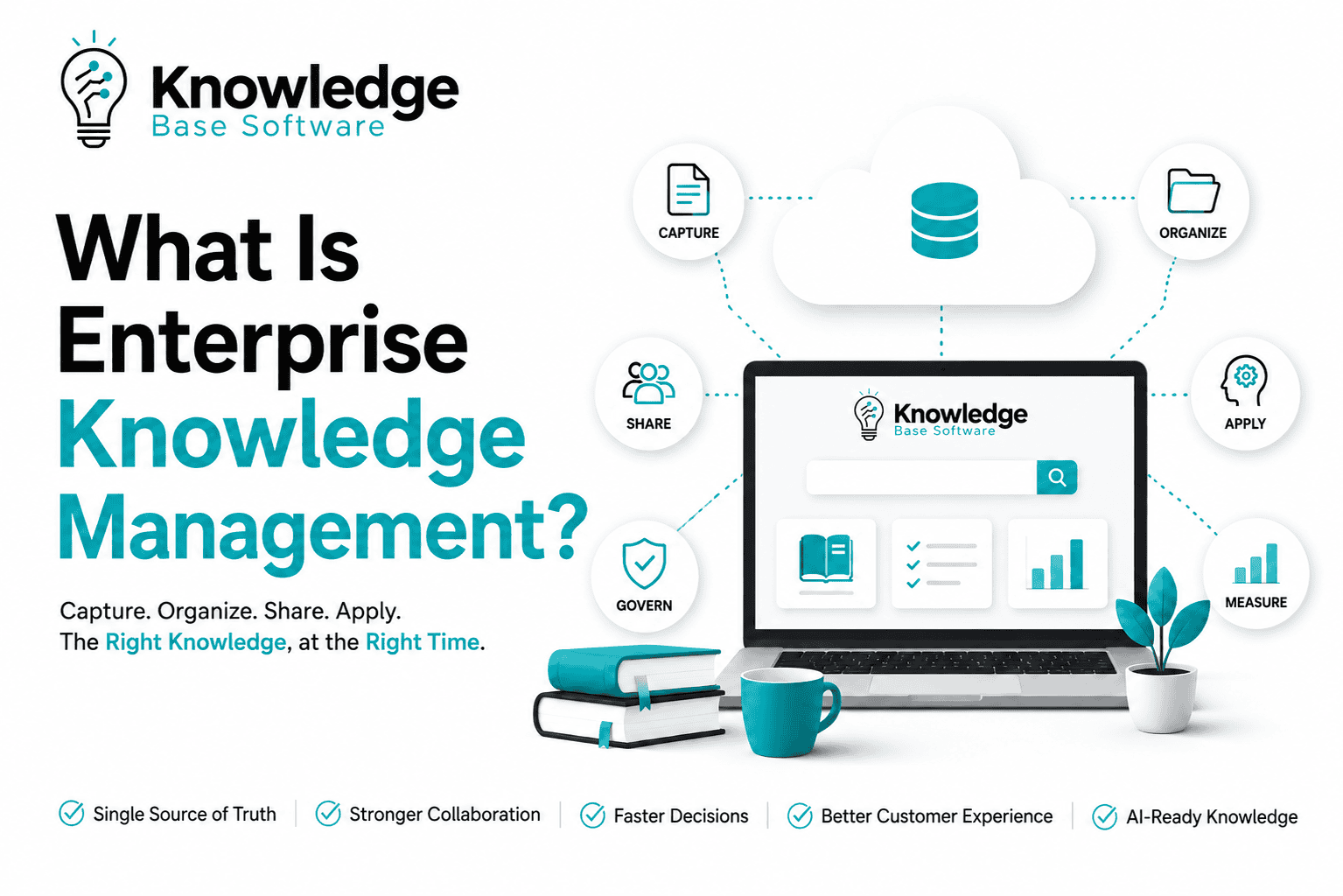
The goal is simple: help the right people find, trust, share, and apply the right knowledge at the right time.
Enterprise Knowledge Management Definition
Enterprise Knowledge Management is the structured process of capturing, organizing, sharing, applying, and maintaining organizational knowledge at enterprise scale. It helps companies turn scattered information, employee expertise, documented processes, and institutional knowledge into accessible, governed, searchable, and reusable knowledge assets that support better decisions, faster work, stronger compliance, and improved customer experiences.
In plain English, enterprise knowledge management, or EKM, helps an organization make its knowledge usable. It connects people, processes, content, and technology so employees do not have to waste time searching for answers, duplicating work, or relying only on informal conversations.
IBM defines knowledge management as the process of identifying, organizing, storing, and disseminating information within an organization, which aligns closely with the broader enterprise-scale approach of EKM.
Why Enterprise Knowledge Management Matters
Enterprise knowledge management matters because knowledge loses value when it is hard to find, outdated, duplicated, locked in silos, or dependent on a few subject matter experts.
A strong EKM program helps organizations:
- Access accurate information faster: Employees can find approved answers, policies, procedures, product details, and customer insights without searching across multiple systems.
- Reduce knowledge silos: Teams can share knowledge across departments, regions, and business units.
- Improve decision-making: Leaders and frontline employees can base decisions on trusted institutional knowledge rather than incomplete information.
- Accelerate onboarding and training: New hires can learn processes, tools, and best practices without relying entirely on managers or peers.
- Improve customer support: Agents can resolve issues faster using accurate knowledge base articles, troubleshooting guides, and product documentation.
- Reduce operational duplication: Teams can reuse existing knowledge assets instead of recreating the same documents, answers, or workflows.
- Retain institutional knowledge: Critical expertise is preserved when experienced employees leave, change roles, or retire.
- Strengthen compliance and risk control: Regulated information can be governed, reviewed, and access-controlled.
- Prepare for AI: Generative AI tools, enterprise search, and AI knowledge bases perform better when they are grounded in accurate, well-governed, up-to-date content.
Google’s guidance on helpful content also reinforces the need to create people-first content that is useful, reliable, and designed to help users rather than simply manipulate search rankings. That same principle applies inside the enterprise: knowledge must serve real users and real workflows.
Enterprise Knowledge Management vs Related Concepts
Enterprise knowledge management overlaps with several business and technology categories, but it is broader than any single tool.
| Concept | What it means | How it differs from EKM |
|---|---|---|
| Enterprise Knowledge Management | A company-wide strategy for capturing, organizing, sharing, applying, and maintaining knowledge | Covers people, process, content, technology, governance, culture, and measurement |
| Knowledge Management | The general discipline of managing organizational knowledge | EKM applies KM at enterprise scale across departments, regions, systems, and use cases |
| Knowledge Base | A structured repository of articles, FAQs, guides, and documentation | A knowledge base is often one component of an EKM program |
| Enterprise Search | Technology that helps users search across enterprise systems | Search helps users discover knowledge, but it does not replace governance, ownership, or content quality |
| Document Management | Systems for storing, versioning, and controlling documents | Focuses mainly on documents, while EKM includes tacit knowledge, workflows, collaboration, and application |
| Enterprise Content Management | Management of business content across its lifecycle | Often content-centric; EKM focuses on usable knowledge and business outcomes |
| Data Management | The governance and use of structured and unstructured data | Data becomes knowledge when it is interpreted, contextualized, and applied to decisions |
A practical way to think about it: a document management system stores documents, enterprise search finds information, a knowledge base organizes answers, and enterprise knowledge management connects all of them into a governed, measurable business capability.
Types of Knowledge Managed in an Enterprise
Enterprise knowledge is not limited to formal documentation. A mature EKM strategy manages several types of knowledge.
| Type of knowledge | Description | Example |
|---|---|---|
| Explicit knowledge | Documented knowledge that can be written, stored, and shared | SOPs, manuals, policies, product documentation, training guides |
| Tacit knowledge | Experience-based knowledge that is difficult to document | Expert judgment, troubleshooting intuition, sales negotiation experience |
| Implicit knowledge | Knowledge embedded in habits, workflows, or repeated practices | How a team handles escalations or prioritizes urgent requests |
| Institutional knowledge | Historical and organizational context built over time | Why a process exists, lessons from past projects, legacy system decisions |
| Customer knowledge | Insights about customers, needs, behaviors, and recurring issues | Support trends, account notes, customer objections, feedback themes |
| Process knowledge | Knowledge about how work gets done | Approval workflows, incident response steps, procurement processes |
| Product knowledge | Information about products, services, features, limitations, and roadmaps | Release notes, configuration guides, competitive positioning |
| Compliance knowledge | Rules, controls, policies, and regulatory requirements | Data retention policies, audit procedures, industry-specific requirements |
The biggest EKM mistake is managing only explicit knowledge. The most valuable knowledge is often tacit or institutional, held by employees who know how things really work.
Core Components of Enterprise Knowledge Management
A successful enterprise knowledge management program combines seven core components.
| Component | What it means | Why it matters |
|---|---|---|
| People | Employees, leaders, subject matter experts, content owners, and knowledge users | Knowledge management succeeds only when people contribute, trust, and use knowledge |
| Processes | Workflows for knowledge capture, review, publishing, maintenance, and retirement | Prevents knowledge from becoming outdated, duplicated, or unmanaged |
| Content | Articles, documents, policies, guides, playbooks, FAQs, videos, and knowledge assets | Content is the substance users rely on to answer questions and complete work |
| Technology | Knowledge management systems, enterprise search, AI knowledge bases, collaboration tools, and integrations | Makes knowledge discoverable, accessible, and usable in daily workflows |
| Culture | The organization’s attitude toward sharing knowledge | Encourages employees to contribute instead of hoarding information |
| Governance | Ownership, permissions, access control, quality standards, review cycles, and compliance rules | Ensures knowledge is accurate, secure, and trustworthy |
| Measurement | Adoption metrics, content performance, search success, ROI, and business impact | Shows whether the program improves outcomes, not just activity |
Technology matters, but EKM is not just a software implementation. The best knowledge management system will fail without ownership, governance, and adoption.
How Enterprise Knowledge Management Works
Enterprise knowledge management works through a repeatable lifecycle that turns scattered knowledge into usable, trusted assets.
| Lifecycle stage | What happens | Practical output |
|---|---|---|
| 1. Knowledge discovery and audit | Identify what knowledge exists, where it lives, who owns it, and what users need | Knowledge inventory, source map, gap analysis |
| 2. Knowledge capture | Collect knowledge from documents, experts, tickets, meetings, processes, and workflows | Draft articles, expert interviews, reusable playbooks |
| 3. Knowledge organization | Apply taxonomy, metadata, tagging, ownership, and content structure | Searchable categories, standardized article templates |
| 4. Knowledge storage and access control | Store knowledge in approved systems with permissions and role-based access | Secure knowledge repository or AI knowledge base |
| 5. Knowledge sharing and discovery | Make knowledge easy to find through search, recommendations, and workflow integrations | Enterprise search, portals, embedded answers |
| 6. Knowledge application | Bring knowledge into daily work, decisions, support, sales, onboarding, and operations | Faster resolutions, better decisions, consistent processes |
| 7. Knowledge maintenance | Review, update, archive, or retire content based on freshness and relevance | Content lifecycle workflows and review schedules |
| 8. Continuous improvement | Use analytics, feedback, and performance data to improve knowledge quality | Better search success, higher adoption, improved ROI |
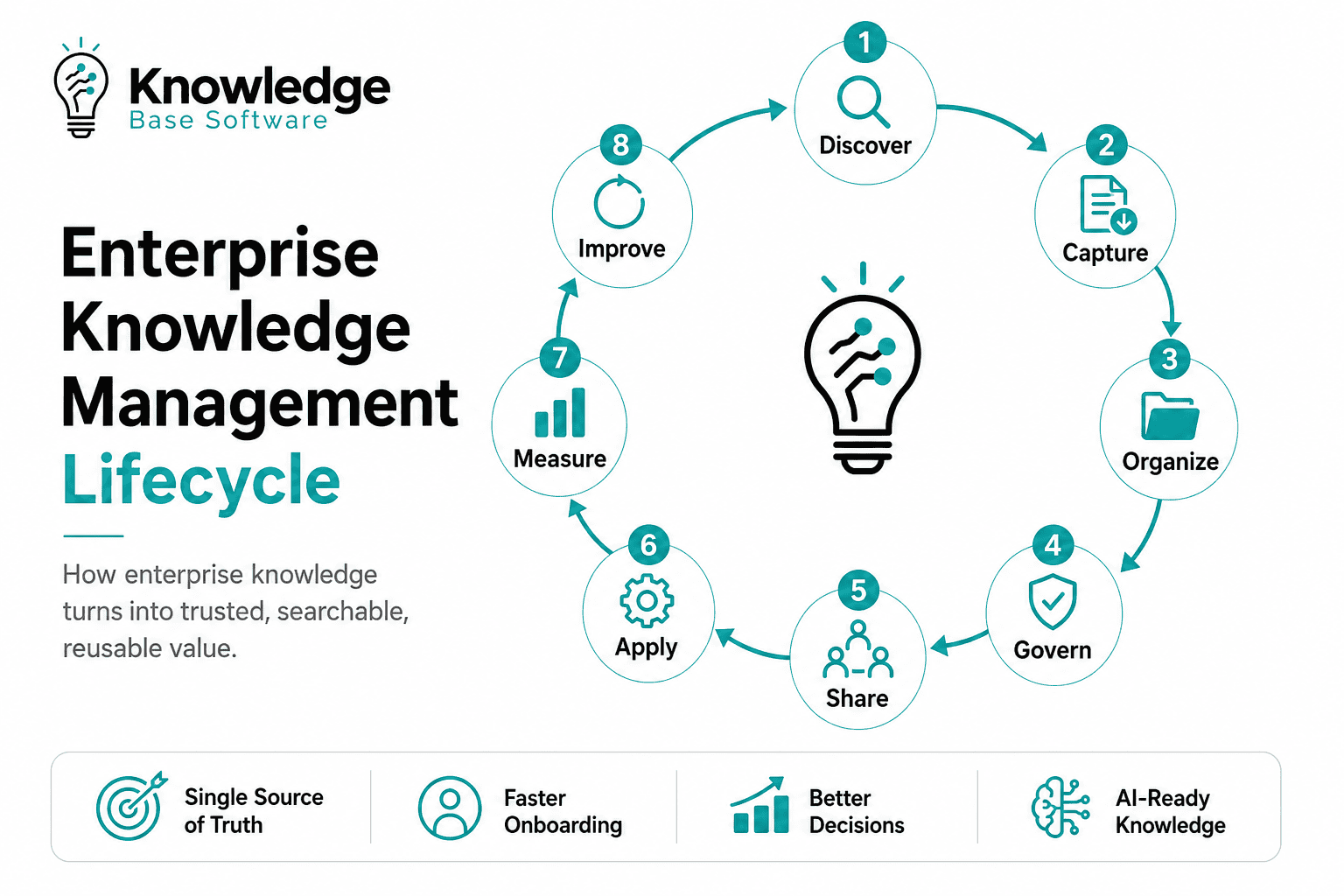
The lifecycle should be continuous. Knowledge is not “done” when it is published. It must be reviewed, improved, retired, and measured.
Enterprise Knowledge Management Use Cases
Enterprise knowledge management supports many business functions.
Customer support and self-service: Support teams use EKM to give agents accurate troubleshooting guides, escalation steps, and product answers. Customers can also resolve common issues through self-service knowledge base content.
HR, onboarding, and employee enablement: HR teams centralize policies, benefits information, onboarding paths, role-based training, and employee FAQs.
IT service management: IT teams document incident response procedures, service catalogs, configuration guides, known errors, and troubleshooting playbooks.
Sales enablement: Sales teams use EKM to access battlecards, pricing rules, proposal templates, product positioning, customer objections, and approved messaging.
Product and engineering teams: Product teams organize release notes, technical documentation, roadmap context, architecture decisions, and lessons from previous releases.
Legal, risk, and compliance: Legal and compliance teams manage approved policies, regulatory guidance, audit evidence, contract playbooks, and risk controls.
Learning and development: L&D teams connect formal training with in-the-moment knowledge, job aids, expert guidance, and performance support.
Mergers and acquisitions: During integration, EKM helps combine processes, policies, systems, team knowledge, and documentation from multiple organizations.
Global distributed teams: Multinational teams use EKM to standardize knowledge across regions while supporting localization, multilingual content, and regional compliance.
Benefits of Enterprise Knowledge Management
The benefits of enterprise knowledge management are strongest when tied to business outcomes.
- Reduced time spent searching for information: Employees spend less time hunting across email, chat, folders, and disconnected systems.
- Faster time to productivity for new hires: New employees can find role-specific guidance without depending on informal tribal knowledge.
- Higher first-contact resolution: Support agents can answer more customer questions without escalation.
- Fewer repeated questions: Teams can document repeat answers once and reuse them across channels.
- Better process consistency: Standardized knowledge reduces variation in how work is performed.
- Faster decision cycles: Leaders can access historical context, expert insight, and approved data faster.
- Reduced dependency on individual experts: Critical knowledge is not trapped with a few employees.
- Better AI answer quality: AI assistants and RAG systems can produce more reliable responses when grounded in governed, current content.
- Improved cross-functional collaboration: Teams can learn from each other instead of recreating work in isolation.
Common Challenges and Mistakes
| Challenge | Why it happens | How to fix it |
|---|---|---|
| Treating EKM as a document dump | Teams upload content without structure or ownership | Define taxonomy, templates, review workflows, and content standards |
| No content ownership | Nobody is accountable for accuracy or updates | Assign content owners and review dates for every knowledge asset |
| Poor taxonomy and tagging | Categories are created inconsistently | Build a controlled taxonomy and metadata model |
| Outdated or duplicate content | Content is published but not maintained | Use review cycles, freshness scores, and archive rules |
| Weak search experience | Users cannot find the right answers | Improve titles, metadata, synonyms, semantic search, and relevance tuning |
| Low adoption | EKM is separate from daily workflows | Embed knowledge into tools employees already use |
| Lack of executive sponsorship | Knowledge work is treated as optional | Tie EKM to business goals such as support efficiency, onboarding, and compliance |
| Poor permissions and governance | Sensitive knowledge is exposed or over-restricted | Use role-based access control and permission-aware search |
| Ignoring tacit knowledge | Organizations document only formal processes | Capture expert interviews, lessons learned, communities of practice, and decision logs |
| Using AI without trusted knowledge foundations | AI retrieves stale or unapproved information | Improve content quality, governance, and retrieval before scaling AI |
| Measuring activity instead of outcomes | Teams track page views but not business impact | Measure search success, time to answer, deflection, resolution quality, and adoption |
The Role of AI in Enterprise Knowledge Management
AI is changing enterprise knowledge management from static repositories into intelligent knowledge experiences. However, AI is not a replacement for governance, ownership, or accurate content.
Key AI capabilities include:
Semantic search: Instead of matching only keywords, semantic search understands user intent and related concepts. This helps employees find answers even when they do not know the exact terminology.
Generative AI assistants: AI assistants can summarize documents, answer questions, draft knowledge articles, and guide employees through complex processes.
Retrieval-augmented generation: RAG combines information retrieval with generative AI so responses can be grounded in enterprise content instead of relying only on a model’s general training. Microsoft’s Azure AI Search documentation describes RAG patterns that retrieve grounding data from enterprise content before generating responses.
Knowledge graphs: A knowledge graph connects people, content, systems, processes, and concepts. This helps AI understand relationships, not just isolated documents.
AI-powered content recommendations: Systems can recommend related articles, experts, or next-best actions based on context.
Automated summarization: AI can summarize long documents, meeting notes, tickets, and policies into usable knowledge.
Content gap detection: AI can identify repeated unanswered questions, missing documentation, outdated pages, and weak search results.
Human-in-the-loop validation: AI-generated or AI-summarized knowledge should be reviewed by subject matter experts before becoming authoritative. McKinsey’s 2025 State of AI research highlights that high-performing AI organizations are more likely to define when model outputs need human validation.
Permission-aware AI: AI systems must respect access control. Microsoft documentation notes that document-level access control is important for secure enterprise search, RAG applications, and agentic systems.
The risks are real: hallucinations, stale content, access-control leaks, over-automation, and misplaced trust. AI works best when the enterprise has clean content, strong governance, clear permissions, and accountable owners.
How to Build an Enterprise Knowledge Management Strategy
Use this roadmap to build a practical EKM strategy.
- Define business goals: Decide whether the priority is support efficiency, onboarding, compliance, sales enablement, AI readiness, or operational consistency.
- Identify target users and use cases: Start with high-value teams and recurring knowledge problems.
- Run a knowledge audit: Find existing documents, systems, experts, gaps, duplicates, and outdated content.
- Map knowledge sources: Include wikis, intranets, ticketing systems, CRM, LMS, document repositories, chat, email, and expert communities.
- Define governance and ownership: Assign owners, approvers, review schedules, and quality standards.
- Build taxonomy and metadata standards: Create consistent categories, tags, content types, and relationships.
- Choose the right technology stack: Select tools that support search, permissions, lifecycle management, integrations, and analytics.
- Integrate EKM into daily workflows: Make knowledge available inside support desks, CRM, HR systems, collaboration tools, and AI assistants.
- Launch with pilot teams: Test with a focused use case before scaling across the enterprise.
- Train users and drive adoption: Teach people how to search, contribute, review, and trust the system.
- Measure outcomes: Track business impact, not just content volume.
- Iterate continuously: Improve taxonomy, content, search, governance, and adoption based on data.
30-60-90 Day Implementation Plan
| Timeline | Focus | Key actions | Deliverables |
|---|---|---|---|
| First 30 days | Discovery and alignment | Define goals, identify users, audit knowledge sources, interview stakeholders | Business case, knowledge audit, priority use cases |
| Days 31–60 | Structure and pilot | Build taxonomy, assign owners, select pilot content, configure workflows, test search | Pilot knowledge base, governance model, metadata standards |
| Days 61–90 | Launch and improve | Train users, launch pilot, collect feedback, measure usage, improve content and search | Adoption report, improvement backlog, scale plan |
How to Choose Enterprise Knowledge Management Software
The right enterprise knowledge management software should support both current needs and future AI-enabled workflows.
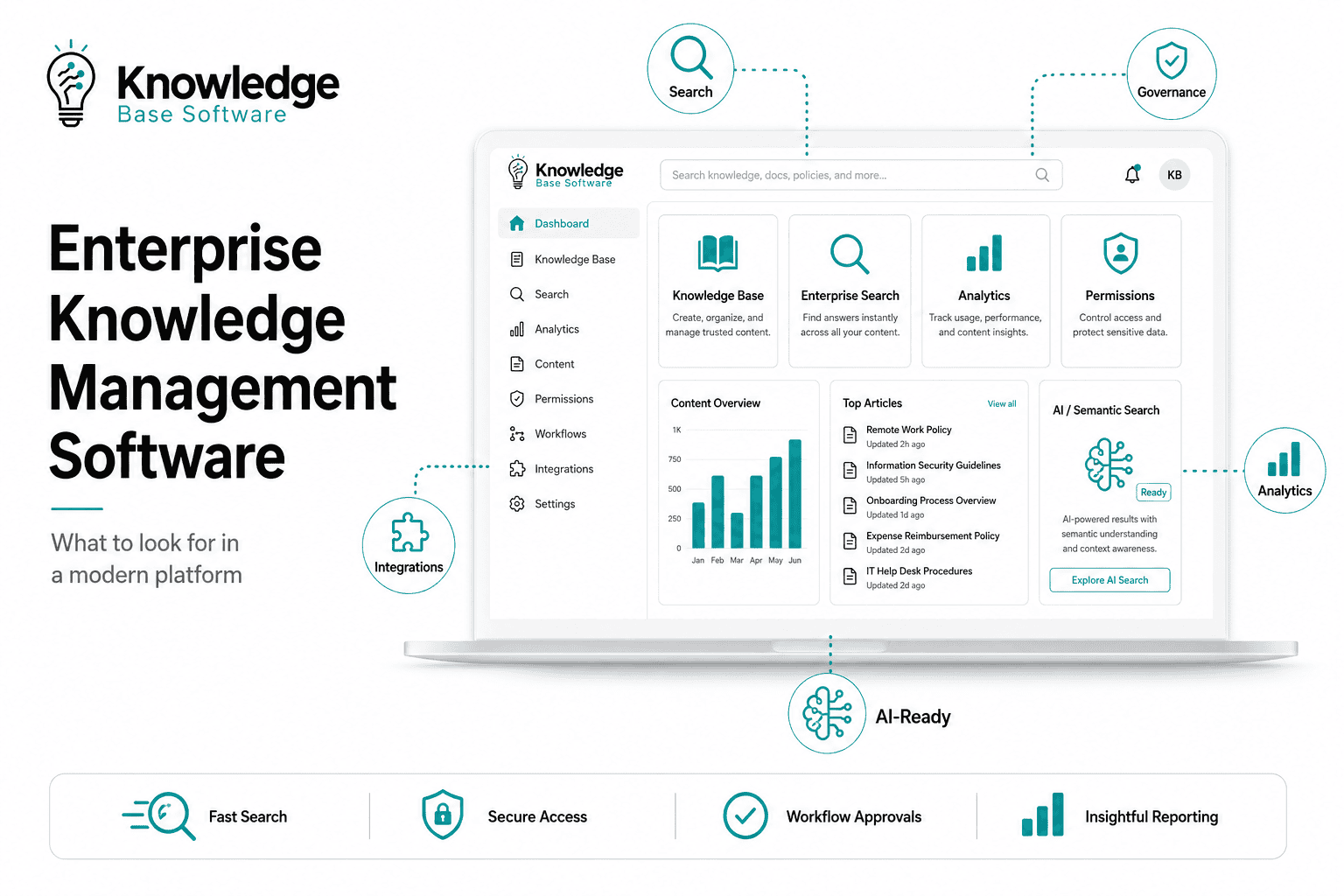
| Evaluation area | What to look for |
|---|---|
| Enterprise search quality | Strong relevance, filters, synonyms, semantic search, and federated search |
| AI capabilities | Generative AI, RAG support, summarization, content recommendations, and AI answer controls |
| Integrations | Connections with CRM, ITSM, HRIS, LMS, collaboration tools, document repositories, and support platforms |
| Permissions and access control | Role-based access, document-level permissions, SSO, and audit logs |
| Content lifecycle management | Review dates, approvals, expiration rules, ownership, archiving, and versioning |
| Version control | Clear history of edits, approvals, and updates |
| Workflow and approvals | Support for drafting, reviewing, publishing, and retiring knowledge |
| Analytics and reporting | Search success, failed searches, article usefulness, adoption, contribution, and ROI metrics |
| Multilingual support | Translation workflows, localization, and language-specific search |
| Scalability | Ability to support multiple departments, regions, and content types |
| Security and compliance | Encryption, access logs, compliance certifications, and data governance features |
| API and extensibility | Ability to connect with enterprise systems and custom applications |
| User experience | Simple authoring, fast search, mobile access, and clean navigation |
| Total cost of ownership | Licensing, implementation, migration, administration, and training costs |
| Vendor support | Onboarding, customer success, documentation, roadmap transparency, and enterprise support |
Buyer Checklist
Before choosing a platform, ask:
- Can users find answers without knowing exact keywords?
- Does search respect permissions?
- Can the system connect to existing enterprise tools?
- Does it support content ownership and review cycles?
- Can subject matter experts contribute easily?
- Does it provide analytics for search failures and content gaps?
- Can it support AI use cases safely?
- Is the platform easy enough for non-technical users?
- Can it scale across departments, countries, and languages?
- Does the vendor support security and compliance requirements?
Enterprise Knowledge Management Metrics and ROI
A mature EKM program measures whether knowledge improves business outcomes. APQC notes that KM metrics should help organizations understand whether knowledge sharing and usage are moving business goals, not simply counting clicks.
| Metric | What it measures | Why it matters |
|---|---|---|
| Search success rate | Percentage of searches that lead to useful results | Shows whether users can find answers |
| Time to answer | How long it takes to find usable information | Measures productivity and speed |
| Content reuse | How often knowledge assets are used across teams | Shows whether content is valuable |
| Content freshness | Whether articles are reviewed and current | Reduces stale or risky information |
| Article helpfulness score | User feedback on article usefulness | Identifies content quality issues |
| Self-service deflection | Issues resolved without human support | Shows customer and employee self-service impact |
| First-contact resolution | Issues resolved in the first interaction | Measures support effectiveness |
| Average handle time | Time required to resolve support interactions | Connects knowledge to operational efficiency |
| Onboarding time | Time for new hires to become productive | Shows HR and enablement value |
| Duplicate questions reduced | Decline in repeated questions to experts or support teams | Indicates better knowledge availability |
| Employee adoption | Active users, searches, contributions, and repeat usage | Shows whether the system is being used |
| Knowledge contribution rate | How often employees create or improve knowledge | Measures participation and culture |
| Compliance review completion | Percentage of regulated content reviewed on time | Supports audit readiness |
| AI answer accuracy | Quality and correctness of AI-generated answers | Critical for AI knowledge base trust |
| Cost per resolved issue | Cost of support or service resolution | Helps estimate financial impact |
ROI can be measured by comparing the cost of EKM against saved employee time, reduced support costs, faster onboarding, fewer escalations, lower compliance risk, and improved productivity.
Best Practices for Enterprise Knowledge Management
- Start with high-value use cases: Choose a pain point that matters, such as support resolution, onboarding, or compliance.
- Design for search and findability: Use clear titles, consistent metadata, helpful tags, and user-friendly language.
- Assign content owners: Every critical asset should have an accountable owner.
- Keep knowledge close to workflows: Put answers where employees work, not in a separate system they rarely visit.
- Capture tacit knowledge from experts: Use interviews, after-action reviews, decision logs, and communities of practice.
- Use governance without slowing contribution: Make it easy to contribute while protecting quality and compliance.
- Review and retire stale content: Outdated knowledge is worse than missing knowledge because it creates false confidence.
- Use AI carefully with human validation: Let AI assist, but keep humans accountable for authoritative knowledge.
- Make contribution easy: Templates, prompts, and lightweight workflows increase participation.
- Measure business outcomes: Track search success, resolution quality, onboarding speed, and content impact.
- Promote a knowledge-sharing culture: Recognize employees who contribute useful knowledge.
Enterprise Knowledge Management Examples
1. Customer Support Organization
Problem: Support agents ask the same product questions repeatedly and escalate issues because answers are scattered across Slack, old tickets, and outdated documents.
EKM solution: The company builds a governed knowledge base connected to support workflows, assigns product owners to review articles, and uses semantic search to surface troubleshooting steps.
Measurable outcome: The team tracks fewer duplicate questions, faster time to answer, improved first-contact resolution, and better article helpfulness scores.
2. Global HR Team
Problem: Employees in different regions receive inconsistent answers about benefits, onboarding, leave policies, and internal processes.
EKM solution: HR creates a centralized employee knowledge hub with localized policy content, approval workflows, review dates, and access permissions.
Measurable outcome: HR measures reduced repeated inquiries, faster onboarding completion, improved employee self-service, and higher policy content freshness.
3. Enterprise Sales Team
Problem: Sales representatives use inconsistent messaging and spend too much time searching for competitive information, pricing rules, and proposal examples.
EKM solution: Sales enablement creates a searchable knowledge repository with battlecards, product positioning, proposal templates, customer stories, and approved messaging.
Measurable outcome: Sales leaders track content reuse, reduced time spent searching, improved onboarding for new reps, and better consistency in customer-facing materials.
Future of Enterprise Knowledge Management
The future of enterprise knowledge management is AI-ready, workflow-connected, and trust-centered.
Key trends include:
- AI-ready knowledge: Content will be structured for retrieval, summarization, and AI-assisted decision-making.
- Knowledge graphs: Organizations will connect concepts, people, systems, and processes to improve discovery and reasoning.
- Personalized knowledge delivery: Employees will receive relevant knowledge based on role, context, location, permissions, and tasks.
- Multimodal knowledge: Text, images, video, audio, diagrams, and meeting recordings will become searchable knowledge assets.
- Agentic AI and enterprise assistants: AI agents will retrieve, summarize, recommend, and act on enterprise knowledge with human oversight.
- Stronger governance and trust layers: Accuracy, permissions, freshness, and auditability will become essential.
- Integration with business workflows: Knowledge will appear directly inside CRM, ITSM, HR, support, collaboration, and analytics tools.
- Knowledge as a strategic enterprise asset: Organizations will treat knowledge quality as a competitive advantage, not an administrative task.
Frequently Asked Questions
What is enterprise knowledge management?
Enterprise knowledge management is the process of capturing, organizing, sharing, applying, and maintaining knowledge across an organization. It helps employees access trusted information, reuse expertise, reduce silos, and make better decisions at enterprise scale.
Why is enterprise knowledge management important?
It is important because scattered knowledge slows work, increases duplication, weakens customer support, creates compliance risk, and makes organizations dependent on individual experts. EKM improves access, consistency, onboarding, collaboration, and AI readiness.
What is the difference between enterprise knowledge management and a knowledge base?
A knowledge base is usually a repository of articles, FAQs, and documentation. Enterprise knowledge management is broader. It includes strategy, governance, people, processes, technology, culture, measurement, and multiple knowledge sources.
What are the main components of enterprise knowledge management?
The main components are people, processes, content, technology, culture, governance, and measurement. All seven are required to make knowledge accurate, accessible, trusted, and useful.
How does AI improve enterprise knowledge management?
AI can improve enterprise knowledge management through semantic search, generative AI assistants, RAG, knowledge graphs, summarization, recommendations, content gap detection, and automated knowledge discovery. However, AI still needs governed, accurate, permission-aware content.
What are the biggest EKM challenges?
Common challenges include poor content ownership, weak search, outdated content, duplicate information, low adoption, knowledge silos, poor permissions, lack of executive support, and using AI before fixing knowledge quality.
How do you implement enterprise knowledge management?
Start by defining business goals, identifying high-value use cases, auditing knowledge sources, assigning ownership, creating taxonomy and metadata standards, choosing technology, launching a pilot, training users, measuring outcomes, and improving continuously.
How do you measure EKM success?
Measure EKM success with metrics such as search success rate, time to answer, content freshness, article helpfulness, self-service deflection, first-contact resolution, onboarding time, employee adoption, contribution rate, and AI answer accuracy.
What features should enterprise knowledge management software include?
Important features include enterprise search, AI and semantic search, integrations, role-based access control, content lifecycle workflows, version control, analytics, multilingual support, scalability, security, APIs, and a simple user experience.
Is enterprise knowledge management only for large companies?
No. While EKM is designed for enterprise scale, growing companies also benefit from capturing expertise, reducing repeated questions, improving onboarding, and building a trusted source of knowledge before complexity becomes unmanageable.
Conclusion
Enterprise Knowledge Management is not just a software category or a documentation initiative. It is a strategic capability that helps organizations turn scattered information and employee expertise into trusted, searchable, reusable, and actionable knowledge.
Successful EKM combines people, processes, content, technology, governance, culture, and measurement. It helps teams work faster, make better decisions, support customers more effectively, preserve institutional knowledge, and prepare for AI-powered workflows.
For organizations beginning the journey, the best next step is to assess current knowledge gaps, identify where employees lose time searching for information, and evaluate whether existing knowledge systems are ready for the demands of modern work and enterprise AI.