Independent knowledge base software guide Evidence-led Updated 2026

Freshdesk Knowledge Base Review: Features, Plans, Limits, and Alternatives
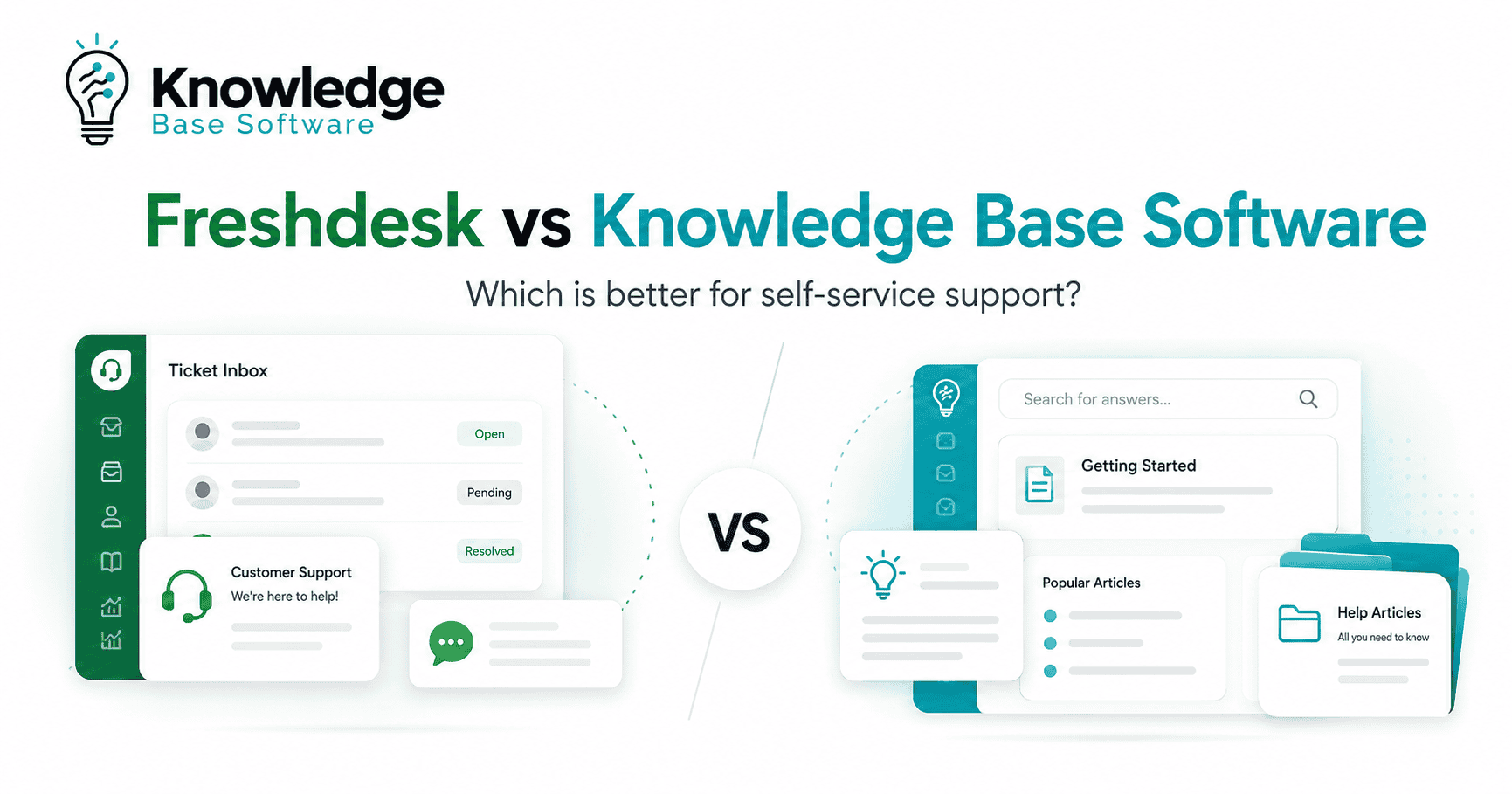
Freshdesk is customer-support software with a built-in knowledge base—not a standalone documentation platform and not the same product as Freshservice. Its strongest use case is keeping customer tickets, agents, suggested solutions, and a customer help center in one system. The main buying constraint is plan gating: multilingual content, versioning, templates, analytics, and multi-product management start on Pro, while approval workflows and the flexible six-level hierarchy require Enterprise.
Quick verdict: Shortlist Freshdesk when your primary goal is customer self-service tied directly to an email-first support operation. Compare dedicated knowledge base software when documentation is a separate product function, requires more granular editorial governance, or must serve several audiences independently of the help desk.
Last verified: July 27, 2026. Pricing, plan entitlements, and AI packaging were checked against current Freshworks pricing and support documentation. Prices exclude taxes and optional add-ons.
Testing disclosure: This is an independent, documentation-based evaluation. We did not use an authenticated Freshdesk production account for this update, so we do not label the product “tested” and make no claims about real-world search quality, migration fidelity, uptime, or support response times.
Freshdesk knowledge base at a glance
| Primary audience | External customers and customer-support agents |
|---|---|
| Product category | Customer-support help desk with an embedded knowledge base (“Solutions”) |
| Core content structure | Category → folder → article; Enterprise adds a flexible hierarchy of up to six levels |
| Paid entry price | $19 per agent/month, billed annually, for Growth |
| Knowledge base on entry plan | Yes; the customer portal and knowledge base are included with Growth |
| Multilingual publishing | Pro and Enterprise |
| Versioning and KB analytics | Pro and Enterprise |
| Approval workflow | Enterprise |
| Free option | A six-month Freshdesk Free Program for up to two agents; it is not a permanent unlimited free plan and does not apply to Freshdesk Omni |
| Best fit | Support teams that want customer help content and ticket workflows in the same product |
What is the Freshdesk knowledge base?
Freshdesk is an email-first customer-support platform. Its Knowledge Base, also called Solutions in the interface, lets a support team publish self-service articles in a customer portal and use those articles while resolving tickets. Freshworks documents three basic content objects: categories, folders, and articles. Articles can include how-to guidance, troubleshooting, FAQs, user guides, and other support content.
This positioning matters. Freshdesk should be evaluated as a help desk that includes knowledge management, not as a neutral publishing system purchased only for documentation. The practical value is the connection between support conversations and help content: agents can turn recurring answers into articles, suggest solutions in ticket workflows, and direct customers to the same portal used for support.
If your project is broader than customer support, start with the knowledge base software selection guide. If the audience is specifically customers who need to solve issues without opening a ticket, see the customer self-service knowledge base guide.
Freshdesk is not Freshservice
| Question | Freshdesk | Freshservice |
|---|---|---|
| Primary job | Customer service and external customer support | IT service management and employee service delivery |
| Typical users | Customer-support agents and customers | IT/service agents and employees or other internal requesters |
| Knowledge context | Customer help center connected to support tickets | Service knowledge connected to incidents, requests, employee portals, and ITSM workflows |
| Modules that define the product | Ticketing, shared inbox, customer portal, and support automation | Incident management, service catalog, problem/change processes, assets, and employee service |
Freshdesk knowledge base features by plan
The table below follows Freshworks’ current Freshdesk Knowledge Base feature matrix. A checkmark means Freshworks explicitly lists the feature for that plan; it does not represent an independent usability test.
| Knowledge base feature | Free Program | Growth | Pro | Enterprise |
|---|---|---|---|---|
| Knowledge base / Solutions | Yes | Yes | Yes | Yes |
| Email to knowledge base | Yes | Yes | Yes | Yes |
| Auto-suggest solutions | No | Yes | Yes | Yes |
| Multilingual knowledge base | No | No | Yes | Yes |
| Advanced article bulk actions | No | No | Yes | Yes |
| Multi-product content management | No | No | Yes | Yes |
| Article templates | No | No | Yes | Yes |
| Article versioning | No | No | Yes | Yes |
| Automatic sitemap generation | No | No | Yes | Yes |
| Knowledge base analytics | No | No | Yes | Yes |
| Flexible multi-level hierarchy | No | No | No | Yes |
| Approval workflow | No | No | No | Yes |
What the plan gates mean in practice
- Growth is a publishing-and-support starting point. It includes the portal, knowledge base, and solution auto-suggestions, but it does not include the documented multilingual workspace, versioning, KB analytics, templates, or sitemap generation.
- Pro is the realistic baseline for a growing documentation operation. It adds multilingual management, versioning, analytics, templates, bulk actions, multi-product content management, and sitemap generation.
- Enterprise is the governance tier. It is the only current Freshdesk plan documented with the approval workflow and flexible multi-level hierarchy.
That distinction should drive the shortlist. A team can publish articles on Growth, but a buyer that requires controlled approvals should price Enterprise from the beginning instead of assuming governance can be added later. For a wider editorial framework, use the knowledge base governance guide.
Portal, search, multilingual publishing, and SEO
Portal and branding
Freshdesk includes a default customer portal. Freshworks documents custom portal domains from Growth upward, with Freshworks-generated SSL, while advanced portal layout and CSS customization start on Pro. Pro also supports up to five products and Enterprise supports unlimited products; each product can have a separate branded portal and knowledge base while agents work from one help desk. Confirm the exact portal and product limits in the account you are buying, especially if Freshdesk Omni is also under consideration.
Official sources: custom portal URL, advanced portal customization, and multiple branded support portals.
Search and suggested solutions
Customers can browse and search the portal, while agents can search solution titles, descriptions, tags, and attachment names. Growth and above can auto-suggest relevant articles while a customer creates a ticket. These documented features establish availability, not relevance quality. A buying test should measure whether the search understands the actual vocabulary, misspellings, product names, and error codes used by your customers.
Multilingual content is linked, not automatically translated
Freshdesk’s multilingual knowledge base starts on Pro. Editors create language versions and can mark translations outdated when the primary article changes. Freshworks’ current language settings page lists 47 supported languages, but this should not be presented as automatic translation: knowledge-base translations are authored and maintained as linked versions. Freddy Live Translate applies to ticket conversations, not to automatic publication of the article library.
Freshworks documents Arabic and Hebrew for the customer portal, but separately states that the embedded help widget does not support right-to-left languages such as Arabic and Hebrew. If RTL is required, test the full portal and widget as two distinct experiences. Sources: language management, multilingual KB setup, and multilingual widget limitations.
SEO and analytics
Freshworks documents article-level SEO title, description, and keyword fields across current Freshdesk plans. Automatic sitemap generation and the curated knowledge-base analytics suite start on Pro. Reader helpful/unhelpful voting is available more broadly than the Pro reporting suite. Freshworks says its automatic sitemap updates weekly, so teams with urgent publishing and indexation requirements should validate that cadence.
Official sources: article SEO fields, automatic sitemap, and knowledge-base reports.
Freshdesk pricing and total-cost checkpoints
Freshworks lists the following Freshdesk prices in US dollars when billed annually. Subscriptions are charged per agent. Taxes, AI overages, Copilot licenses, connector tasks, and occasional-agent day passes can increase the total.
| Plan | Published annual-billing rate | One agent/year | Ten agents/year | Knowledge-base buying signal |
|---|---|---|---|---|
| Growth | $19/agent/month | $228 | $2,280 | Basic customer self-service; no documented KB versioning or analytics |
| Pro | $55/agent/month | $660 | $6,600 | Multilingual content, versioning, analytics, templates, and multi-product management |
| Enterprise | $89/agent/month | $1,068 | $10,680 | Approval workflow and flexible hierarchy, plus enterprise help-desk controls |
Free Program versus free trial
Freshdesk currently offers two different evaluation routes, and they should not be described as the same thing:
- Fourteen-day trial: Freshworks says new accounts receive full feature access for 14 days and can compare paid plans.
- Freshdesk Free Program: Freshworks documents no-cost use for six months with a maximum of two agents. It applies to Freshdesk only, not Freshdesk Omni. After six months—or when more than two agents are needed—the account must move to a paid plan.
The Free Program includes the basic knowledge base, but the official KB matrix excludes auto-suggest, multilingual management, bulk actions, templates, versioning, approvals, sitemap generation, and KB analytics. Treat it as a limited evaluation or micro-team option, not evidence that Freshdesk offers an unrestricted permanent free knowledge base. See Freshworks’ Free Program documentation.
Freddy AI: included usage versus paid add-ons
Freshdesk’s AI packaging contains separate products and usage units. Avoid the vague claim that “AI is included” without explaining which capability and limit applies.
| AI item | Current documented treatment | Knowledge-base relevance |
|---|---|---|
| Freddy AI Agent sessions | Freshworks states that new Growth, Pro, and Enterprise customers receive 500 complimentary sessions once. Extra packs cost $49 per 100 sessions. | AI can answer or automate customer interactions using approved knowledge, but usage is session-based and can stop when sessions are exhausted. |
| Freddy AI Copilot | $29 per licensed agent/month on annual billing; offered as an add-on to Pro and Enterprise. | Includes agent assistance such as generating draft solution articles and suggesting relevant articles. |
| Solution Article Generator | Copilot add-on on Pro and Enterprise. | Creates an article draft from prompts. Freshworks explicitly instructs users to review and refine generated content before publishing. |
| Solution Article Suggester | Requires an active Copilot subscription and a Copilot license for the agent. | Freshworks recommends at least 25 published solution articles; the feature suggests relevant articles for newly created email or web tickets. |
Accuracy rule: AI-generated drafts and answers still require ownership, review, and source maintenance. The existence of grounding or suggested articles does not independently prove answer accuracy. Build a repeatable evaluation set using the AI answer quality testing guide.
Packaging caution: Freshdesk’s pricing page advertises the initial 500 AI Agent sessions on all three paid plans, while some detailed deployment documentation lists Pro and Enterprise prerequisites or describes AI Agent Studio differently for standalone Freshdesk and Freshdesk Omni. Confirm the exact agent type, eligible channels, session window, and Growth availability in your own account before including AI deflection in the business case.
When Freshdesk is a strong fit
- Your support team already works in Freshdesk and wants the help center close to ticket context.
- The main audience is customers seeking product or service support.
- Email ticketing, a shared inbox, and customer self-service are part of the same buying decision.
- You can select Pro when multilingual publishing, version history, analytics, templates, or multiple products are requirements.
- You can justify Enterprise when formal article approvals or deeper navigation are mandatory.
When to compare a dedicated knowledge base
- Documentation is the product. Technical documentation, developer portals, release notes, and docs-as-code workflows may require a more specialized authoring and publishing stack.
- You need governance below Enterprise pricing. Freshdesk’s documented approval workflow is Enterprise-only.
- You serve several independent audiences. Validate domains, brands, portals, permissions, localization, and analytics for every intended audience rather than assuming one customer portal will cover them.
- You want to decouple content from the help desk. A separate platform can preserve documentation ownership when the support system changes.
- Search quality is the deciding factor. Run your own query set; a feature list cannot establish relevance, typo handling, permissions-aware results, or zero-result recovery.
Useful comparisons include Document360 for a dedicated documentation route, Help Scout and Intercom for support-led alternatives, and the Zendesk comparison for another customer-service suite. These are comparison starting points, not universal recommendations.
A practical hybrid architecture
Freshdesk does not have to hold every type of knowledge. A common evaluation pattern is to keep short customer-resolution articles in Freshdesk while using a dedicated documentation platform for deep product guides, API references, or multi-audience documentation. If you test this model, define one canonical owner for every article and prevent duplicate pages from being indexed.
- Use Freshdesk for ticket-adjacent answers, customer troubleshooting, and support workflows.
- Use the dedicated system for long-form product documentation and specialized publishing.
- Link between systems with descriptive anchors and preserve consistent navigation.
- Choose which system feeds AI answers and document how permissions are enforced.
- Measure search exits, ticket creation after article views, helpfulness, and content freshness separately.
Export and migration considerations
Freshworks documents a full help-desk export on every plan. For knowledge content, Pro and Enterprise can export an article list and properties as CSV, but that ordinary CSV does not contain the complete article body; article content is included in the Solutions XML file within the full account export. Freshdesk also exposes solution categories, folders, and articles through its REST API.
This provides migration routes, but it does not prove that another platform will preserve every attachment, internal link, translation relationship, author, redirect, permission, and SEO field. Run a small round-trip export before contracting. Official sources: manage and export KB articles, full help-desk export, and Freshdesk Solutions API.
Freshdesk proof-of-concept checklist
Use the 14-day trial to test the workflows that affect the purchase. Do not spend the entire trial reproducing a polished demo.
- Import or recreate 25–50 representative articles, including tables, images, attachments, and long troubleshooting steps.
- Test 30 real customer searches: exact terms, synonyms, misspellings, error codes, and vague questions.
- Confirm folder visibility for public, authenticated, customer-segment, and agent-only content where applicable.
- On Pro, test version recovery, templates, multilingual status tracking, sitemap output, and KB analytics.
- On Enterprise, test the approval workflow and the deepest information architecture you expect to use.
- Test ticket-to-article and article-to-ticket workflows with normal agents—not only administrators.
- Validate mobile rendering, accessibility, canonical tags, redirects, custom-domain behavior, and indexability.
- Export representative data and confirm what is preserved: body HTML, authors, dates, attachments, tags, redirects, translations, and permissions.
- Calculate the full annual cost using paid agents, occasional-agent passes, Copilot seats, AI Agent sessions, connectors, taxes, and implementation work.
For a structured migration test, use the knowledge base migration guide. For cost modeling beyond license price, see the knowledge base pricing and TCO guide.
Methodology and limitations
We reviewed the live Freshdesk pricing page and current Freshdesk support documentation for the knowledge base, subscriptions, Free Program, and Freddy AI. We used official Freshworks sources for factual product, plan, price, and availability statements. We then assessed fit by comparing those documented capabilities with common customer-support and knowledge-governance requirements.
We did not conduct an authenticated hands-on test for this revision. Accordingly, this page does not score editor usability, search relevance, import accuracy, portal performance, vendor support, or AI answer accuracy. Features can also differ for older accounts and Freshdesk Omni editions; Freshworks notes that accounts created before December 2025 may have a different Omni experience. Verify the exact edition and entitlements inside Plans & Billing before contracting.
Freshdesk knowledge base FAQ
Does Freshdesk include a knowledge base?
Yes. Freshworks lists the customer portal and knowledge base on the Growth plan, and its feature documentation also lists the basic Knowledge Base/Solutions capability for the limited Free Program. Advanced KB features are plan-gated.
Is the Freshdesk knowledge base free?
Freshdesk has a Free Program for six months and up to two agents. It applies to Freshdesk only, not Freshdesk Omni. It is different from the 14-day trial and should not be described as a permanent unrestricted free tier.
Which Freshdesk plan supports a multilingual knowledge base?
Freshworks’ current Knowledge Base matrix lists multilingual management on Pro and Enterprise, not on the Free Program or Growth.
Which Freshdesk plan includes article approvals?
The current official matrix lists the knowledge base approval workflow only on Enterprise.
Are Freshdesk and Freshservice the same?
No. Freshdesk is designed for customer service. Freshservice is designed primarily for IT service management and employee service delivery. They have different plans, knowledge workflows, AI packaging, and buying contexts.
Is Freddy AI included with Freshdesk?
Only some usage and capabilities are included. Freshworks documents 500 one-time complimentary AI Agent sessions for new Growth, Pro, and Enterprise customers; additional sessions cost extra. Freddy AI Copilot is a separate per-agent add-on on Pro and Enterprise.
Final verdict
Freshdesk’s knowledge base is a credible choice when customer support is the center of the project and the team values tight proximity to ticketing. Growth covers basic self-service, Pro is the more realistic tier for multilingual content and operational analytics, and Enterprise is required for the documented approval workflow and flexible hierarchy.
It is less convincing as a default choice when documentation must operate independently of the help desk, when governance is required below Enterprise, or when specialist publishing and developer-documentation workflows dominate. In those cases, compare dedicated platforms and validate a hybrid setup before committing.