Independent knowledge base software guide Evidence-led Updated 2026

Preventing Knowledge Base Content Poisoning: Protecting AI Answers from Bad Sources
Executive Summary
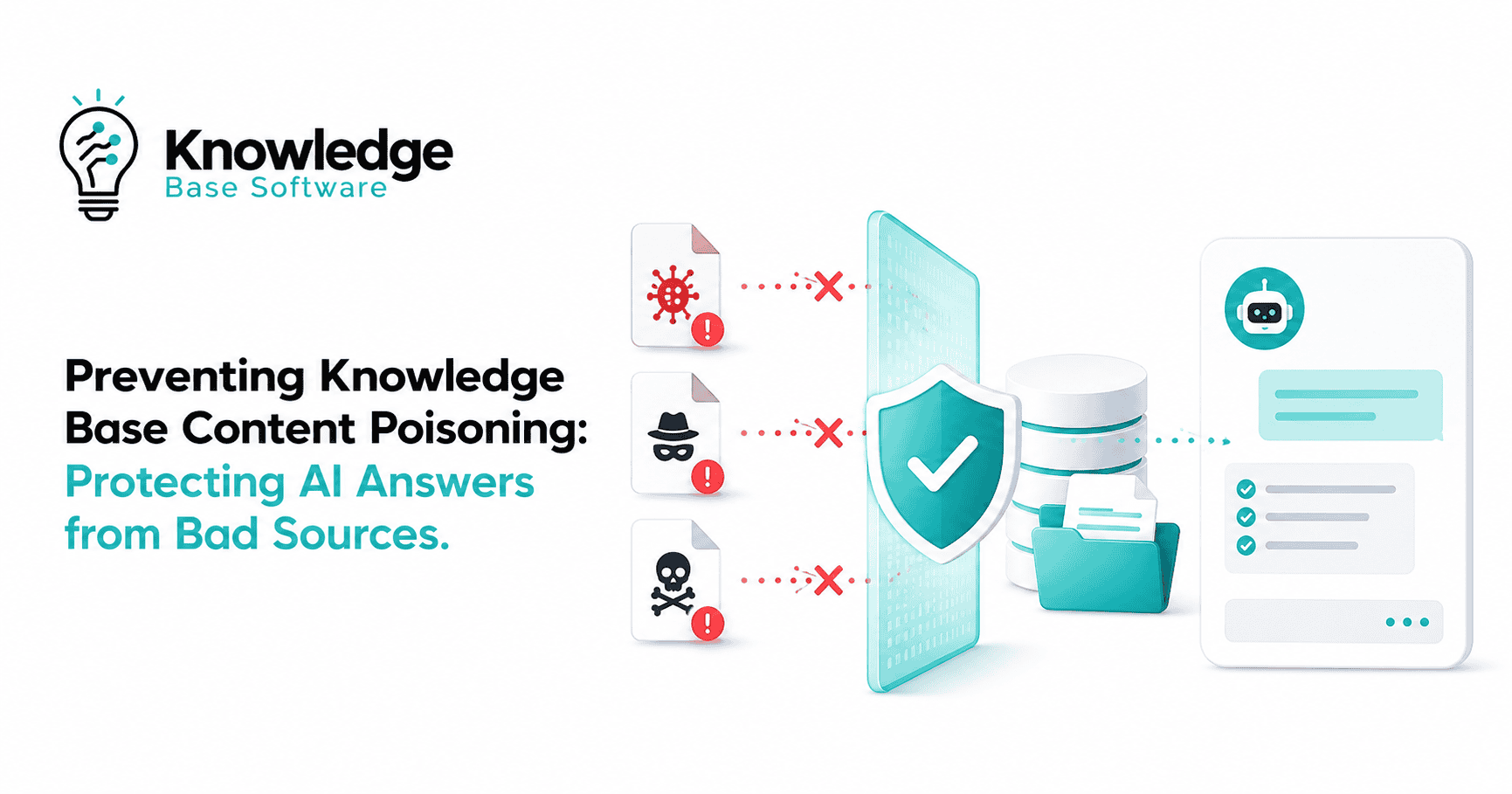
Preventing knowledge base content poisoning means protecting the information sources that an AI system retrieves from, trusts, summarizes, and uses to answer questions. In retrieval-augmented generation, or RAG, the model may not be compromised at all; the problem can begin when a poisoned document, misleading page, altered policy, compromised wiki entry, malicious upload, or tampered vector index becomes part of the retrieval pipeline.
This risk matters because many enterprise AI assistants treat internal knowledge bases as trusted context. OWASP describes document poisoning as malicious content injected into the retrieval corpus that can later enter the model’s context window and alter behavior when retrieved. OWASP also highlights shared knowledge bases such as Confluence, SharePoint, Google Drive, and S3 buckets as common risk areas when multiple users or systems can upload documents.
The practical answer is not one tool or one filter. No single control prevents all poisoning risks. The safest approach is layered: source governance, ingestion validation, chunk-level provenance, permission-aware retrieval, output verification, logging, red-team testing, and rehearsed incident response.
What Is Knowledge Base Content Poisoning?
Knowledge base content poisoning is the intentional or accidental contamination of the documents, records, metadata, embeddings, or indexed content that an AI application uses as external knowledge.
In a RAG system, the model retrieves relevant chunks from a knowledge base, adds them to the prompt context, and generates an answer. If the retrieved content is false, manipulated, stale, adversarial, or unauthorized, the generated answer may become unreliable even if the underlying LLM is functioning normally.
A poisoned knowledge base can cause an AI assistant to:
- Give incorrect policy, product, legal, financial, medical, or technical guidance.
- Prefer a manipulated source over an authoritative one.
- Cite a poisoned document as if it were trustworthy.
- Surface outdated or revoked information.
- Retrieve content the user should not be allowed to see.
- Follow hidden instructions embedded inside files, metadata, or document text.
- Trigger unsafe downstream actions if the AI system is connected to tools or agents.
OWASP’s 2025 LLM risk taxonomy treats data and model poisoning as an integrity issue that can affect pre-training, fine-tuning, and embedding data. It specifically notes that manipulated embedding data can compromise model security, performance, or behavior.
Why This Risk Is Bigger in RAG Systems
RAG improves usefulness by connecting AI systems to current, private, or domain-specific knowledge. It also expands the trust boundary.
A traditional application may query a database and return a known field. A RAG application retrieves semi-structured text, ranks it by relevance, passes it into an LLM, and asks the model to synthesize an answer. That creates more places where untrusted content can influence the final output.
Research has also shown that the knowledge database itself can become a practical attack surface. The USENIX Security 2025 PoisonedRAG paper reports that, under the paper’s experimental setup, injecting five malicious texts per target question into a knowledge database with millions of texts achieved a high attack success rate, and the authors found several tested defenses insufficient against the attack. A later ACL Anthology paper, One Shot Dominance, studied a stealthier knowledge poisoning scenario where a single poisoned document could be effective against RAG systems under tested conditions.
These findings should not be read as proof that every production RAG system is easily compromised. They do show why teams should treat the knowledge base, ingestion pipeline, retrieval layer, and vector index as security-critical components rather than passive storage.
Knowledge Base Poisoning vs. Related AI Risks
| Risk | What It Means | How It Affects AI Answers | Practical Control Priority |
|---|---|---|---|
| Knowledge base content poisoning | Bad, manipulated, hidden, stale, or unauthorized content enters the retrieval corpus | The model retrieves poisoned context and generates a bad answer | Source governance, ingestion scanning, provenance, retrieval validation |
| Training data poisoning | Manipulated data affects model training or fine-tuning | The model’s learned behavior may be altered | Secure training data pipelines, dataset review, model evaluation |
| Prompt injection | Instructions attempt to override intended model behavior | The model may follow malicious or conflicting instructions | Prompt isolation, input filtering, instruction hierarchy, output validation |
| Hallucination | The model generates unsupported or incorrect information | The answer may be wrong even without a poisoned source | Grounding, citations, refusal behavior, evaluation |
| RAG oversharing | The system retrieves content the user should not access | Sensitive data may be exposed | Permission-aware retrieval, metadata filtering, tenant isolation |
| Vector or embedding weakness | The embedding/index layer leaks, misranks, or retrieves inappropriate content | Poisoned or unauthorized chunks may be surfaced | Vector database access controls, index integrity checks, namespace isolation |
OWASP separates RAG poisoning from broader prompt injection patterns, describing it as malicious content injected into RAG systems that rely on external knowledge bases. OWASP also treats vector and embedding weaknesses as a distinct LLM risk category, including data poisoning, cross-context leakage, access-control failures, and embedding inversion.
Where Poisoning Enters the Knowledge Pipeline
A useful prevention program starts by mapping where bad content can enter or influence the system.
1. Source Layer
Poisoning can begin before the AI team touches the data. Risky sources include public websites, scraped documentation, customer-uploaded files, support tickets, wikis, CMS content, shared drives, partner portals, and third-party connectors.
Google’s Secure AI Framework risk guidance notes that data poisoning can occur before data is ingested, during processing or training, or while data is in storage. That lifecycle framing is useful for RAG systems because the risk is not limited to model training.
2. Ingestion Layer
The ingestion layer converts raw files and source records into normalized text. This is where teams should inspect files, extract text safely, scan for anomalies, validate source ownership, and decide whether content is allowed into the knowledge base.
AWS emphasizes that RAG security controls should be applied not only at inference time but also when ingesting external data into the knowledge base. AWS also warns that public or external content can contain malicious material intended to influence a RAG application.
3. Chunking and Embedding Layer
Once documents are split into chunks, context can be lost. A chunk may lose its source owner, access-control metadata, approval status, version, or surrounding caveats. If the system stores only text and embeddings, it may later retrieve content without knowing whether the user is authorized to see it or whether the source is still valid.
4. Vector Index and Retrieval Layer
The vector index decides which chunks are retrieved. If attackers or misconfigured services can modify the index, they can influence answers without directly changing the original documents. OWASP recommends restricting vector index write access to authorized ingestion pipelines, logging index modifications, monitoring index integrity, and using snapshots for rollback.
5. Generation Layer
Even after retrieval, the model needs clear instructions about how to treat retrieved text. Retrieved content should be treated as untrusted evidence, not as system instructions. The model should cite sources, handle conflicts, express uncertainty, and refuse to answer when the evidence is weak or unsafe.
6. Monitoring and Feedback Layer
Poisoning may not be obvious at ingestion time. Teams need retrieval logs, answer traces, user feedback, source-change monitoring, and red-team tests to detect abnormal answer shifts or suspicious retrieval patterns.
A Layered Prevention Model for Knowledge Base Content Poisoning
Preventing knowledge base content poisoning requires controls across the full lifecycle. The following model is designed for enterprise RAG systems, internal copilots, customer support assistants, AI search products, and AI agents that rely on internal or external knowledge.
Layer 1: Govern Which Sources Are Allowed
The first control is deciding what the AI system is allowed to know from.
A secure knowledge base should have an approved-source policy. This policy defines which repositories, websites, drives, file types, APIs, business systems, and user groups can contribute content. It should also define who owns each source and who can approve changes.
Practical controls:
- Maintain an allowlist of trusted sources.
- Assign a business owner and technical owner to every source.
- Require approval before adding a new connector or repository.
- Classify sources by trust level, sensitivity, and business impact.
- Block direct ingestion from unmanaged public web sources unless there is a review process.
- Require stronger controls for high-impact domains such as legal, medical, financial, security, HR, and customer commitments.
- Review source permissions before ingestion, not after deployment.
OWASP recommends maintaining an allowlist of trusted document sources and rejecting unknown or unapproved sources in RAG pipelines.
Layer 2: Preserve Provenance for Every Document and Chunk
Provenance answers: where did this content come from, who approved it, when was it last changed, and can it still be trusted?
At minimum, every document and chunk should carry:
- Source system.
- Source URL or record ID.
- Document owner.
- Upload or sync identity.
- Approval status.
- Version.
- Timestamp.
- Classification.
- Access-control metadata.
- Hash or integrity identifier.
- Expiration or review date.
- Connector name and sync job ID.
Provenance should survive chunking. If a PDF becomes 80 chunks, each chunk still needs source identity and access rules. Without chunk-level provenance, the AI system may retrieve text that looks relevant but cannot prove it is current, authorized, or authoritative.
OWASP specifically recommends document hashing and provenance tracking at ingestion, including who uploaded the document, when, from what source, and with what approval.
Layer 3: Validate Content Before Ingestion
Ingestion-time validation reduces the chance that poisoned content enters the retrieval corpus.
A practical validation pipeline should check:
- File type and MIME consistency.
- Malware and suspicious links.
- Hidden text, invisible characters, zero-width spaces, and abnormal Unicode.
- Document metadata and hidden layers.
- Duplicate and near-duplicate documents.
- Stale versions of policies or manuals.
- Conflicting claims against authoritative sources.
- Sensitive data and PII.
- Unauthorized source changes.
- Unusually large or bulk uploads.
- Content that appears to instruct the AI assistant rather than inform the user.
OWASP’s RAG Security Cheat Sheet recommends scanning ingested documents for adversarial patterns, hidden instructions, invisible Unicode characters, and zero-width spaces. It also warns against trusting content based only on file extension or MIME type.
For high-risk systems, validation should not be a single pass. Use staged gates:
- Automated screening for format, malware, hidden content, and policy violations.
- Source validation against approved repositories and owners.
- Human review for high-impact or externally supplied content.
- Quarantine for suspicious or unverified documents.
- Audit logging for every accept, reject, and override decision.
Layer 4: Secure Chunking, Embeddings, and Index Integrity
After ingestion, the system transforms content into chunks and embeddings. Security controls must follow the data through this transformation.
Recommended controls:
- Keep document and chunk IDs stable across versions.
- Store hashes for original files and extracted text.
- Preserve access-control metadata at chunk level.
- Track which embedding model created each vector.
- Separate vector namespaces by tenant, department, classification, or risk tier.
- Restrict write access to the vector index.
- Log inserts, updates, deletes, re-embeddings, and metadata changes.
- Use index snapshots so teams can roll back after tampering or accidental corruption.
- Alert on sudden index growth, shrinkage, or unusual update patterns.
OWASP warns that the vector index is a critical component because modifying the index can alter which documents are retrieved even without modifying the original documents.
Layer 5: Enforce Permission-Aware Retrieval
A common mistake is to secure source repositories but lose permissions after content enters the vector database. RAG systems must enforce authorization at retrieval time.
Permission-aware retrieval means the system checks the user’s identity, role, group, tenant, geography, clearance, contractual boundary, and business context before returning chunks to the model.
Practical controls:
- Apply metadata filters before similarity search where possible.
- Do not retrieve all chunks and filter after retrieval if restricted similarity scores could leak information.
- Separate tenants or classification levels into different namespaces, collections, or indexes where appropriate.
- Bind session identity to the authenticated user.
- Re-check permissions on every turn in multi-turn conversations.
- Invalidate cached answers when permissions or source documents change.
- Fail closed when authorization data is missing or unavailable.
AWS’s 2026 RAG architecture guidance describes a defense-in-depth pattern that uses independent authorization layers and document-level retrieval filtering for granular access control within a tenant. AWS also distinguishes filter-level logical isolation from hard tenant isolation and recommends dedicated knowledge bases with IAM-enforced boundaries where cross-tenant compliance boundaries require stronger separation.
Layer 6: Treat Retrieved Content as Evidence, Not Instructions
A RAG system should not treat retrieved text as if it were part of the system prompt. Retrieved content may be useful evidence, but it can also contain errors, outdated instructions, hidden text, or malicious language.
Generation-time controls should require the model to:
- Use retrieved content only as reference material.
- Ignore instructions found inside retrieved documents that attempt to control assistant behavior.
- Cite sources for factual claims.
- Prefer authoritative and recent sources when documents conflict.
- State uncertainty when sources are incomplete.
- Refuse or escalate when the retrieved evidence is unsafe or insufficient.
- Avoid taking external actions based only on a single unverified source.
- Separate tool instructions from retrieved content.
This is especially important for AI agents. If an assistant can send emails, update tickets, execute code, retrieve secrets, or change account settings, poisoned content can become an action risk rather than only an answer-quality risk.
Layer 7: Detect Suspicious Retrieval and Answer Drift
Prevention will never catch everything. Monitoring should show what the model retrieved, why it retrieved it, and how the answer changed.
Track:
- Which chunks were retrieved for each query.
- The source, owner, classification, and version of each chunk.
- Whether the answer cited the retrieved sources.
- Which documents are retrieved unusually often.
- Which new documents suddenly influence many answers.
- Sudden changes in answers to stable benchmark questions.
- Repeated user reports about incorrect or suspicious answers.
- Retrieval from newly added or low-trust sources.
- Attempts to retrieve restricted content.
- Unexpected tool calls after retrieval.
- Cache usage and cache invalidation events.
OWASP recommends full observability across RAG pipelines, including query, retrieved chunks, access-control metadata, assembled model input, generated output, and tool calls. It also recommends replayable traces for incident investigation.
Practical Risk-Control Matrix
| Risk Scenario | Primary Impact | Preventive Controls | Detective Controls | Response Action |
|---|---|---|---|---|
| Public web source is poisoned before crawl | Wrong or manipulated answers | Approved source list, source reputation, ingestion review | Source drift checks, answer benchmark tests | Remove source, rebuild affected index, review outputs |
| Insider edits an internal policy with misleading content | Bad business decisions or compliance risk | Change approval, document ownership, version control | Audit trails, unusual edit alerts | Roll back document, quarantine chunks, notify owners |
| Hidden text in uploaded files enters the corpus | Model follows hidden or conflicting instructions | Hidden text scanning, parser hygiene, quarantine | Retrieval trace review, red-team tests | Remove file, invalidate cache, tune scanner |
| Metadata is stripped during chunking | Unauthorized retrieval or weak attribution | Chunk-level metadata preservation | Access-boundary tests | Re-index with metadata, review exposed answers |
| Vector index is tampered with | Retrieval manipulation | Restricted write access, index snapshots | Checksum verification, index size alerts | Restore snapshot, investigate credentials |
| Conflicting source versions are retrieved | Inconsistent or outdated answers | Version rules, source priority, expiration dates | Conflict detection, stale document reports | Deprecate stale content, update ranking rules |
| Cached answer survives permission change | Data leakage or stale guidance | Permission-scoped cache, short TTL | Cache access logs, permission-change tests | Invalidate cache, audit recipients |
Secure RAG Ingestion Checklist
Use this checklist before allowing a source into an AI knowledge base.
Source Approval
- The source has a named business owner.
- The source has a named technical owner.
- The source is approved for AI retrieval.
- The source’s trust level is documented.
- The source’s sensitivity classification is documented.
- The source has a review cadence.
- Public or third-party sources require additional validation.
Content Validation
- Files are scanned for malware and suspicious links.
- Extracted text is inspected for hidden instructions and invisible characters.
- Metadata and hidden layers are reviewed where applicable.
- Duplicate and stale versions are detected.
- Sensitive data and PII checks run before indexing.
- High-impact content requires human approval.
- Rejected documents are logged with reason codes.
Provenance and Integrity
- Original documents are hashed.
- Extracted text is hashed.
- Every chunk keeps document ID, source, owner, version, and classification.
- Every chunk keeps access-control metadata.
- Ingestion jobs are logged.
- Index updates are logged.
- Index snapshots are available for rollback.
Retrieval and Generation
- Retrieval is permission-aware.
- Metadata filters are applied before or during retrieval.
- Tenants or classifications are isolated where needed.
- Retrieved content is treated as evidence, not instruction.
- Answers cite sources when factual claims depend on retrieved content.
- The system handles conflicting or weak evidence explicitly.
- High-impact answers can escalate to human review.
Monitoring and Response
- Retrieval traces are retained.
- Suspicious retrieval patterns trigger alerts.
- Canary questions test stable answers.
- Red-team tests include poisoned-document scenarios.
- Cache invalidation is tied to source and permission changes.
- Incident response includes quarantine, rebuild, and user-impact review.
- Lessons learned update ingestion and retrieval controls.
Incident Response Mini-Playbook
When poisoned content is suspected, the goal is to stop further exposure, preserve evidence, identify affected outputs, and harden the pipeline.
Step 1: Quarantine the Suspect Content
Remove the document, chunk, source, connector, or index entry from retrieval. Do not delete evidence immediately. Preserve the original file, extracted text, metadata, hash, upload identity, and sync logs.
Step 2: Freeze or Limit the Affected Connector
If the issue came from a shared drive, CMS, public crawl, or third-party integration, pause ingestion until the source owner and security team confirm the path is safe.
Step 3: Identify Affected Answers
Use retrieval traces to find which users, sessions, queries, generated answers, citations, cached responses, and tool calls were influenced by the suspect content.
Step 4: Invalidate Cache and Rebuild Indexes
Remove affected cache entries. Rebuild the vector index from verified clean content if index integrity is uncertain. Use snapshots when available.
Step 5: Review Credentials and Permissions
If poisoning involved unauthorized upload, connector misuse, compromised accounts, or direct index writes, rotate credentials and review service permissions.
Step 6: Notify Stakeholders Based on Impact
Security, legal, compliance, product, support, and affected business owners may need to know. Avoid over-alerting, but do not hide material risk.
Step 7: Update Controls
Convert the incident into better controls: new scanner rules, stricter source approval, stronger metadata checks, narrower permissions, better tests, or more conservative answer behavior.
Metrics That Show Whether Prevention Is Working
Executives need measurable risk reduction, not only architecture diagrams.
Useful metrics include:
- Percentage of indexed chunks with complete provenance.
- Percentage of sources with named owners and review dates.
- Number of unapproved or orphaned sources.
- Number of documents rejected during ingestion.
- Number of stale documents retrieved in production.
- Percentage of factual answers with citations.
- Retrieval rate from low-trust sources.
- Cross-tenant or cross-classification retrieval test failures.
- Mean time to quarantine suspicious content.
- Mean time to invalidate affected cache entries.
- Number of red-team poisoned-document tests passed.
- Number of high-impact answers escalated due to weak evidence.
- Number of unresolved source conflicts.
These metrics help security and AI teams move from “we added guardrails” to “we can prove which parts of the knowledge pipeline are governed, monitored, and improving.”
What to Prioritize First
Not every organization needs the same control depth on day one. Prioritize based on risk.
For Startups and Small Teams
Start with:
- Approved source list.
- Basic ingestion scanning.
- Document owner and version tracking.
- Permission-aware retrieval.
- Source citations in answers.
- Retrieval logging.
- Manual review for high-impact content.
Avoid connecting a customer-facing AI assistant to broad, unmanaged public sources before you have source validation and monitoring.
For Mid-Market SaaS and Internal Enterprise Assistants
Add:
- Chunk-level provenance.
- Connector approval workflows.
- Source trust scoring.
- Index snapshots and rollback.
- Red-team tests in CI/CD.
- Cache invalidation tied to document changes.
- Role-based retrieval filtering.
- Incident response runbooks.
For Regulated or High-Impact Environments
Require:
- Formal AI knowledge base governance, using references such as NIST’s voluntary AI Risk Management Framework where relevant.
- Human approval for sensitive sources.
- Immutable logs and replayable traces.
- Tenant or classification isolation.
- Strong authorization at retrieval time.
- Independent control testing.
- Documented risk acceptance.
- Legal, compliance, and security review for new data sources.
- Fail-closed behavior for authorization failures.
NIST’s adversarial machine learning taxonomy is useful for aligning security, risk, and governance teams around shared terminology for attacks, mitigations, attacker goals, lifecycle stages, and consequences. Treat it as a terminology and risk-management reference, not as a standalone compliance requirement for every knowledge base or RAG system.
Common Mistakes to Avoid
Mistake 1: Securing the Chat Interface but Ignoring Ingestion
Output filters are not enough. If poisoned content enters the knowledge base, the model may retrieve and reason over it before output filtering occurs.
Mistake 2: Trusting Internal Content Automatically
Internal does not always mean trustworthy. Internal documents can be stale, contradictory, over-permissioned, accidentally wrong, or intentionally modified.
Mistake 3: Losing Permissions During Chunking
If access controls are not preserved at chunk level, the retrieval system may expose information that the original repository would have blocked.
Mistake 4: Treating Vector Databases as Low-Risk Storage
Embeddings and indexes influence what the AI sees. If the vector layer is tampered with, the final answer can be manipulated even when the original documents remain unchanged.
Mistake 5: Not Keeping Replayable Traces
When an AI answer is challenged, teams need to know exactly which chunks were retrieved, which sources were cited, and which model input produced the answer.
Mistake 6: Relying on One Defense
Paraphrasing, filtering, source citations, or guardrails may each reduce some risk, but none is complete alone. Poisoning prevention is a system design problem.
Practical Architecture Pattern
A secure knowledge base pipeline should look like this:
- Approved source registry
Defines which repositories, APIs, drives, websites, and upload paths are allowed. - Connector and ingestion gate
Authenticates source systems, validates files, scans content, checks metadata, and logs every ingestion event. - Quarantine zone
Holds suspicious, unapproved, high-risk, or conflicting content until reviewed. - Normalization and chunking service
Extracts text safely, removes unsafe artifacts, preserves provenance, and attaches access-control metadata to every chunk. - Embedding and indexing service
Embeds approved chunks only, logs index writes, separates namespaces, and supports rollback. - Permission-aware retriever
Applies identity, role, tenant, classification, and source trust filters before returning context. - Answer generation layer
Separates retrieved evidence from instructions, requires citations, handles uncertainty, and blocks unsafe tool actions. - Observability and response layer
Stores traces, monitors anomalies, runs canary tests, supports investigation, and enables fast quarantine.
This pattern works because it assumes poisoned content may appear somewhere and creates multiple chances to block, detect, or reduce its impact.
Conclusion
Preventing Knowledge Base Content Poisoning is about protecting the trust chain behind AI answers. The model is only one part of that chain. The sources, connectors, parsers, chunks, embeddings, retrieval filters, prompts, citations, caches, logs, and human approval workflows all influence whether an answer can be trusted.
The most resilient programs use layered controls: approve sources, validate content before ingestion, preserve provenance, secure the vector index, enforce permission-aware retrieval, treat retrieved text as evidence rather than instruction, monitor answer drift, and rehearse incident response.
The goal is not to promise perfect prevention. The goal is to make poisoning harder to introduce, easier to detect, faster to contain, and less likely to affect important decisions.
FAQ
What is knowledge base content poisoning?
Knowledge base content poisoning is the contamination of the external content an AI system retrieves from, such as documents, wiki pages, PDFs, support articles, records, metadata, embeddings, or vector indexes. The result can be incorrect, manipulated, unsafe, or unauthorized AI-generated answers.
Is knowledge base poisoning the same as data poisoning?
Not exactly. Data poisoning is broader and can affect training, fine-tuning, embeddings, or stored data. Knowledge base poisoning usually refers to external content used by RAG systems at retrieval time. OWASP’s 2025 LLM taxonomy includes poisoning of embedding data as part of data and model poisoning risk.
How is RAG poisoning different from prompt injection?
Prompt injection attempts to influence the model through instructions in a prompt or external content. RAG poisoning focuses on contaminating the retrieval corpus or retrieval process so the model receives bad context. The two can overlap when poisoned documents contain instructions that try to manipulate the assistant.
Can knowledge base content poisoning be fully prevented?
No. Any system that ingests changing content from people, tools, public sources, or third parties has residual risk. The realistic goal is layered risk reduction through source governance, ingestion validation, index protection, permission-aware retrieval, output verification, and monitoring.
Should AI assistants cite sources in every answer?
For factual, policy, technical, legal, financial, medical, or high-impact answers, citations are strongly recommended. Citations help users and auditors verify which sources influenced the answer. For casual or low-risk interactions, citations may be less necessary, but the system should still retain internal traces.
What is the most important first control?
For most teams, the first control is an approved-source registry with ownership and ingestion validation. If you do not know which sources are allowed, who owns them, and how they are checked, later controls become harder to trust.
How do you detect poisoned knowledge base content?
Use a combination of source-change monitoring, ingestion scanning, retrieval logs, answer regression tests, red-team poisoned-document tests, user feedback, and anomaly detection for unusual retrieval patterns or sudden answer changes.
What should teams do after detecting poisoned content?
Quarantine the suspect content, freeze the affected connector if needed, preserve evidence, identify affected answers and users, invalidate caches, rebuild indexes from clean sources, review credentials and permissions, and update prevention controls.