Independent knowledge base software guide Evidence-led Updated 2026

Build vs Buy Knowledge Base Software: Costs, Risks, and Decision Framework
Last verified: July 21, 2026. This analysis uses official regulatory and security guidance. All monetary and schedule examples are hypothetical planning models, not market averages.
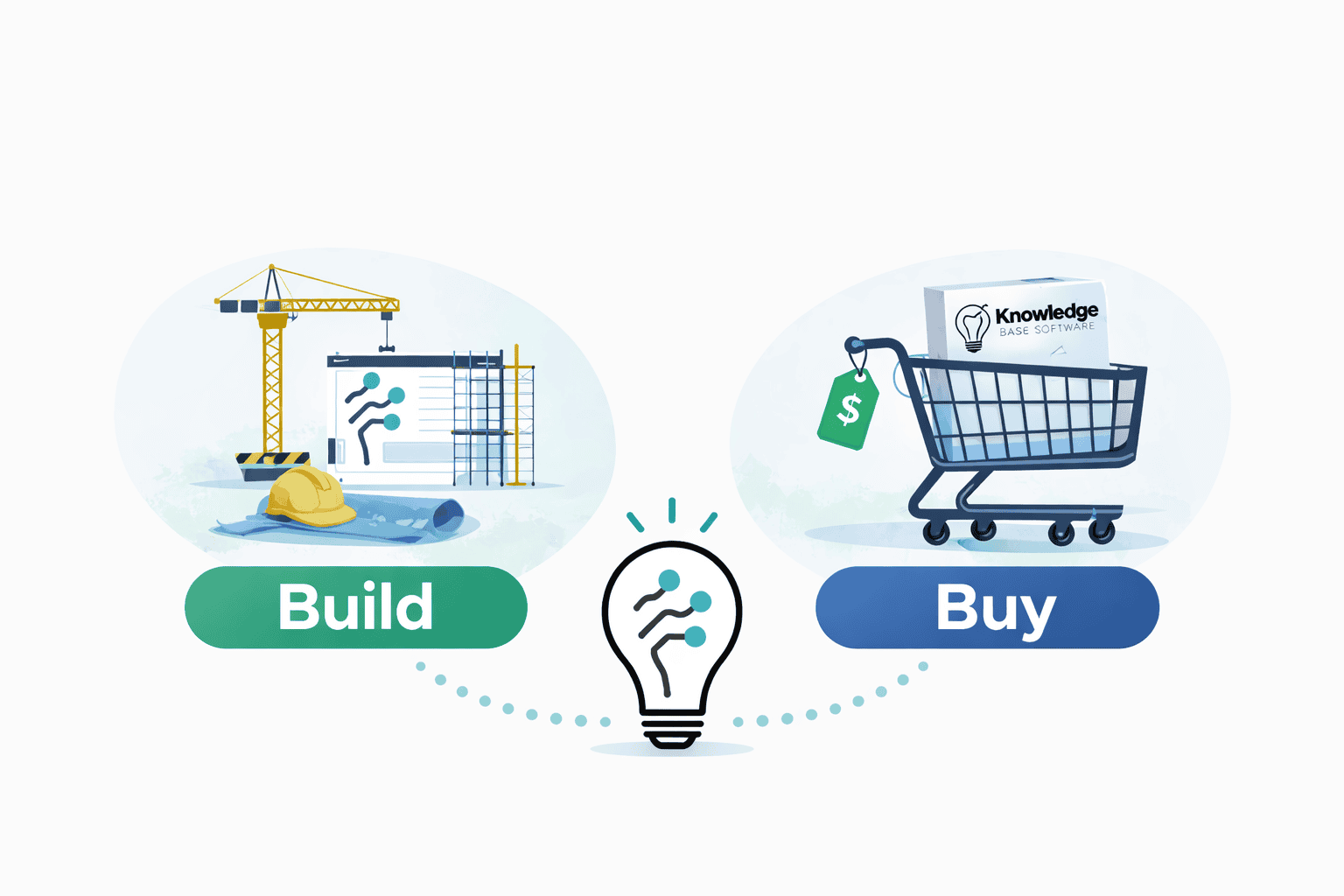
A practical default is to buy standard capabilities, build only where a requirement creates meaningful business value, and use a hybrid model when you need both. A hosted platform can supply the editor, search, permissions, analytics, and publishing system. A custom layer can then provide the distinctive interface, integration, or workflow that the business cannot obtain through configuration.
That is a starting point, not a universal rule. The right decision depends on requirements, total cost of ownership, delivery risk, security responsibilities, portability, and the team that will operate the system after launch. This guide provides a decision framework and a transparent cost worksheet without treating unsupported cost or timeline figures as facts.
Build vs buy knowledge base software: the short answer
| Choose | It is a strong candidate when | Main risk to test |
|---|---|---|
| Buy | Your needs are mostly standard, a usable help center is needed without building a software product, and a vendor can meet the required security and export terms. | Plan limits, long-term price, vendor dependency, configuration limits, and the cost of leaving. |
| Build | The knowledge experience is strategically distinctive, a non-negotiable requirement remains unmet after vendor pilots, and a funded team can own development and operations for the system’s life. | Opportunity cost, incomplete requirements, security engineering, maintenance, staff continuity, and underestimated operations. |
| Hybrid | A vendor can supply the content platform, while a custom front end, integration, search layer, or workflow supplies the differentiated part. | Two systems can create integration, support, and accountability gaps unless ownership is explicit. |
| Self-host or extend open source | You need source access or deployment control and can operate the application, dependencies, backups, and upgrades. | No license fee does not mean no ownership cost; security and upgrade work remain with your team. |
If you are still defining audiences, workflows, search needs, and permissions, complete those requirements before selecting an architecture. Our knowledge base software buyer’s guide provides a complementary product-evaluation checklist.
What “build,” “buy,” and “hybrid” actually mean
Build means your organization is responsible for the application and its lifecycle. The team may write every component or combine frameworks, search services, identity providers, databases, and cloud infrastructure. Either way, it owns architecture decisions, integration, testing, deployment, monitoring, incident response, upgrades, and eventual retirement.
Buy means licensing a hosted or commercially supported platform. The supplier operates some or most of the software, but your organization still owns configuration, content quality, user access, integrations, adoption, governance, and the obligations that apply to its use of data.
Hybrid is broader than embedding a help-center widget. Examples include buying a headless knowledge platform and building the reader experience; using a vendor editor and search index with a custom in-product help panel; or keeping restricted operational content in an internal system while publishing approved content through a separate public portal.
An open-source project can fall anywhere on this spectrum. A managed open-source service resembles “buy.” A fork that your engineers operate and modify resembles “build.” Classify the option by who carries the lifecycle work, not by whether the source code is visible.
Compare the options across eight decision factors
| Factor | Build | Buy | Hybrid |
|---|---|---|---|
| Functional fit | Can be designed for exact requirements, provided the team funds the work. | Fit is limited to supported configuration, extensions, and roadmap. | Standard functions come from the platform; custom work targets genuine gaps. |
| Delivery | Requires discovery, design, engineering, testing, migration, and operational readiness. | Removes core product development, but migration, configuration, training, and acceptance testing remain. | Can launch the platform first and add custom components in controlled stages. |
| Cost shape | Higher project and staffing exposure; usage charges may still apply for infrastructure and services. | Subscription and add-on costs are easier to identify, but can change with seats, portals, traffic, AI usage, or support tiers. | Combines subscription costs with targeted engineering and integration maintenance. |
| Control | Direct control over roadmap, code, deployment, and data architecture. | Control is bounded by contract and product capabilities. | Control is concentrated in the layer that matters most. |
| Operations | Your team owns availability, backups, recovery, monitoring, patching, and support. | The supplier owns platform operations within its service terms; your team still owns administration and connected systems. | Operational responsibilities must be mapped across both parties and components. |
| Security | Full design authority, plus full responsibility for secure development and operation. | Access to a supplier’s controls, evidence, and security team, but also supplier and sub-processor risk. | Can isolate sensitive or distinctive components, but adds integration boundaries. |
| Portability | You control the schema and export process, assuming the system is documented and maintained. | Depends on export formats, APIs, attachments, URL controls, and contract terms. | A canonical content model can reduce dependency if designed deliberately. |
| Product focus | Consumes engineering capacity that could serve another roadmap. | Preserves engineering capacity but accepts supplier constraints. | Directs engineering effort to differentiated capabilities rather than the entire stack. |
Start with requirements, not a preferred architecture
A fair comparison begins with the same written requirements for every option. Separate them into three groups:
- Must have: failure makes the option unusable or non-compliant.
- Should have: material value, but a documented workaround is acceptable.
- Could have: useful only if its cost and complexity are justified.
Include both reader and operator needs. A knowledge base is not merely a page renderer. Requirements may cover authoring, review and approval, version history, article ownership, taxonomy, search behavior, public and private audiences, identity, permissions, localization, accessibility, analytics, redirects, APIs, audit records, retention, backups, and AI data handling.
Use a hard-requirement gate
Before scoring features, test each option against the non-negotiable requirements. A vendor should not survive the gate because its demo looks polished. A custom build should not survive merely because a requirement could theoretically be coded. Ask whether the option can meet the requirement within the approved budget, evidence standard, and delivery window.
- Define the requirement and an observable acceptance test.
- Record whether it is available by configuration, supported extension, custom development, or not at all.
- Identify the owner and recurring work needed to keep it working.
- Attach evidence: trial result, architecture review, contract language, API documentation, or a tested prototype.
- Reject or formally accept the risk of every unmet must-have.
Calculate total cost of ownership without invented benchmarks
There is no defensible universal price or schedule for a custom knowledge base. Complexity, labor rates, existing components, security scope, migration quality, traffic, and service expectations vary too widely. Build a model from your own requirements and vendor quotes instead of using an anonymous “six-figure build” or a fixed maintenance percentage.
TCO formulas
Build TCO = initial product work + migration + integrations + infrastructure + security and compliance work + support and operations + maintenance and enhancement + exit or replacement cost + risk contingency.
Buy TCO = implementation + migration + subscription and usage charges + add-ons + integrations + administration + assurance and legal review + training + expected price changes + exit and migration reserve.
Hybrid TCO = buy TCO for the platform + design, development, testing, and operation of the custom layer + integration monitoring + coordinated incident and change management.
| Cost line | Inputs to collect | Common omission |
|---|---|---|
| Discovery and design | Roles × hours × loaded hourly cost | Accessibility, taxonomy, search relevance, and operational design |
| Engineering or configuration | Estimated work by role, plus contingency tied to identified risks | Authentication, permissions, imports, redirects, and error handling |
| Content migration | Article count, attachments, cleanup rate, mapping, redirects, and validation | Duplicate or obsolete content and manual quality review |
| Platform and infrastructure | Subscription, seats, usage, environments, storage, traffic, search, monitoring, and backup | AI usage, premium support, SSO, sandboxes, and non-production environments |
| Security and compliance | Reviews, testing, evidence, contracts, audits, remediation, and incident exercises | Recurring assurance and sub-processor changes |
| Operations | Administration, support, on-call, recovery tests, upgrades, dependency work, and training | Time spent by content owners and subject-matter experts |
| Change and exit | Enhancements, price scenarios, exports, replacement, overlap period, and archive retention | URL redirects, attachment export, identity migration, and historical versions |
A transparent hypothetical three-year example
Scenario only—not a price estimate: imagine an organization comparing a custom build with a hosted platform over 36 months. It uses $100 per engineering hour and $75 per administration or implementation hour solely to demonstrate the arithmetic.
| Hypothetical build model | Arithmetic | Amount |
|---|---|---|
| Discovery and design | 160 hours × $100 | $16,000 |
| Initial engineering | 1,200 hours × $100 | $120,000 |
| QA, security, and accessibility | 240 hours × $100 | $24,000 |
| Infrastructure in year one | 12 months × $500 | $6,000 |
| Years two and three operations | 2 × [(360 hours × $100) + $6,000 infrastructure] | $84,000 |
| Illustrative build subtotal | Sum of the rows above | $250,000 |
| Hypothetical buy model | Arithmetic | Amount |
|---|---|---|
| Platform subscription | 36 months × $1,500 | $54,000 |
| Implementation | 160 hours × $75 | $12,000 |
| Custom integration | 120 hours × $100 | $12,000 |
| Administration | 6 hours/month × 36 × $75 | $16,200 |
| Illustrative buy subtotal | Sum of the rows above | $94,200 |
These are subtotals, not complete TCO figures. Neither subtotal includes a risk contingency or an exit and replacement reserve. In the build model, the 360 hours in each of years two and three cover both operations and maintenance. In the buy model, the six administration hours per month cover administration only; ongoing integration maintenance is not included. Add those missing lines using comparable, scenario-specific assumptions before drawing a cost conclusion. Content creation and routine editorial governance are also excluded because the scenario assumes they are equal under both options; include any difference your evaluation uncovers. This example does not prove that buying is always cheaper.
If you calculate a break-even point, use (build initial cost − buy initial cost) ÷ (buy monthly recurring cost − build monthly recurring cost). The result is meaningful only when the denominator is positive and every input has the same scope. Add scenario ranges rather than a single precise forecast: for example, planned, higher-usage, delayed-delivery, and early-exit cases.
Estimate delivery with work packages, not generic timelines
A purchased platform can remove software-development work, but it does not remove requirements discovery, content cleanup, information architecture, identity configuration, integrations, training, or acceptance testing. A custom build needs those same activities plus product engineering and operational readiness. Therefore, fixed rollout or development durations should not be treated as general facts.
Create a schedule from named work packages and dependencies:
- Requirements and acceptance criteria
- Information architecture and content inventory
- Vendor trial or technical prototype
- Security, privacy, legal, and procurement review
- Configuration or application development
- Identity, support, analytics, and product integrations
- Migration, redirects, and content validation
- Accessibility, performance, recovery, and security testing
- Training, support process, and phased launch
- Post-launch monitoring and defect resolution
For illustration, a team might model a vendor project as two weeks of configuration, four weeks of migration, and two weeks of user acceptance testing: eight weeks if the work is sequential. A build scenario might model four weeks of discovery, twelve weeks for an MVP, four weeks of testing, and four weeks for migration and training: twenty-four sequential weeks. These are hypothetical assumptions, not promised durations. Parallel work, procurement, content condition, integrations, defects, and review availability can materially change either plan.
Security and compliance: responsibility is shared, not transferred
Buying software does not make the supplier responsible for every legal obligation, and building does not automatically make a system safer. The legal roles, data involved, jurisdiction, contract, configuration, and actual conduct matter. Obtain advice from qualified privacy, security, and legal professionals for your circumstances.
Under UK GDPR terminology, an organization that determines why and how personal data is processed is a controller, while a supplier acting on its instructions may be a processor. The ICO’s controller and processor guide explains that controllers carry the highest level of compliance responsibility and processors also have direct obligations. The ICO’s guidance on contracts says controllers must use processors that provide sufficient guarantees, include required processing terms, and remain primarily responsible for overall compliance. A processor can also face contractual and direct regulatory liability for its own failures. A contract can allocate operational and indemnity risk; it does not erase statutory duties. The ICO marks both linked guides as under review because of changes made by the Data (Use and Access) Act. Confirm the provisions and updated guidance that apply to your processing before relying on this summary.
HIPAA has different rules and should not be summarized using GDPR language. The US Department of Health and Human Services states that a covered entity is generally not required to continuously monitor how a business associate carries out privacy safeguards and is not automatically liable for the business associate’s actions. It must have the required arrangement and, when it learns of a material breach or violation, take reasonable steps to cure or end it and then terminate or report when the rule requires. See the official HHS business-associate liability FAQ. HHS also explains that a cloud service provider acting as a business associate can be directly liable for failing to safeguard electronic protected health information and for impermissible uses or disclosures of it; see its cloud provider assurance guidance.
Security work when you build
A build proposal should fund security throughout the software lifecycle, not add a penetration test immediately before launch. The NIST Secure Software Development Framework describes practices that can be integrated into development and used as a common language between software producers and acquirers. For a knowledge base, the plan should cover threat modeling, secure coding, dependency and secret management, code review, testing, identity, least privilege, audit events, backups, recovery, vulnerability handling, incident response, and supported retirement.
Due diligence when you buy
- Data map: what content, user data, logs, attachments, prompts, and analytics enter the service?
- Roles and terms: who is controller, processor, business associate, or independent controller for each activity, and which agreement applies?
- Access: SSO, MFA, role design, privileged administration, service accounts, guest access, and revocation.
- Protection: encryption scope, key management options, tenant isolation, secure development, vulnerability response, and independent assurance evidence.
- Operations: backups, restoration tests, incident notification, support escalation, service commitments, and recovery objectives.
- Data lifecycle: retention, deletion, legal holds, account closure, export completeness, and deletion from backups where applicable.
- Supply chain: subprocessors, change notification, hosting locations, AI providers, and international transfer mechanisms where required.
- AI controls: whether customer content trains models, which data is sent to model providers, retention, grounding boundaries, permissions, and human review.
- Exit: machine-readable exports, attachments, metadata, revisions, permissions, URLs, redirect plan, export assistance, and post-termination access.
Do not treat a security certification, compliance claim, or signed agreement as a substitute for checking scope and configuration. Ask which product, region, controls, and dates the evidence covers, then map it to your own risk assessment.
Test scale and reliability with your own workload
Large-scale user claims are not useful without a primary, comparable test and a definition of users, concurrency, content volume, geography, latency, and feature set. Do not assume that buying automatically scales or that custom software has no ceiling.
Define a workload profile for both options: article and attachment counts; index update frequency; authenticated and anonymous traffic; peak concurrent searches; response-time objectives; regions; languages; permissions complexity; API calls; and growth scenarios. For a vendor, request documented limits and test a representative pilot. For a build, run load and recovery tests against an architecture with monitoring and capacity assumptions. Record what happens when search, identity, storage, or a third-party API is unavailable.
Avoid lock-in with an exit plan before signing or building
Both paths can create lock-in. A vendor may restrict exports, APIs, themes, or contract exit assistance. A custom system may depend on undocumented code, one engineer, an obsolete framework, or a proprietary cloud service. Ownership of source code is not the same as practical portability.
Run an export test during the pilot and inspect the output. Confirm whether it includes article bodies, stable identifiers, slugs, metadata, categories, attachments, translations, permissions, comments, analytics, and revision history. Estimate the effort to preserve URLs or create redirects. If building, document the data model, deployment, dependencies, recovery process, and ownership so another team can operate or replace the system.
A practical build-vs-buy evaluation process
- Name the outcome. Specify the audience and measurable problem, such as faster discovery of approved internal procedures or a searchable public help center.
- Inventory content and dependencies. Count content types, attachments, languages, permissions, integrations, URLs, and quality issues.
- Write acceptance tests. Convert must-haves into tests for search, authoring, access, migration, performance, recovery, and export.
- Shortlist three architectures. Include buy, build, and hybrid unless a hard requirement validly excludes one.
- Run comparable pilots. Use the same representative content, users, queries, integration, and security questions.
- Model TCO and schedule ranges. Use quotes, loaded labor costs, work packages, risk-adjusted cases, and an exit reserve.
- Review risk and responsibility. Map the operator, controller/processor roles where relevant, support owner, incident path, and residual risks.
- Decide with evidence. Score fit, cost, risk, and strategic value; document assumptions and dissent.
- Set a review trigger. Revisit the decision when scale, regulation, product strategy, pricing, or a critical requirement changes.
Suggested scorecard
Choose weights before seeing final vendor or engineering estimates. Score each option from 1 to 5, multiply by the weight, and retain the evidence behind each score. Suggested categories—not universal weights—are functional fit, user experience, content governance, security and compliance, delivery confidence, three- or five-year TCO, operations, scalability, portability, and strategic differentiation.
When each option is justified
Buy when standard capability is the priority
- The primary need is a conventional public help center or internal knowledge base.
- A vendor passes must-have, security, migration, and export tests.
- The organization wants authors and administrators to operate the system without depending on a product engineering team.
- The vendor’s commercial model remains acceptable across realistic seat, portal, traffic, storage, and AI-usage scenarios.
Build when the unmet requirement is strategic
- A tested, non-negotiable workflow or experience cannot be delivered by viable platforms or extensions.
- The capability is part of the product’s differentiated value, not merely an internal preference.
- A named team and budget cover secure development, operation, support, and succession beyond launch.
- The organization accepts the opportunity cost and has tested the technical risks with a prototype.
Use hybrid when only part of the stack is special
- A vendor provides strong authoring and governance, but the reader experience must live inside a product.
- A custom integration must apply business context while the platform remains the canonical content source.
- Different data classes require different systems, with an approved publishing path between them.
- The team can define support boundaries, monitor integrations, and preserve an exit path.
Frequently asked questions
Is it cheaper to build or buy knowledge base software?
There is no universal answer. Compare the same functional and service scope over a defined period. Building includes product work, infrastructure, secure operation, support, maintenance, and replacement. Buying includes implementation, subscription and usage fees, add-ons, administration, assurance work, integration maintenance, and exit. Use your labor costs and written vendor quotes rather than a generic benchmark.
How long does each option take?
Estimate from work packages. Buying removes much of the product-engineering phase but still requires evaluation, procurement, configuration, migration, testing, and training. Building adds architecture, development, security engineering, operations, and defect resolution. Content condition and integrations may dominate either schedule.
Does a SaaS vendor take over compliance liability?
No general statement supports that conclusion. Under UK GDPR, the controller remains primarily responsible for its own compliance and for ensuring processor compliance, while processors have direct duties. HIPAA applies a different framework: a covered entity is not automatically liable for a business associate’s actions, but must use the required agreement and respond appropriately to known material violations. Contracts may allocate risk without removing each party’s statutory duties.
Is self-hosted open-source knowledge base software a build or buy decision?
Usually it is a hybrid. You reuse an existing codebase but own hosting, upgrades, monitoring, backup, compatibility, and incident response unless a managed provider supplies them. Evaluate the project’s maintenance, license, extension model, export path, and your ability to operate it. See our comparison of open-source knowledge base software for product-level options.
Can a company buy first and build later?
Yes, if it protects portability from the beginning. Use stable URLs where possible, retain canonical content outside proprietary features when appropriate, test exports, document integrations, and budget for overlap and redirects. Starting with a vendor can also reveal which custom capabilities users genuinely need.
What should a proof of concept test?
Use representative articles, attachments, permissions, languages, authors, and search queries. Test authoring, approval, versioning, migration fidelity, identity, integrations, accessibility, performance, backup or export, failure behavior, and administrator workload. Record pass/fail evidence against the same acceptance criteria for every option.
Final decision
Do not build a complete knowledge platform merely because custom software offers theoretical control, and do not buy merely because a supplier presents a fast demo. Buy when mature platform capabilities meet the tested requirements at an acceptable lifecycle cost. Build when a strategic, unmet requirement justifies a permanently funded software responsibility. Choose hybrid when the standard platform is adequate and only one layer creates differentiated value.
The strongest decision is traceable: requirements are explicit, assumptions are visible, cost arithmetic can be changed, security and legal responsibilities are mapped, and an exit path exists before implementation begins.