Independent knowledge base software guide Evidence-led Updated 2026

Intercom vs Knowledge Base Software: Pricing, Features, and Fit
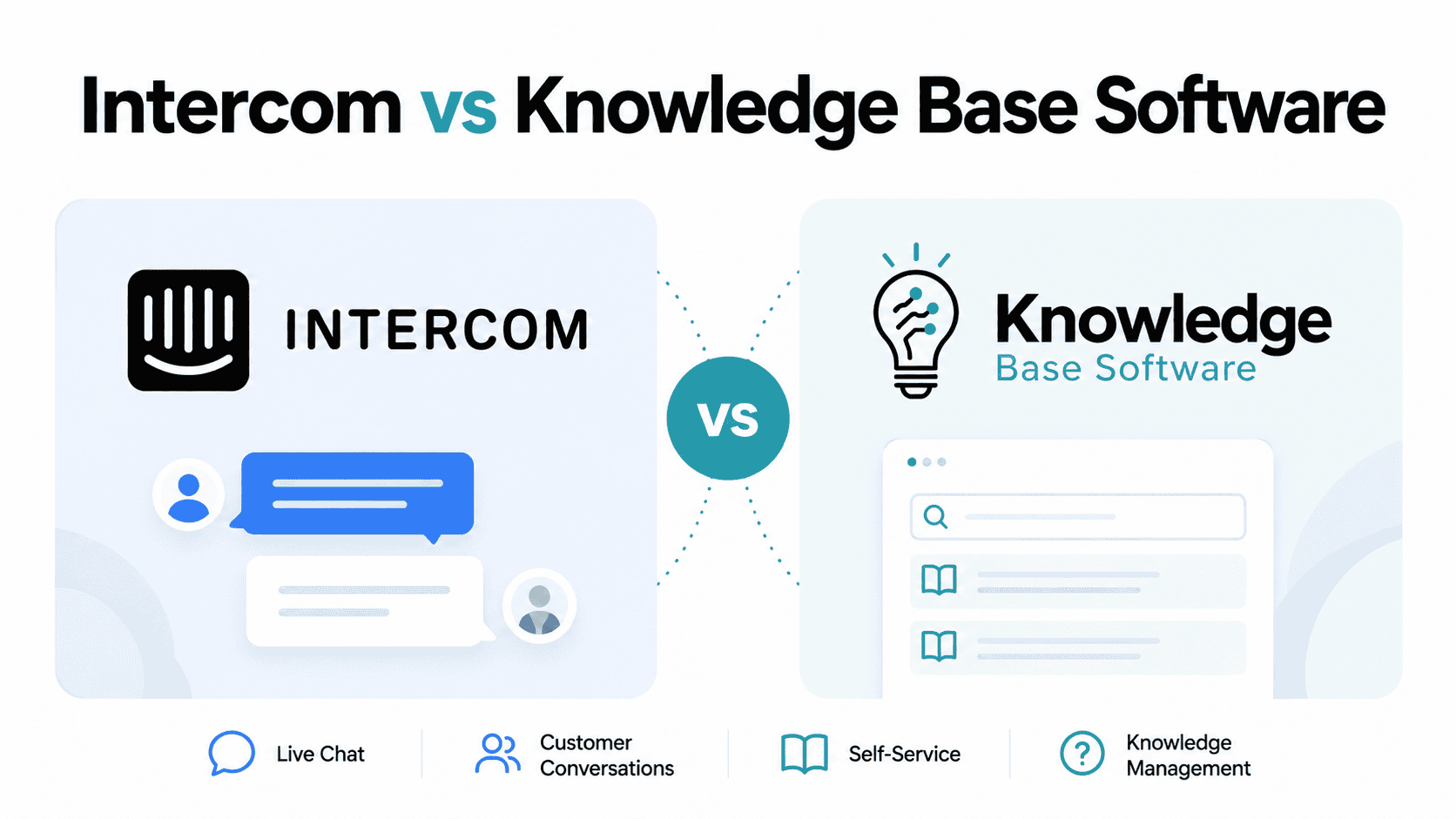
Intercom combines a public Help Center, centralized Knowledge workspace, Messenger, shared inbox, ticketing, automation, and Fin AI Agent. That makes it a credible knowledge-enabled customer service platform—not merely a live-chat tool. A dedicated knowledge base can still be the better choice when documentation structure, editorial governance, portability, or public documentation is the primary requirement.
Quick verdict: Choose Intercom when knowledge must work inside AI-assisted customer conversations and human support workflows. Choose dedicated knowledge base software when the documentation operation itself is the priority. Consider both when you need a documentation-first source of truth plus Intercom’s conversational delivery layer.
Last verified: August 16, 2026. Prices are in USD. Intercom can change promotions, plan entitlements, included credits, and usage rates, so confirm the order summary before purchase.
Intercom vs Knowledge Base Software at a Glance
| Decision point | Intercom | Dedicated knowledge base software |
|---|---|---|
| Primary job | AI and human customer service across conversations, tickets, and self-service | Create, organize, publish, govern, and search documentation |
| Knowledge delivery | Help Center, Messenger, Fin AI Agent, Copilot, and Inbox | Public docs, private portals, embedded search, or integrations |
| Public help content | Public Help Center is listed on every base plan | Usually a core capability; exact limits vary by vendor and plan |
| Restricted article access and multilingual Help Center | Advanced and Expert. Intercom’s “Private Help Center” label refers to article-level visibility controls; the Help Center shell remains accessible. | Varies; verify site-level authentication separately from article-level restrictions. |
| Multiple Help Centers | Expert; official documentation allows up to 100 per workspace | Varies by portal, brand, workspace, or language limits |
| AI cost model | Fin is usage-based at $0.99 per outcome | May be bundled, metered, credit-based, or unavailable |
| Strongest fit | Teams that need AI, live support, routing, and customer context in one workflow | Teams whose main problem is documentation depth, governance, or knowledge access |
| Key evaluation risk | Seat, outcome, channel, and add-on costs can compound | A separate platform may require integration and process ownership |
The distinction is not “chat versus articles.” Intercom has meaningful knowledge-management capabilities. The practical question is whether those capabilities match your content model and whether the additional customer-service platform is worth its total cost. If you are starting the broader selection process, use this knowledge base software evaluation guide alongside the comparison below.
What the Intercom Knowledge Base Actually Includes
Intercom separates the content-management layer from the customer-facing destination. Knowledge is the centralized workspace for content sources, while the Help Center is the browsable self-service site customers visit. Fin AI Agent and Copilot can use enabled knowledge in their respective support workflows.
According to Intercom’s Knowledge documentation, teams can create public articles, internal articles, and snippets, as well as sync or import supported external sources. The public Help Center is explicitly included in Essential, Advanced, and Expert. This makes it inaccurate to describe Intercom as having no knowledge base.
Native and external knowledge sources
- Public articles: publishable to the Help Center and usable by Fin or Copilot when enabled.
- Internal articles: agent-facing knowledge that is not added to the public Help Center.
- Snippets: shorter reusable answers for AI and agent workflows.
- Zendesk content: public articles can be synced or imported, depending on whether Zendesk or Intercom remains the editing source.
- Confluence, Guru, and Notion: supported for internal-content sync or import.
- Websites and PDFs: supported as AI knowledge sources, subject to each source type’s ingestion and refresh behavior.
These source types are not interchangeable. Intercom’s knowledge-source compatibility table shows which sources can be synced, imported, used by Fin, used by Copilot, or added to the Help Center. Before migrating, decide where each article will be edited, how quickly changes must reach AI, and whether the content must also appear in public self-service.
Content structure and navigation
Intercom supports more structure than a flat FAQ list. Its collection documentation describes a hierarchy of up to three collection levels, a tree view, drag-and-drop organization, and article ordering. Articles must be added to a collection to appear in Help Center browsing and search.
Three levels may be sufficient for a product help center. It may be restrictive for a large developer portal, regulated documentation set, or multi-product library that needs deeper nesting, complex metadata, content reuse, or versioned product documentation. Do not assume either outcome: model your real taxonomy in the trial.
Drafts, versions, audiences, and reporting
Public articles support saved drafts, version history, change highlighting, and restoration of an earlier version as a new draft. The editor also separates the Fin audience from the Help Center audience, so content visibility in self-service does not have to match the content Fin may use. Intercom documents these controls in its public-article management guide.
Access-model caveat: Intercom cannot make the Help Center itself private. Teams can keep individual articles unlisted or restrict them to logged-in users and defined audiences; visitors may still reach the Help Center shell, but they cannot see restricted articles unless they match the rules. Audience targeting is applied to individual articles—not collections—and targeting logged-in users requires the documented custom-domain, cookie-forwarding, and login-link setup. See Intercom’s article-access documentation.
The Articles report covers views, reactions, conversations started from articles, search terms, and searches with no results. Intercom labels this a legacy report and says it is not customizable; its documentation also says the report cannot be exported. Teams that require scheduled content reviews, formal multi-step approvals, fully exportable content-health reporting, or more granular editorial roles should verify those requirements rather than inferring them from drafts and version history.
Intercom pricing: August 2026 snapshot
Intercom pricing has two major components: paid full seats and usage. Optional add-ons and metered channels can add further cost. The advertised price therefore is not a complete monthly estimate.
| Plan | Public price verified August 16, 2026 | Knowledge-related boundary | Included Lite seats |
|---|---|---|---|
| Essential | $29/full seat/month under annual billing | Public Help Center included; restricted-article audience controls and multilingual Help Center are not listed | None |
| Advanced | $85/full seat/month under annual billing | Adds restricted-article audience controls—marketed by Intercom as “Private Help Center”—and multilingual publishing. The Help Center shell itself remains accessible | 20 |
| Expert | $132/full seat/month under annual billing | Adds multiple branded Help Centers, SSO and identity management, SLAs, and custom roles | 50 |
| Fin AI Agent | $0.99 per outcome | Included as a capability on every base plan, but successful outcomes are billed separately | Not applicable |
Why the Essential price needs context: Intercom’s official plan explainer lists the standard rates as $29 per full seat/month on annual billing or $39 monthly for Essential, $85 annually or $99 monthly for Advanced, and $132 annually or $139 monthly for Expert. Use the pricing calculator and written order summary for the configuration offered to your account. Treat any temporary promotion separately from the standard rate and confirm renewal pricing, billing frequency, and contract terms before purchase.
The official pricing FAQ says one full seat is enough to get started. Advanced includes 20 Lite seats and Expert includes 50, but Lite seats have limited collaboration access and cannot replace full seats for teammates who need to communicate with customers or use core features. Essential does not include Lite seats.
What counts as a Fin outcome?
Intercom says an outcome is counted when the customer confirms resolution, does not ask for more help after Fin responds, or Fin completes a workflow procedure, including a handoff. Intercom charges once per conversation even if Fin answers multiple questions in that conversation. This definition matters: “Fin included” means access to the capability, not unlimited outcomes at no additional charge.
Fin can also be purchased for an existing external helpdesk without Intercom seats. Intercom states that minimum commitments apply to that route; its pricing FAQ gives 50 outcomes as an example. The public $0.99 rate applies to chat and email, while Fin Voice pricing requires sales contact. Keep this standalone route separate from an Intercom-plan estimate.
Illustrative monthly and annual costs
| Example | Seat cost per month equivalent | Annual seat total | Fin usage example |
|---|---|---|---|
| 5 Essential full seats | $145 | $1,740 | Add $99 for 100 outcomes |
| 10 Advanced full seats | $850 | $10,200 | Add $495 for 500 outcomes |
| 10 Expert full seats | $1,320 | $15,840 | Add $990 for 1,000 outcomes |
These are arithmetic examples, not quotes. They assume the displayed annual per-seat rates and exactly $0.99 for every billed Fin outcome. Taxes, exchange rates, phone, SMS, WhatsApp, email campaigns, extra usage, onboarding, support services, add-ons, and temporary promotions are excluded. Confirm the final order summary before purchase.
Add-ons and trial boundaries
- Copilot: each full-seat teammate receives limited monthly use; unlimited use is an optional per-seat add-on. The pricing page lists $29 per agent/month annually or $35 monthly.
- Pro: starts at $99/month. Intercom’s public pricing FAQ currently includes analysis of 1,000 conversations and 2,000 credits per month; credits meter Operator usage, and additional credits cost $0.01 each. Pro also includes tools to analyze performance, monitor quality, identify trends, and improve Fin. Confirm the included allowance and set usage limits for the intended workflow.
- Proactive Support Plus: starts at $99/month with 500 messages, followed by usage charges beyond the allowance.
- Metered channels: email campaigns, SMS, WhatsApp, and phone have usage-based charges. Inbound support email is included.
- Trial: Intercom documents a 14-day trial with no credit card. It includes the chosen plan, Fin, and add-ons during the trial; access during a trial should not be mistaken for post-trial entitlement.
Where Intercom Is Stronger
Knowledge inside the support conversation
Intercom’s central advantage is delivery. A public article can serve self-service, inform Fin, assist agents through Copilot, and be shared from the Inbox. Customers can move from an article or AI answer to a human conversation without switching between unrelated systems. That workflow is valuable for SaaS, ecommerce, and product-led services where questions are contextual or account-specific.
A connected improvement loop
Article reactions, failed searches, conversations started after reading, and Fin performance can expose missing or weak content. When support content and customer conversations live in the same platform, teams can move from observed question to article update with less integration work. That benefit still depends on assigning owners and reviewing high-risk content.
Support operations beyond documentation
Essential includes Messenger, shared inbox, ticketing, pre-built reports, public Help Center, and simple automations. Advanced adds multiple team inboxes, Workflows, round-robin assignment, and custom reports. Expert adds security, service-management, multibrand, workload, and real-time capabilities. A standalone knowledge base normally needs integrations to reproduce these customer-service workflows.
Where Dedicated Knowledge Base Software May Be Stronger
“Dedicated” does not guarantee better quality. Capabilities differ widely by vendor. However, a documentation-first platform deserves closer evaluation in the following situations.
- Complex information architecture: you need more than Intercom’s documented three-level collection hierarchy, or you rely on reusable components, product versions, or sophisticated metadata.
- Formal governance: content requires named owners, scheduled review cycles, approval stages, audit-ready change control, or separation of author, reviewer, and publisher duties.
- Developer or technical documentation: API references, code samples, version selectors, changelogs, Git-based workflows, or documentation-as-code are central requirements.
- Public documentation and search acquisition: the help site needs granular metadata, schema, redirect, URL, sitemap, and design control. Intercom supports public Help Centers, indexing settings, custom domains, and same-workspace redirects, but each required SEO control should be tested explicitly.
- Portability: you require a complete nontechnical export path. Intercom’s public-article FAQ says there is no article export in the workspace UI; articles can instead be extracted through the REST API.
- Predictable cost: you prefer a content-platform price without outcome charges or a full customer-service seat for every active support teammate.
If the primary project is an employee knowledge system rather than customer service, compare the access model with the requirements in this internal knowledge base software guide. Internal articles in Intercom are useful for agents, but that is not automatically the same as a company-wide intranet or departmental knowledge portal.
Feature-by-Feature Buying Comparison
| Requirement | Verified Intercom position | What to test against a dedicated KB |
|---|---|---|
| Public self-service | Public Help Center on all base plans | Search relevance, branding, mobile UX, analytics, and content scale |
| Restricted help content | Restricted articles and audience targeting from Advanced; the Help Center shell remains accessible, and Help Center audience rules are separate from Fin audiences | Authentication, audience rules, identity integration, and leakage prevention |
| Languages | Multilingual Help Center from Advanced; translations must be supplied | Localization workflow, translation memory, language search, and fallback behavior |
| Multiple brands | Multibrand Help Center on Expert; up to 100 Help Centers per workspace | Per-brand domains, themes, permissions, analytics, and shared content |
| Content lifecycle | Drafts, version history, restoration, and article analytics | Approvals, review reminders, ownership, bulk actions, and audit requirements |
| Taxonomy | Collections support up to three levels; articles and tags organize content | Deeper hierarchy, metadata, faceted search, and reusable content |
| AI answers | Fin uses enabled sources and costs $0.99 per billed outcome | Grounding controls, citations, answer quality, escalation, and total usage cost |
| External sources | Supported sources include Zendesk, Confluence, Guru, Notion, websites, and PDFs, with source-specific rules | Refresh delay, formatting fidelity, permissions mapping, deletion, and source ownership |
| Migration and exit | Zendesk sync/import and REST API article retrieval; no article export in the UI | Redirect coverage, attachments, translations, IDs, metadata, and bulk export |
| Support operations | Native Messenger, Inbox, tickets, Fin, routing, and automations by plan | Integration depth and whether a separate helpdesk remains necessary |
When to Choose Intercom, a Dedicated KB, or Both
Choose Intercom when
- Customers need in-app chat, email support, tickets, AI answers, and human handoff in one system.
- Your help content primarily answers customer-support questions rather than serving as a complex documentation product.
- Conversation context and support routing matter more than extensive editorial workflows.
- You can forecast full seats, Fin outcomes, channels, and add-ons with acceptable variance.
- Your required privacy, language, security, and brand controls fit the selected plan.
Choose dedicated knowledge base software when
- The knowledge base is a major product experience, documentation portal, or internal operating system.
- You need deeper taxonomy, specialist documentation tooling, or formal governance.
- Public documentation control and content portability outweigh conversational support features.
- You already have a helpdesk that works and do not want to migrate the entire support operation.
- A content-focused pricing model matches your staffing and usage more closely.
Use both when
A hybrid design can keep a dedicated knowledge base as the governed source of truth while Intercom manages Messenger, Inbox, tickets, Fin, and escalation. This avoids forcing one product to do every job. It also introduces integration risk: test synchronization delay, source links, permissions, audience targeting, duplicate indexing, and deletion behavior before launch.
Intercom’s Zendesk sync illustrates why this matters. Synced content remains edited in Zendesk, and Intercom disables indexing on its copy to avoid duplicate search results. Importing instead makes Intercom the editable source. The right method depends on which system will own the content after migration—not merely which connector is available.
How to Evaluate Intercom in the 14-Day Trial
Do not evaluate with a polished demo article alone. Build a representative test set and compare it with the same content and queries in your shortlisted knowledge base. The following checklist turns the trial into an evidence-gathering exercise.
- Recreate the real taxonomy. Import or write 30–50 articles across products, audiences, and content types. Confirm the three-level collection model fits.
- Run a fixed search set. Test exact titles, customer wording, synonyms, misspellings, error codes, and queries that should return no result.
- Test Fin separately. Use at least 50 representative questions. Record correct answer, source used, unsupported claim, escalation behavior, and whether an outcome would be billed.
- Verify audiences. Test anonymous visitors, signed-in customers, segments, agents, and any multilingual or restricted content. Check both Help Center audience and Fin audience behavior.
- Exercise the editorial workflow. Draft, revise, restore, publish, unlist, redirect, and retire content. Confirm your approval and audit requirements can be enforced.
- Measure sync behavior. Change a source article, remove one, alter permissions, and add media. Record refresh time and formatting or access differences.
- Test migration and exit. Retrieve articles through the API, preserve attachments and translations, and validate redirects. Avoid adopting a platform you cannot leave safely.
- Build a 12-month cost model. Include full seats, realistic Fin outcomes, add-ons, metered channels, taxes, implementation, migration, content maintenance, and the promotion’s possible end.
If the content library does not yet exist, this step-by-step knowledge base guide covers ownership, structure, writing, launch, and maintenance before software selection.
Questions to Put in Writing Before You Buy
- What standard and promotional rates apply to our account, how long does any promotion last, and what is the renewal rate?
- Are our displayed seat rates monthly or monthly equivalents billed annually?
- What is our Fin outcome commitment, and how are disputed or workflow outcomes handled?
- Which trial features disappear unless we purchase an add-on?
- Which teammates need full seats, and what can our included Lite seats actually do?
- Does our plan support every required language, audience, identity provider, and Help Center?
- How often does each external source refresh, and what happens when source permissions change?
- Can we export all articles, translations, attachments, redirects, and metadata in a usable format?
- Which onboarding, support, phone, messaging, or compliance costs are absent from the calculator?
Frequently Asked Questions
Does Intercom include a knowledge base?
Yes. Intercom includes a public Help Center on Essential, Advanced, and Expert, plus a Knowledge workspace for managing public articles, internal articles, snippets, and supported external sources. Its knowledge is designed to support self-service, Fin, Copilot, and human agents.
How much does Intercom Essential cost?
Intercom’s standard public rate is $29 per full seat/month when billed annually or $39 with monthly billing. Temporary promotions may reduce the initial price for eligible accounts, so confirm the promotion period, renewal rate, billing frequency, and contract terms in the written order summary.
Is Fin included free with Intercom?
Fin is available on each Intercom base plan, but its successful outcomes are billed at $0.99 each. “Included” describes access to Fin, not unlimited outcome usage. Other channels and add-ons can create separate charges.
Which Intercom plan supports restricted articles and a multilingual Help Center?
Intercom lists its “Private Help Center” and multilingual Help Center features on Advanced and Expert, not Essential. “Private” does not mean the Help Center shell can be closed to visitors. Visibility is controlled at the article level: articles may be unlisted or limited to logged-in users and defined audiences, while the Help Center itself remains accessible. Intercom lists multiple branded Help Centers on Expert. Test the custom domain, cookie forwarding, login link, and audience rules with one matching and one non-matching account before launch.
Can Intercom replace dedicated knowledge base software?
It can for teams whose primary need is a customer-support Help Center connected to AI and human conversations. A dedicated platform may remain preferable for complex technical documentation, formal approvals, deeper taxonomy, company-wide internal knowledge, or specialized public-docs requirements.
Can Intercom use content stored elsewhere?
Yes, for supported sources. Intercom documents sync or import routes for Zendesk, Confluence, Guru, and Notion, plus website and PDF sources. Editing location, refresh frequency, Help Center availability, and AI compatibility differ by source and connection method.
Can Intercom Help Center articles be exported?
Intercom’s public-article FAQ says articles cannot be exported from the workspace UI. It points customers to the REST API to list and extract them. Test a complete export—including translations, media, hierarchy, tags, and redirects—before making portability assumptions.
Final Verdict
Intercom is a strong candidate when customer knowledge must be delivered through self-service, AI, live conversations, tickets, and agent workflows. Its public Help Center is available on Essential, while Advanced and Expert add restricted-article audience controls and multilingual publishing. These controls do not make the Help Center shell private. Expert adds multiple branded Help Centers.
The buying decision should not be based on the base seat price alone. Standard rates, Fin outcomes, full seats, channels, and add-ons materially affect total cost. A dedicated knowledge base is the more focused option when content architecture, governance, technical documentation, or portability matters more than the surrounding support suite. For many mature teams, the best design is a governed knowledge source connected deliberately to Intercom—not an assumption that one system must replace everything.
Methodology and independence disclosure: This independent comparison reviewed Intercom’s public pricing page, calculator output, plan documentation, Help Center documentation, Knowledge source compatibility, and content-management guidance on August 16, 2026. We did not access a paid workspace or run an authenticated, matched-query search or Fin benchmark. Product quality, import fidelity, AI answer accuracy, and support performance are therefore evaluation criteria—not claims from hands-on testing. No vendor paid for placement.