Independent knowledge base software guide Evidence-led Updated 2026

HR knowledge base software: secure employee self-service
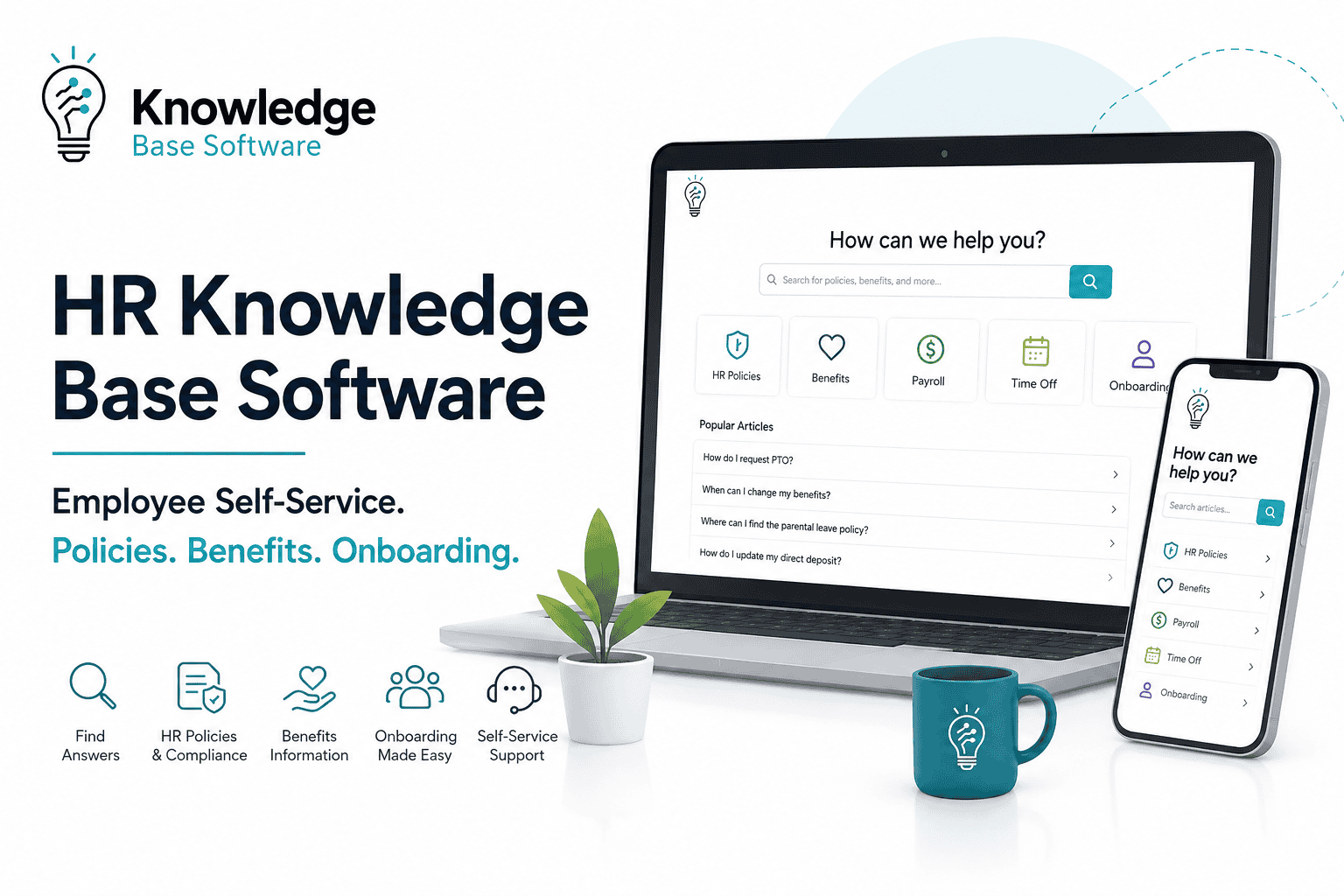
HR knowledge base software gives employees a governed place to find policies, benefits guidance, onboarding steps, and HR processes without exposing private employee records. The useful distinction is not “portal versus PDF.” It is whether the system can publish the right approved answer to the right audience, preserve ownership and version history, and keep restricted material out of search results as well as direct page views.
For most organizations, the knowledge base should contain reusable guidance, while an HRIS or case-management system remains the system of record for an individual employee’s pay, medical information, performance case, or complaint. This guide explains that operating model, shows how to design permissions by role and location, and reports a controlled synthetic access test.
Last tested: July 31, 2026.
What HR knowledge base software should do
An HR knowledge base is a publishing and retrieval layer for repeatable employee questions. It should make approved guidance easier to find than an old attachment, while giving HR a controlled workflow for ownership, review, localization, replacement, and retirement.
- Publish a direct answer, its audience, effective date, owner, and escalation path.
- Show employees only the policies that apply to their role, employment type, entity, and location.
- Remove unauthorized items before search ranking, autocomplete, snippets, related-content widgets, and AI retrieval.
- Route personal questions to the correct HR workflow instead of asking an employee to disclose case details in a public feedback box.
- Preserve approval evidence and version history while making one current version discoverable.
- Measure whether readers completed the intended task, not merely whether a page was viewed.
A shared drive may store files, but it rarely supplies this complete operating model. An intranet can provide navigation and company communications, while an internal knowledge base supplies task-focused answers. Many organizations use both.
Separate reusable guidance from employee records
Do not turn the knowledge base into a second personnel database. A policy article can explain how to request an accommodation; it should not contain the request, diagnosis, manager notes, or decision for a named employee. The article can link into an authenticated case workflow after explaining who is eligible, what to prepare, what happens next, and where to ask for help.
| Information | Recommended home | Knowledge-base treatment |
|---|---|---|
| Leave policy and request instructions | Knowledge base | Publish the approved rule, audience, effective date, owner, and secure request link. |
| Employee leave balance or request | HRIS or case system | Link to the authenticated record; do not copy the value into an article. |
| Benefits enrollment instructions | Knowledge base | Localize eligibility and deadlines, then link to the enrollment system. |
| Medical or accommodation documentation | Restricted case system | Keep it outside general knowledge search and employee feedback. |
| Manager performance process | Restricted manager knowledge | Require manager or HR authorization before retrieval. |
| Company holiday schedule | Knowledge base | Target by legal entity or location and archive replaced schedules. |
This separation supports data minimization and need-to-know access. Article 5 of the EU General Data Protection Regulation requires personal data to be adequate, relevant, and limited to what is necessary for the stated purpose. In the United States, the EEOC explains that employee medical information is generally confidential and maintained separately, subject to narrow exceptions. Applicable duties differ by jurisdiction, so involve qualified HR, privacy, security, and legal owners rather than treating this page as legal advice.
Design permissions with role and context
A role-only rule is often too broad for HR knowledge. “Employee” does not tell the system whether a California supplement, a New York schedule, or a UK leave guide applies. “Manager” does not automatically justify access to salary administration or medical-case notes.
Role-based access control attaches permissions to roles. NIST’s attribute-based access control guide describes decisions that can also evaluate subject, object, operation, and environmental attributes. For HR publishing, a practical policy can combine role with location, legal entity, worker type, business unit, sensitivity, and requested operation.
Use one decision at every retrieval surface
Apply authorization before the system returns a title, snippet, answer, attachment, or related link. A page that blocks the final click but reveals “Medical accommodation case notes” in search has already leaked information. The same policy decision should protect direct URLs, indexes, autocomplete, APIs, exports, email digests, and AI retrieval.
Deny by default and test negative cases
Write an explicit access matrix before migration. Test expected access, then deliberately test users from the wrong location, contractors, managers without HR duties, expired accounts, and integrations with insufficient scope. Log denied requests without placing sensitive query text into a broadly visible analytics report. The broader knowledge base security guide covers authentication, audit trails, exports, and incident response.
Use an HR article model that can be governed
A policy title and body are not enough. Store the attributes the system needs to select, review, and replace the answer.
| Field | Purpose | Example |
|---|---|---|
| Task title | Matches the employee’s question | Request parental leave in the UK |
| Applies to | Defines audience attributes | Employees; UK entity |
| Owner and approver | Creates accountability | People Operations; Employment Counsel |
| Effective and review dates | Separates legal effect from editorial review | Effective 1 April; review by 1 October |
| Version status | Prevents two current answers | Current; superseded; archived |
| Source of authority | Supports verification | Approved policy record or regulator |
| Task steps | Helps the employee act | Check eligibility, submit form, track status |
| Escalation path | Handles exceptions safely | Open a private HR case |
Use a consistent template and plain language, but do not compress a material exception into an ambiguous summary. The site’s knowledge base style guide and content lifecycle guide provide complementary writing and review controls.
How we tested
We built a controlled synthetic local fixture with ten invented identities and eight invented HR knowledge objects. Roles covered employee, manager, benefits, HR business partner, HR administrator, and contractor. Location scopes covered California, New York, the United Kingdom, the United States, and global administration. Documents ranged from a global handbook to state leave supplements, manager calibration guidance, salary administration, and a restricted medical-case object.
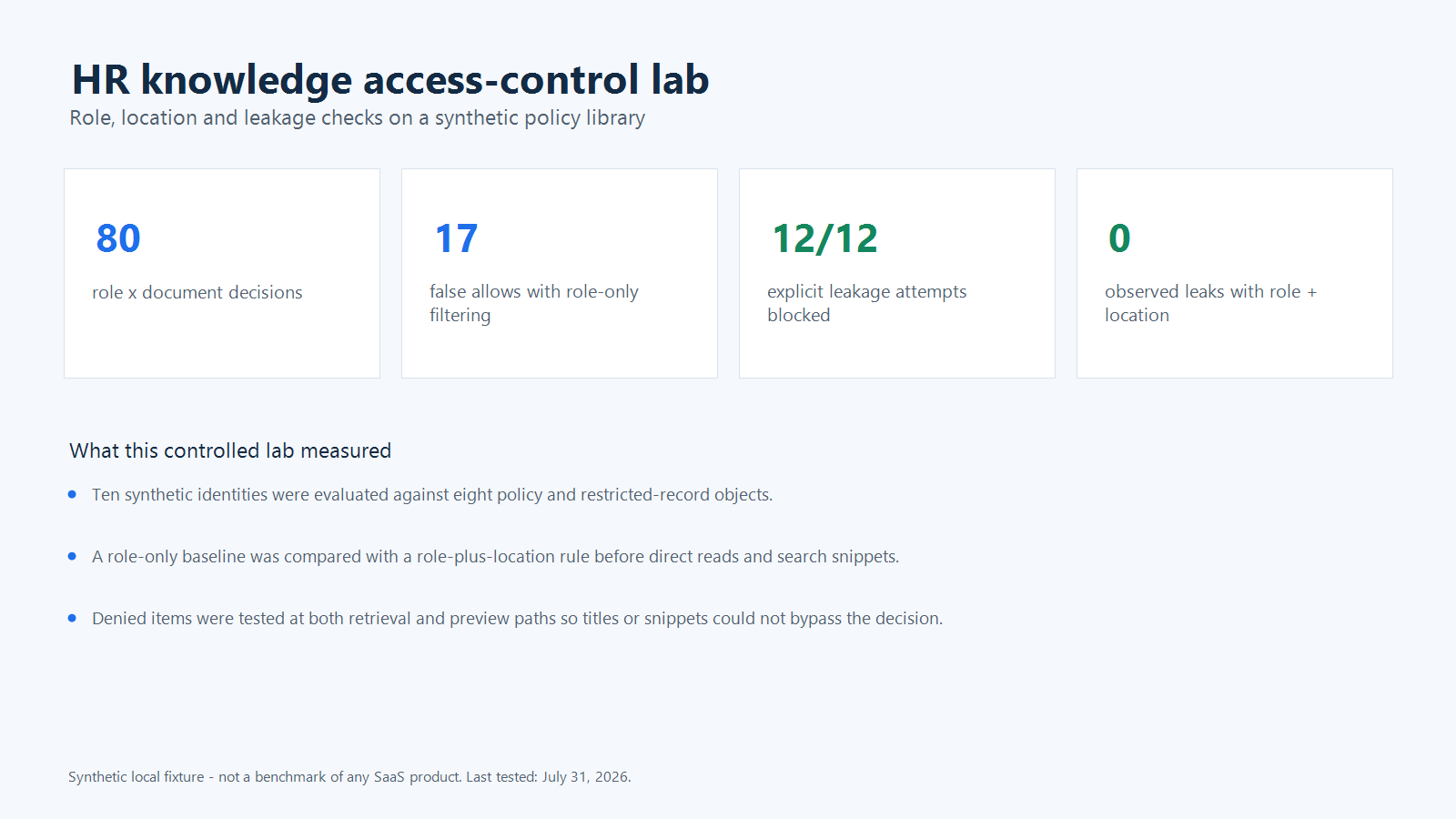
The lab evaluated all 80 identity-document pairs. We compared a role-only baseline with a rule requiring both an allowed role and an intersecting location scope. We then ran 12 deliberately unauthorized attempts through direct-read, search-result, and search-snippet paths. The fixture, decision matrix, attempts, method, and result JSON are retained with the test artifact.
Results
- The combined rule allowed 38 of 80 declared pairs and denied 42.
- The role-only baseline would have allowed 17 pairs that failed the location requirement.
- The combined rule blocked 12 of 12 explicit unauthorized attempts.
- No tested direct-read, result-title, or snippet path returned a denied object.
The result demonstrates the fixture’s rule behavior, not the security of any commercial platform. The important implementation lesson is to test context and every retrieval surface, not to assume a role label alone is sufficient.
Implementation plan
- Inventory questions and systems. Separate reusable answers from personal records, transactions, and case evidence.
- Classify content. Assign sensitivity, audience, jurisdiction, legal entity, worker type, owner, and review interval.
- Define the authority chain. Record who drafts, validates, approves, publishes, and retires each content class.
- Build the access matrix. Include search, preview, attachment, API, export, and AI-answer operations—not only page views.
- Rewrite for tasks. Lead with eligibility and the next action; link to the system of record for personal data.
- Publish one current version. Redirect or remove obsolete copies and preserve a non-searchable audit history where required.
- Run positive and negative tests. Test each audience and deliberately attempt cross-location and cross-role access.
- Launch a narrow pilot. Start with high-volume, lower-risk topics before restricted cases or broad AI retrieval.
For migration and system connections, document the data direction, identity claims, owner, failure handling, and revocation behavior. See the knowledge base integrations guide rather than treating “integrates with HRIS” as a sufficient requirement.
Measure task completion without overstating deflection
Page views show exposure, not success. A helpful rating means the reader reported that the article was helpful; it does not prove that a leave request, enrollment, or address change was completed. Add an explicit task-completion event where the workflow permits it, such as a successful form submission, a confirmed update, or a reader’s “I completed this task” response.
- Findability: successful searches, no-result queries, reformulations, and time to the applicable answer.
- Task outcome: explicit completion or solved event tied to a defined journey.
- Content health: owner coverage, overdue reviews, superseded versions returned, and broken workflow links.
- Access quality: denied attempts, permission-test coverage, stale group membership, and time to revoke access.
- Escalation quality: whether the correct private HR route was offered and whether required context transferred safely.
A ticket-deflection signal estimates journeys that did not lead to assisted contact under a defined event rule and time window. It does not prove prevented tickets without an explicit success signal or causal comparison. The Consortium for Service Innovation’s self-service measurement guidance likewise cautions against treating visits as a one-to-one count of problems solved.
Buyer and pilot checklist
- Can access rules combine groups with location, entity, employment type, sensitivity, and operation?
- Are unauthorized documents removed before indexing, snippets, recommendations, and AI retrieval?
- Can HR test permissions as representative users and export an auditable decision history?
- Can one policy have localized variants without exposing or ranking the wrong version?
- Can owners receive review reminders and see exactly which current pages lack an owner?
- Can a retired version leave search while remaining available to authorized auditors?
- Can employees reach a private case workflow without placing sensitive details in article feedback?
- Does export include content, attachments, metadata, permissions, versions, and redirect mappings?
Test these requirements with your own policies and identities. A feature label or sales demonstration is weaker evidence than a written pilot script with expected and observed results. The platform selection guide explains how to turn requirements into a scored evaluation.
Limitations
Our experiment used synthetic identities, policies, attributes, and decisions on a local rule engine. It did not connect to a vendor interface, identity provider, HRIS, search service, or AI assistant. It did not test nested groups, emergency access, session revocation, cache behavior, attachment previews, multilingual policy conflicts, or jurisdiction-specific legal compliance. The zero observed leaks applies only to the 12 declared attempts in this fixture and must not be read as a security guarantee.
Frequently asked questions
Is an HR knowledge base the same as an HRIS?
No. The knowledge base publishes reusable guidance and process instructions. The HRIS normally holds employee-specific records and transactions. The two can link or integrate, but their data and authorization boundaries should remain explicit.
Should every employee see every HR policy?
No. Global guidance may be broad, but many policies vary by location, entity, worker type, or role. Publish the applicable version and prevent inapplicable or restricted variants from appearing in retrieval surfaces.
Can AI answer HR questions safely?
Only if authorization is applied before retrieval, sources are current and owned, answers cite the applicable policy, and sensitive cases move to a private workflow. Test unauthorized queries, location conflicts, stale versions, and refusal behavior before expansion.
What should be piloted first?
Start with high-volume, repeatable, lower-risk tasks such as holidays, onboarding, enrollment navigation, and common process questions. Establish ownership, versioning, access tests, and outcome measurement before adding restricted manager or case content.