Independent knowledge base software guide Evidence-led Updated 2026

Knowledge base security and compliance: controls and evidence
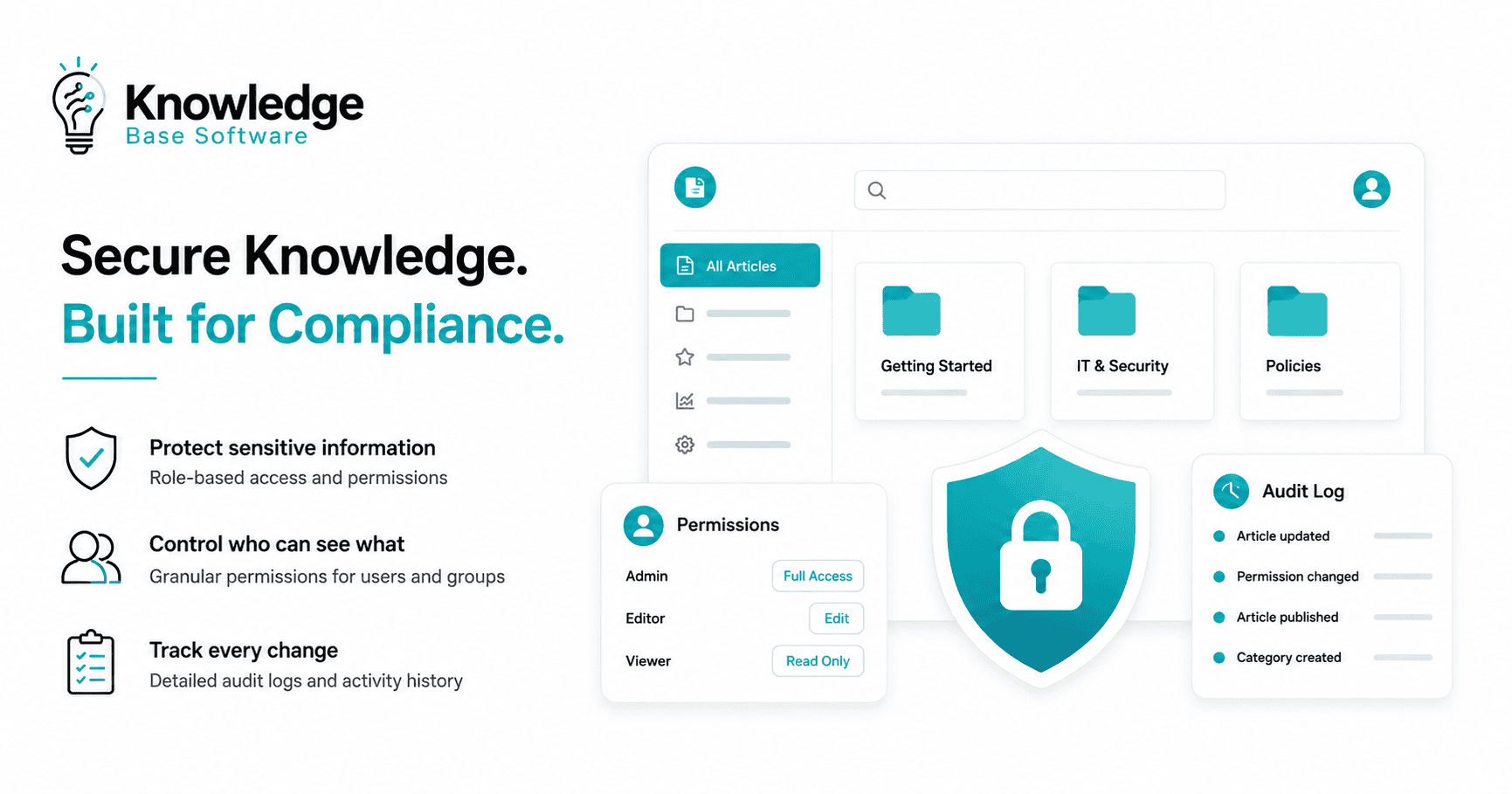
Knowledge base security and compliance starts with keeping each article, attachment, search result, export, and AI-generated answer available only to the right people—and producing evidence that the controls worked. Compliance also requires mapping those controls to the laws, contracts, and assurance criteria that actually apply to your organization.
No feature badge makes a knowledge base “GDPR compliant,” “HIPAA compliant,” or “SOC 2 compliant” by itself. Scope, configuration, data flows, people, contracts, and operating evidence all matter. Use this guide as an engineering and procurement framework, then have qualified privacy, security, and legal owners confirm your obligations.
Start with scope, not a compliance label
- Inventory content and data: articles, drafts, comments, attachments, search queries, analytics, identities, audit logs, backups, exports, and AI indexes.
- Classify audiences: public, customer, partner, employee, privileged team, administrator, and machine account.
- Identify data subjects and jurisdictions: where people are located, where data is processed, and which entity controls each purpose.
- Define harmful outcomes: unauthorized disclosure, incorrect change, unavailable guidance, hidden deletion, or untraceable activity.
- Select and test controls: tie every risk to an owner, implementation, test, evidence location, and review date.
Include copies outside the editor. A restricted article can leak through search snippets, notifications, cached pages, analytics payloads, exported PDFs, backups, integrations, or retrieval-augmented generation. The knowledge base integrations guide covers connector boundaries in more detail.
What GDPR, HIPAA, and SOC 2 mean here
| Framework | Relevant knowledge-base question | Do not assume |
|---|---|---|
| GDPR | What personal data is processed, for which purpose and legal basis, for how long, by whom, and with what security? | Encryption or EU hosting alone resolves every duty. |
| HIPAA | Does the system create, receive, maintain, or transmit ePHI for a covered entity or business associate, and are required safeguards and agreements in place? | A vendor’s security page replaces a risk analysis or BAA. |
| SOC 2 | What system and period did the CPA examine, which Trust Services Criteria were in scope, and what exceptions and user-entity controls apply? | A SOC 2 report is a product certification or guarantees your configuration. |
The official GDPR text includes purpose limitation, data minimization, accuracy, storage limitation, integrity and confidentiality, and accountability among its principles. Those principles affect what you collect in comments and analytics as much as how you protect articles.
The U.S. Department of Health and Human Services states that the HIPAA Security Rule requires appropriate administrative, physical, and technical safeguards for ePHI. Its cloud-computing guidance says a cloud service provider that creates, receives, maintains, or transmits ePHI for a covered entity or business associate is a business associate even when it holds encrypted ePHI without the key; a HIPAA-compliant business associate agreement is required in that scenario. Confirm current rulemaking on the official HHS Security Rule page.
AICPA describes System and Organization Controls as assurance services CPAs provide over system- or entity-level controls. A SOC 2 examination addresses controls relevant to security and may also cover availability, processing integrity, confidentiality, or privacy, depending on scope. Read the report, period, opinion, exceptions, subservice organizations, and complementary user-entity controls rather than accepting a logo. See the official AICPA SOC suite overview.
Build a minimum control baseline
| Control area | Minimum implementation | Test evidence |
|---|---|---|
| Identity | Unique accounts, centralized SSO where appropriate, MFA based on risk, automated deprovisioning | Joiner/mover/leaver samples; failed-login and MFA tests |
| Authorization | Deny by default; role, tenant, group, and content-class checks on every delivery path | Positive and negative access matrix, including search and exports |
| Administration | Separate author, publisher, auditor, and platform-admin capabilities; controlled emergency access | Privilege review and break-glass exercise |
| Data protection | Encrypted transport and storage, managed keys, secret exclusion, secure attachment handling | Configuration evidence and restore/decryption tests |
| Logging | Record security-relevant allow/deny, publish, permission, export, and configuration events | Event coverage, field completeness, alert, and tamper tests |
| Lifecycle | Retention and deletion rules for content, comments, queries, logs, indexes, and backups | Deletion sample traced through dependent stores |
| Resilience | Backups, recovery targets, incident playbooks, and tested rollback | Restore exercise and incident timeline |
| Vendors | Contract, subprocessor, location, breach, export, deletion, and exit requirements | Due-diligence record and annual reassessment |
NIST SP 800-53 Revision 5 provides a flexible catalog spanning Access Control, Audit and Accountability, Identification and Authentication, Incident Response, System and Communications Protection, and related families. NIST issued Release 5.2.0 updates in August 2025; use the current official SP 800-53 page and tailor controls to risk rather than treating the catalog as a universal checklist.
Design authorization around the resource
Authentication establishes an identity; authorization decides what that identity can do to a particular resource. Do not let “logged in,” “employee,” or “support” act as a universal permission. Evaluate the user, tenant, region, group, content classification, lifecycle state, and requested action together.
- Apply the same policy to article pages, APIs, search results, autocomplete, feeds, attachments, exports, and AI retrieval.
- Use stable groups or attributes from the identity provider; avoid one-off grants without expiry and ownership.
- Separate view, suggest, edit, publish, delete, permission-change, export, and audit-log access.
- Test cross-tenant and cross-region access explicitly.
- Revoke sessions, tokens, cached access, and group memberships promptly when roles change.
- Review privileged and machine accounts more frequently than ordinary readers.
For identity design, federation, and lifecycle controls, use the SSO and identity management guide. NIST finalized SP 800-63 Revision 4 in July 2025; it uses risk assessment to select identity, authentication, and federation assurance levels. See the official NIST Digital Identity Guidelines.
Create audit logs that answer an investigation
A useful audit record should answer: when did the event occur, who acted, what action was attempted, which object and version were affected, what was the result, from what context, and how can related events be correlated? Record denied access as well as successful changes. Protect logs from unauthorized reading, alteration, and early deletion.
- Log sign-in, privilege and group changes, publish/unpublish, export, deletion, bulk actions, API-key changes, configuration changes, and access to sensitive resources.
- Use synchronized timestamps, stable actor and object IDs, result and reason fields, source context, and a correlation ID.
- Alert on repeated denials, unusual exports, mass permission changes, disabled logging, and emergency-account use.
- Do not write passwords, access tokens, encryption keys, full session identifiers, or unnecessary personal and sensitive data into logs.
- Set retention from legal, contractual, security, and privacy needs; do not retain logs indefinitely by default.
The OWASP Logging Cheat Sheet recommends consistent application logging, protection against tampering, testing logging failures, and excluding or masking secrets and sensitive data.
How we tested
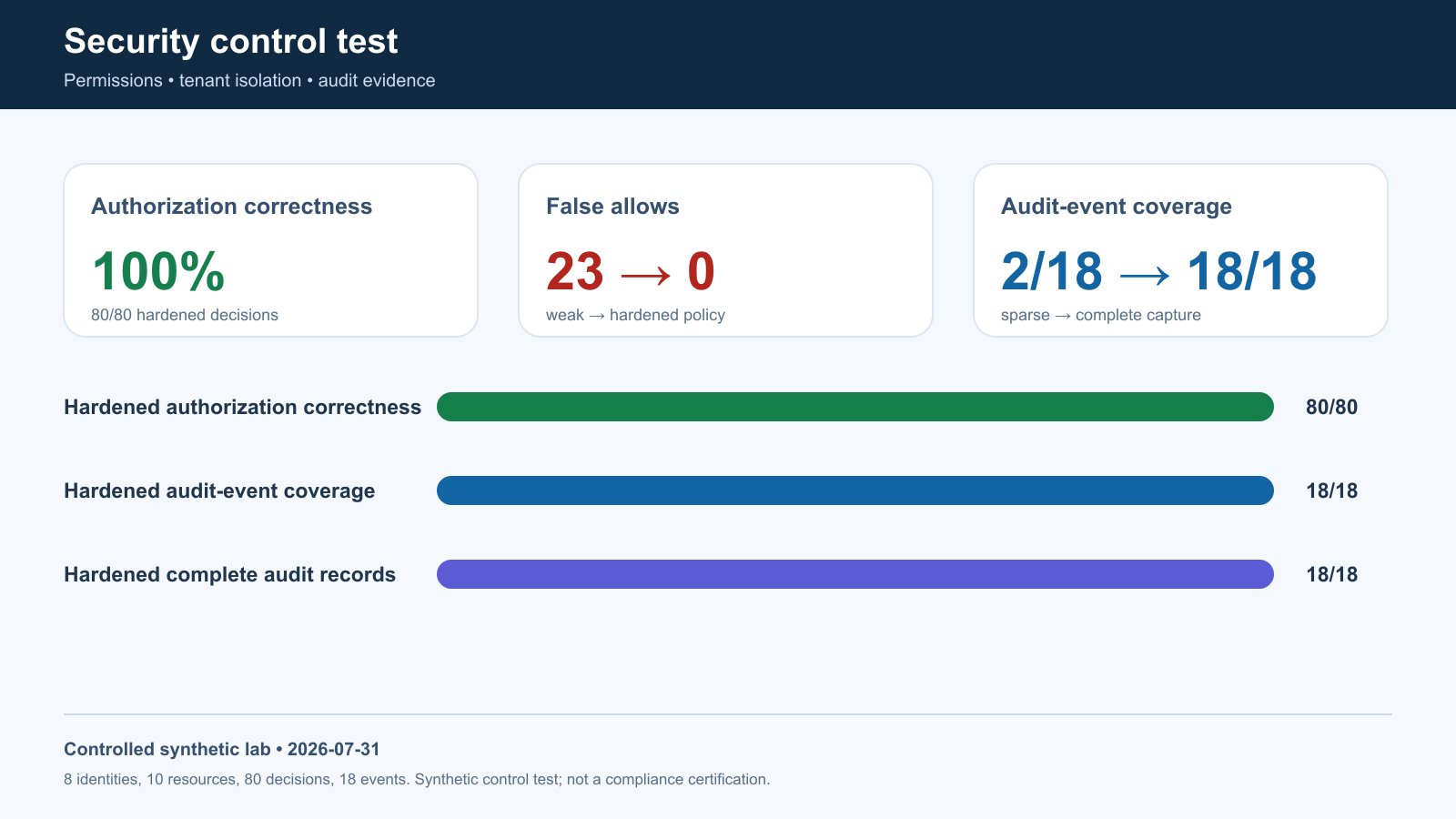
We ran a controlled synthetic lab on July 31, 2026 using 8 invented identities and 10 invented resources, creating 80 authorization decisions. Resources represented public, registered, internal, and restricted classes, including tenant A and tenant B records. We also evaluated 18 synthetic auditable events against seven required fields. This was not a penetration test, certification, or SaaS product review.
We declared the expected allow or deny decision for every identity-resource pair before execution. The weak baseline authorized by broad classification and ignored tenant boundaries: any authenticated identity could reach registered content, while broad staff groups could reach internal or restricted content. The hardened policy required both an explicitly allowed role and, where a tenant was present, an exact tenant match. Administrators were the only global exception.
For logging, the baseline captured only a narrow subset of successful export events and omitted source IP and correlation ID. The hardened variant captured every tested allow and deny event with timestamp, actor, action, resource, result, source IP, and correlation ID. We measured authorization correctness, false allows, event coverage, and field completeness. The full inputs and decision-level results accompany the evidence image.
| Measure | Weak baseline | Hardened control |
|---|---|---|
| Authorization correctness | 57/80 (71.3%) | 80/80 (100%) |
| False allows | 23 | 0 |
| Auditable events captured | 2/18 (11.1%) | 18/18 (100%) |
| Captured records with all 7 fields | 0/2 | 18/18 (100%) |
The baseline intentionally used broad rules—any authenticated person for “registered” content and any staff member for “internal” content—while ignoring tenant and function. The hardened policy used exact allowed roles plus tenant matching. Results show why positive tests alone are insufficient: a user opening their own resource proves nothing about whether they can open another tenant’s resource.
The audit result is equally bounded. Complete fields and event coverage do not prove tamper resistance, appropriate retention, alert response, or legal compliance. Production validation must also test logging outages, clock drift, administrator access to logs, export volume, retention enforcement, and evidence recovery.
Protect AI, search, and integrations
- Carry source permissions into indexes and enforce them before retrieval.
- Remove deleted or downgraded content from indexes and caches within a measured time.
- Prevent restricted titles and snippets from appearing to unauthorized users.
- Treat prompts, retrieved text, and model output as data flows in the privacy and security inventory.
- Limit connector scopes and service accounts; rotate credentials and monitor unusual reads.
- Require source citations and safe refusal for AI answers; never let generation bypass content access.
- Test indirect prompt injection and malicious content before enabling actions.
See the agent-assist knowledge base guide for permission-aware retrieval tests and the data residency guide for location and transfer questions.
Evaluate a vendor with evidence
- Draw the complete data-flow diagram, including subprocessors, support access, analytics, AI services, backups, and disaster-recovery copies.
- Request the current independent report and read its scope, period, opinion, exceptions, and complementary controls.
- Test your roles, tenants, search, APIs, exports, and offboarding in a trial environment.
- Verify encryption, key responsibility, audit-log availability, retention configuration, deletion behavior, incident notice, and evidence export.
- Confirm contract terms: data-processing agreement, BAA where applicable, subprocessor notice, assistance with rights requests, breach duties, return/deletion, and exit.
- Document gaps and compensating controls with an owner and due date.
Collect comparable responses: use the Security & AI due-diligence questionnaire to request product- and region-scoped evidence, record exceptions, and keep the buyer’s risk decision separate from the vendor’s claim.
Availability belongs in the assessment too. Define recovery time and recovery point objectives, then prove them with an exercise using the knowledge base disaster recovery guide.
Limitations
The controlled synthetic lab demonstrates policy and logging logic against a predeclared oracle. It is not a penetration test, privacy impact assessment, HIPAA risk analysis, SOC 2 examination, GDPR assessment, or legal opinion. The identities, resources, tenants, and events were invented, and the sample did not test a commercial knowledge-base platform.
Perfect decisions in 80 cases do not establish that every production path enforces the same policy. Search suggestions, cached content, file downloads, APIs, mobile clients, exports, webhooks, AI indexes, backups, and administrator tools each need negative tests. Complete log fields do not establish that logs are authentic, protected from tampering, retained for the correct period, monitored, or usable during an incident.
Production validation should include a live data-flow inventory, threat model, configuration review, dependency and connector assessment, vulnerability testing, recovery exercise, log-failure simulation, alert-response test, and evidence review by accountable privacy, security, legal, and audit owners. Repeat control tests after identity, permission, integration, index, retention, or vendor changes.
Operate the controls continuously
- Review privileged access and stale accounts on a defined schedule.
- Run automated negative authorization tests after permission, connector, and index changes.
- Sample logs for event coverage, field completeness, and alert follow-through.
- Exercise restore, breach response, evidence collection, and emergency access.
- Trace deletion requests through the live platform, indexes, analytics, exports, and backup policy.
- Reassess vendors, subprocessors, data locations, and contract terms after material changes.
- Review content ownership and classification through the knowledge base governance framework.
Frequently asked questions
Does SOC 2 mean a knowledge base is secure?
No. A SOC 2 report is an independent assurance report for a defined system, criteria, and period. You must inspect scope, exceptions, subservice organizations, and controls that the customer must operate, then test your own configuration.
Is encryption enough for HIPAA?
No. HIPAA obligations depend on role and facts, and the Security Rule covers administrative, physical, and technical safeguards. HHS cloud guidance also states that holding only encrypted ePHI without the key does not by itself remove a cloud provider’s business-associate status.
Should audit logs contain full article text?
Usually not. Prefer stable object and revision IDs plus the security-relevant event. Store content in the governed content system, and exclude or mask secrets and unnecessary personal data from logs.
How often should permissions be tested?
Test automatically after relevant configuration or code changes, and run scheduled reviews based on risk. Privileged roles, tenant boundaries, exports, and machine accounts deserve more frequent checks than public reading.
Last tested: July 31, 2026. This educational guide is not legal advice or a certification. Verify current laws, regulatory guidance, contracts, and assurance reports for your circumstances.