Independent knowledge base software guide Evidence-led Updated 2026

Revenue operations knowledge base: CRM rules and change control
A Revenue Operations knowledge base is the governed source for CRM fields, funnel definitions, routing rules, forecasting logic, ownership, integrations, and recovery procedures. Its job is not to repeat every CRM screen. It should explain the business meaning of each rule, identify the system of record, show who may change it, and preserve what downstream teams and integrations must do when the schema changes.
This guide focuses on the highest-risk RevOps failure modes: renamed fields, inconsistent mappings, excessive write permissions, transient delivery failures, and undocumented retries. It includes a controlled synthetic local lab; it does not claim to test a live Salesforce, HubSpot, or other SaaS tenant.
Last tested: July 31, 2026.
What belongs in a Revenue Operations knowledge base
The knowledge base should document the operating contract shared by marketing, sales, customer success, finance, analytics, and the systems that exchange revenue data. A practical core includes:
- CRM data dictionary: stable field identifier, display label, object, type, allowed values, business definition, owner, sensitivity, and deprecation status.
- Lifecycle and pipeline rules: entry and exit criteria, required evidence, automation, exception route, and reporting effect.
- Forecast rules: category definitions, amount and close-date rules, override permissions, cadence, and audit expectations.
- Ownership and routing: territory, account, lead, opportunity, and renewal assignment logic, including conflict resolution.
- Integration contracts: source and destination fields, direction, transformations, identity, permissions, event IDs, and failure handling.
- Change records: proposal, impact analysis, approvers, effective time, migration, rollback, validation, and communication.
- Runbooks: how to detect, contain, replay, reconcile, and close an incident without creating duplicates.
Keep screenshots as supporting evidence, not the definition itself. Labels and layouts change. An internal field name, object, data type, and declared enum are more durable integration references. HubSpot’s official CRM properties documentation, for example, distinguishes a human-readable label from the internal property name used through the API and documents the relationship between property type and field type.
Treat every CRM field as a contract
| Field documentation | Required detail | Why it matters |
|---|---|---|
| Identity | Object, stable internal name, label, type | Prevents an interface label from becoming an unreliable API contract |
| Meaning | Business definition, non-examples, source of authority | Keeps teams from using the same value differently |
| Allowed values | Enum key, display value, active status, replacement | Supports validation and safe deprecation |
| Ownership | Business owner, technical owner, approver | Separates policy decisions from implementation |
| Write policy | Authorized roles and systems; precedence | Prevents competing sources from overwriting one another |
| Downstream use | Reports, workflows, integrations, models | Defines the blast radius of change |
| Quality rule | Required, unique, format, reconciliation | Makes validation testable |
| Lifecycle | Introduced, changed, deprecated, removed | Gives consumers a migration window |
The knowledge article is the readable contract; the CRM schema and repository configuration should remain the executable contract. Link them with a stable identifier and test whether the documented definition matches the live schema. Do not ask users to infer a field’s meaning from its name.
Use a controlled field-change workflow
A rename is not merely editorial. It can change form submissions, imports, dashboards, workflows, enrichment, warehouse models, scoring, and partner integrations. Apply the same change record whether the request originates in a CRM admin queue, analytics project, or business meeting.
- Open a proposal. Record the reason, owner, old and proposed definitions, affected populations, and target date.
- Discover dependencies. Search workflows, forms, APIs, sync jobs, reports, models, exports, and training material for the stable field ID and enum values.
- Choose compatibility behavior. Decide whether to add a new field, retain an alias, map old and new values, or migrate in place.
- Define permissions. Specify who can read or write the field in UI, API, import, automation, and system contexts.
- Create acceptance tests. Include old and new schemas, invalid values, unauthorized writes, rollback, duplicates, and delayed events.
- Run a staged migration. Backfill, validate counts and values, compare reports, then switch producers and consumers.
- Observe and reconcile. Monitor validation errors, unmapped values, retry queues, and material report differences.
- Deprecate deliberately. Communicate the cutoff, remove obsolete producers, retain an audit record, and update the knowledge article.
For a wider integration architecture, see knowledge base integrations and the CRM integration implementation guide.
Document permissions at field and operation level
Record-level access alone is not sufficient. A sales representative may update a deal stage but not a forecast override or commission field. A CRM integration may need to write acquisition source but have no reason to read compensation. Apply least privilege to the role, object, field, operation, and execution context.
NIST’s attribute-based access control guidance separates the subject, object, requested operation, and environment used in an authorization decision. The exact implementation differs across products, but the documentation lesson is portable: state which layer a rule protects and test the API or automation context, not only the interface.
| Role | Typical permitted action | Typical restriction to test |
|---|---|---|
| Sales representative | Update owned opportunity stage | Cannot write forecast override or compensation |
| Sales manager | Set forecast category for the team | Cannot change finance-controlled fields |
| RevOps | Administer funnel and mapping fields | Cannot write compensation without explicit grant |
| Finance | Read or approve commission adjustments | Cannot silently change pipeline stages |
| Integration identity | Write declared synchronization fields | Cannot access unrelated sensitive fields |
| Administrator | Emergency and configuration access | Privileged activity must be logged and reviewed |
Specify failure, retry, and replay behavior
“Retry on error” is not an implementation plan. The runbook should classify errors, bound attempts, use idempotency or deduplication, preserve the original event, and define reconciliation.
- Validation errors: do not repeatedly retry an invalid field or enum. Send it to a reviewable dead-letter state with the reason.
- Authentication and authorization errors: stop, alert the owner, and verify credentials or scope; do not broaden permissions as an automatic recovery.
- Rate limits and transient service failures: respect provider guidance, use bounded backoff, and preserve the event ID.
- Conflicts: apply an explicit source-of-truth and concurrency policy rather than last-write-wins by accident.
- Timeouts with unknown outcome: check by idempotency key or target state before writing again.
- Replay: retain enough payload, schema version, mapping version, timestamps, and authorization context to reproduce the decision safely.
RFC 9110 defines HTTP status semantics and the Retry-After field, but it does not make every failure safe to retry. Classify outcomes against the documentation for the endpoint you actually use: retry only defined transient conditions, respect server guidance, cap attempts, and route exhausted or permanent failures to a dead-letter queue.
How we tested
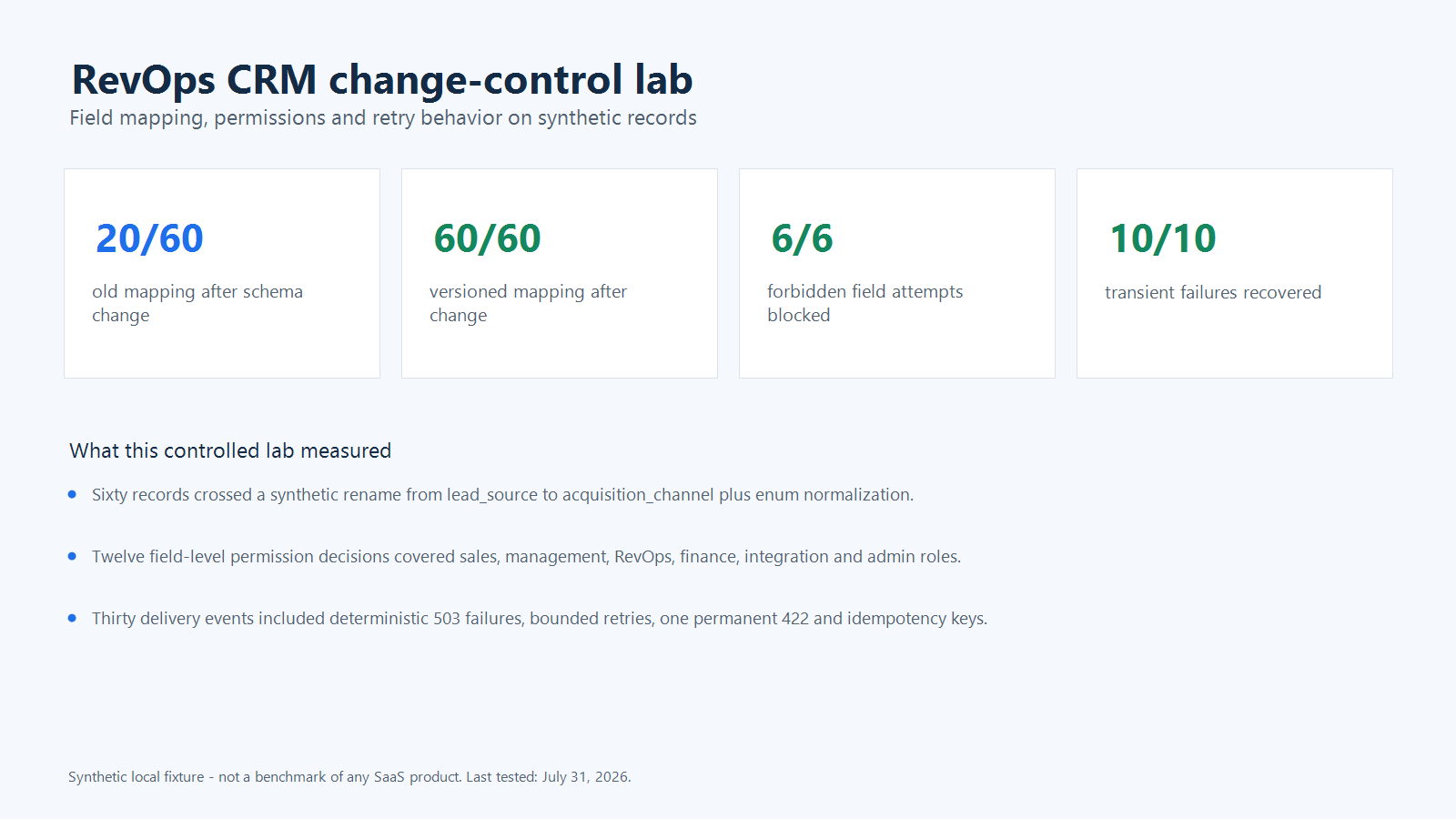
We created a controlled synthetic local fixture with 60 invented CRM records. Twenty used a version-one field named lead_source. Forty used a version-two field named acquisition_channel, with three normalized enum changes: Organic Search to Organic, Paid Search to Paid, and Partner Referral to Partner.
The baseline mapping read only the old field. The governed mapping accepted both declared schema versions and normalized the documented aliases. We also evaluated 12 field-level permission attempts across sales representative, sales manager, RevOps, finance, integration, and administrator roles. Finally, 30 synthetic delivery events included deterministic transient 503 outcomes, one permanent 422 validation error, at most four attempts, and an idempotency key. Retry timing was simulated locally; no network request was sent.
Results
- The old-field-only mapping processed 20 of 60 records and left all 40 version-two records unmapped.
- The versioned mapping processed 60 of 60 records and normalized the declared values.
- All 12 permission decisions matched the expected matrix; six of six forbidden attempts were denied.
- Ten events encountered declared transient failures and all ten succeeded within the attempt limit.
- One permanent validation error moved to the dead-letter state; 29 events were delivered.
- The idempotency check produced zero duplicate writes in the fixture.
These results show that the written compatibility, permission, and retry rules behaved as declared in the fixture. They do not estimate the reliability of a CRM or integration product. A real pilot must use the actual API, scopes, schemas, limits, concurrency, observability, and recovery process.
Build each RevOps article as an operational record
Use a repeatable article structure so a reader can act and an auditor can reconstruct the decision.
- Direct answer: the current rule in one or two sentences.
- Applies to: teams, objects, pipelines, regions, products, and schema versions.
- Business meaning: definition, non-examples, and why the rule exists.
- System behavior: automation, precedence, permissions, and downstream effects.
- Procedure: steps, inputs, expected result, and validation.
- Exceptions: who can approve them and how they are recorded.
- Failure and recovery: error classes, alerts, retry, dead letter, replay, and reconciliation.
- Ownership: business owner, technical owner, validator, and review trigger.
- Change history: effective date, schema or mapping version, successor, and rollback.
For consistent writing and lifecycle status, pair the style guide with the content lifecycle guide.
Measure reliability and user outcomes
- Schema health: unmapped fields or enums, consumers on deprecated versions, and time to complete a migration.
- Data quality: required-field completeness, invalid values, reconciliation differences, and duplicate records.
- Access quality: denied unauthorized attempts, overprivileged identities, scope drift, and revocation time.
- Delivery reliability: success by attempt, retry volume, dead-letter age, duplicate suppression, and recovery time.
- Knowledge health: owner coverage, overdue reviews, conflicting current definitions, and source-schema drift.
- Task success: explicit completion of the documented process or validated correct decision.
A helpful vote reports perceived usefulness; it does not prove that the CRM update or approval succeeded. A ticket-deflection signal estimates journeys that did not reach assisted support under a defined event rule and time window. It does not establish prevented tickets without an explicit success signal or causal comparison.
Thirty-day improvement plan
- Days 1–5: choose one high-impact object and inventory fields, reports, automation, integrations, owners, and existing definitions.
- Days 6–10: publish the data dictionary and field-level permission matrix; resolve conflicting definitions.
- Days 11–15: document one change workflow and create old/new schema, invalid-value, and unauthorized-write tests.
- Days 16–20: document error classification, idempotency, retry limits, dead-letter ownership, replay, and reconciliation.
- Days 21–25: run the tests in a safe environment, record observed results, and repair gaps.
- Days 26–30: train affected teams, set owner and review alerts, publish the change log, and schedule a recovery exercise.
Limitations
The lab used invented records, schemas, roles, mappings, and HTTP outcomes in a local script. It did not authenticate to a CRM, exercise a vendor interface, measure network latency, verify webhook signatures, discover real dependencies, or test provider-specific rate limits and transaction semantics. The field change was deliberately bounded to one rename and three enum aliases. Permission results cover only the 12 declared attempts, and zero duplicate writes applies only to the synthetic idempotency flow. Use a sandbox or equivalent safe environment before production change.
Frequently asked questions
Who should own the Revenue Operations knowledge base?
RevOps can own the operating model, but each rule needs the accountable business and technical owners. Finance should validate finance-controlled definitions, Sales leadership should validate sales policy, and system owners should validate executable behavior.
Should CRM documentation live inside the CRM?
Contextual help can live in the CRM, but the governed source may live elsewhere if it supports ownership, review, history, search, access, and export. Link contextual help to the stable source and avoid maintaining two current definitions.
What is the first integration rule to document?
Document source of truth and write precedence. Without them, two systems can each behave as designed while repeatedly overwriting the other’s valid value.
When should an integration retry?
Retry only errors classified as transient for that endpoint, use bounded backoff, respect provider instructions such as Retry-After, and prevent duplicate effects. Send permanent validation failures to an owned resolution path.