Independent knowledge base software guide Evidence-led Updated 2026

Developer Portals and API Knowledge Bases: What Each Layer Should Do
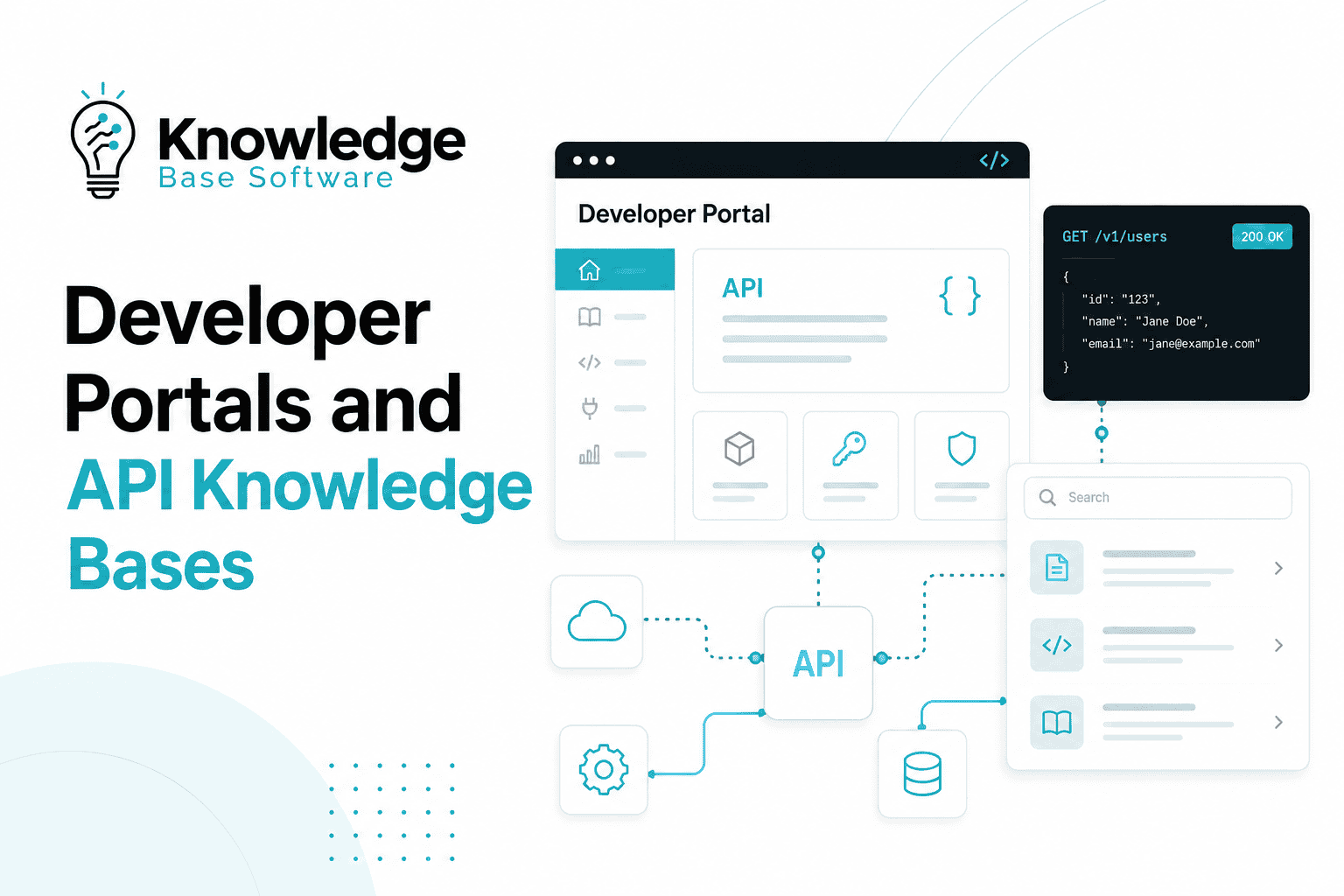
A developer portal is not the same thing as an API reference, and neither one replaces an API knowledge base. The strongest documentation systems connect all three: the portal helps a developer discover the right product and obtain access, the reference defines the API contract, and the knowledge base helps people complete tasks, diagnose failures, and adapt to change.
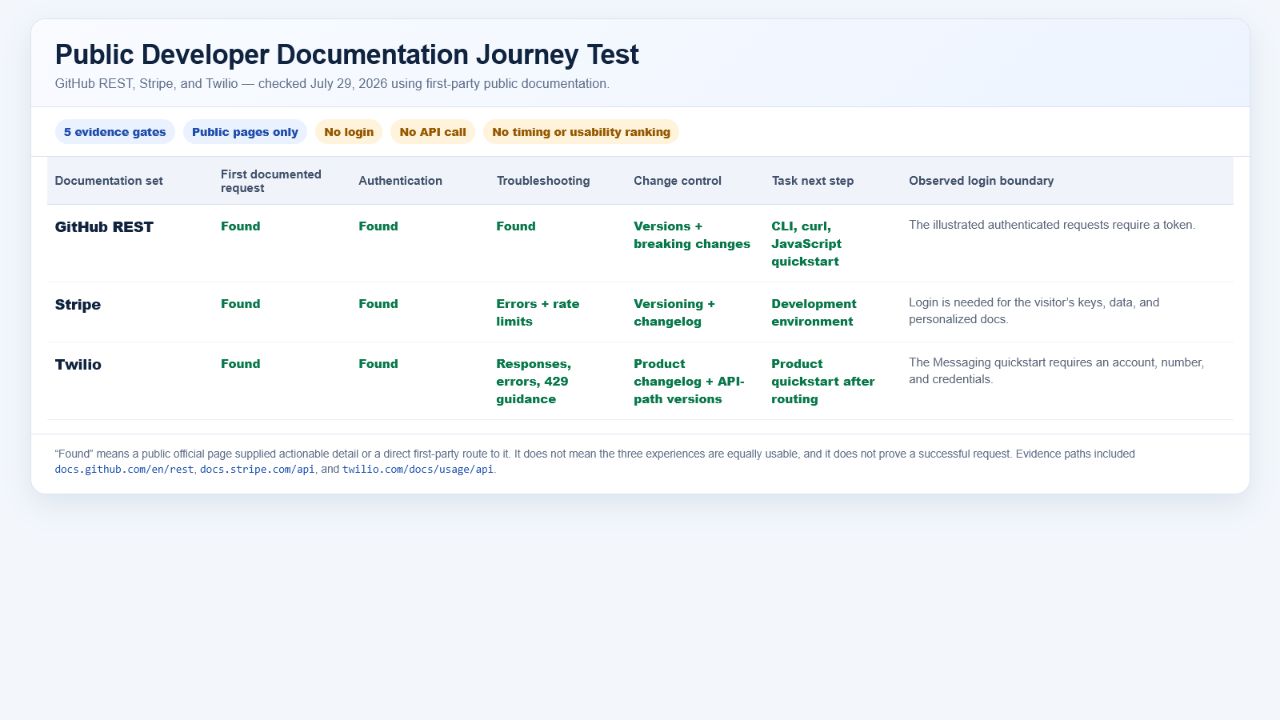
This guide explains that architecture and turns it into a practical evaluation method. We also applied a five-artifact public documentation test to GitHub, Stripe, and Twilio on July 29, 2026. We used only public, first-party pages. We did not sign in, use credentials, send an API request, or claim that a documented example produced a successful response.
Developer portal vs API reference vs API knowledge base
The useful distinction is not which publishing tool produced a page. It is the job that page performs for a developer.
| Layer | Primary developer question | Typical content | Failure symptom |
|---|---|---|---|
| Developer portal | “Where do I start, and how do I get access?” | Product catalog, audience routes, signup, applications, keys, plans, sandbox, dashboard, status, and support entry points | Developers cannot identify the right API, environment, or credential path |
| API reference | “What exactly can I send, and what can the API return?” | Hosts, authentication schemes, operations, parameters, schemas, responses, examples, and version identifiers | Developers guess field behavior or rely on an SDK to reveal the contract |
| API knowledge base | “How do I complete this task, recover from this error, or handle a change?” | Quickstarts, workflows, error resolution, limits, known issues, migrations, deprecations, security guidance, and operational support | Reference pages exist, but integration work stalls when the happy path ends |
A single website can contain all three layers. A portal may even render reference pages and host guides. The architecture still matters because each content type needs a distinct purpose, owner, review trigger, and success measure.
What each documentation layer should own
1. The developer portal owns discovery and access
The portal should help a new visitor choose an API or product without already knowing the organization’s internal vocabulary. Its product pages should state the audience, use cases, prerequisites, data or geographic constraints, pricing or plan dependencies, and a concrete next step.
Access is part of the journey, not a detached administrative chore. Explain whether a developer needs an account, application, approval, subscription, sandbox, OAuth client, API key, or production review. Keep secrets behind authentication, but make the learning path public when security and licensing allow. A developer should understand the integration shape before surrendering personal information or asking an administrator for access.
2. The API reference owns the contract
The reference is the canonical source for machine-level behavior: server URLs, methods, authentication, request fields, constraints, response schemas, status codes, pagination, idempotency, and version-specific differences. Examples should illustrate the contract, not substitute for it. If generated reference and hand-written guidance disagree, users need a visible rule for which source wins and a fast route to report the defect.
Reference pages should link outward at the moment context becomes necessary. An authentication section should lead to credential setup and rotation guidance. A 429 response should lead to the relevant limit and retry policy. A deprecated field should lead to a migration path and dated change record.
3. The API knowledge base owns successful use and recovery
An API knowledge base converts contract details into decisions. It should cover complete tasks, not merely repeat endpoint descriptions. Useful articles explain prerequisites, the recommended sequence, expected checkpoints, common failures, security implications, cleanup, and the next production concern.
Error articles deserve their own content model. At minimum, record the exact error identifier, affected product and version, likely causes, diagnostic evidence, safe resolution steps, retry guidance, escalation data, owner, and last verification date. Do not copy the same mutable limit or workaround into multiple guides. Store it once, then link to it from reference and task pages.
Design the journey around six developer capabilities
A page-count inventory cannot tell you whether developers can make progress. Test whether the documentation supports these six capabilities from end to end.
| Capability | Evidence to look for | What to record |
|---|---|---|
| Discover | A product route, audience statement, use case, and prerequisites | Starting URL and whether the correct product can be chosen without internal terminology |
| Access | Authentication scheme, credential path, permissions, environments, and secret-handling advice | Public learning boundary and the exact point at which login or approval is required |
| Make a first documented request | Base URL or product endpoint, method, minimal example, and expected response shape | Whether all required information is available before execution |
| Build | Task guides, SDK choices, pagination, testing, limits, and production guidance | Whether a quickstart leads to the next real implementation task |
| Recover | Status codes, error identifiers, diagnostics, retry rules, status page, and escalation path | Whether an observed failure can be mapped to a safe next action |
| Change safely | Version policy, changelog, deprecations, breaking-change notices, and migration instructions | Whether a developer can determine impact, deadline, and required action |
The first three capabilities reduce onboarding friction. The last three determine whether the documentation remains useful after a proof of concept. Mature programs measure both.
Original public documentation audit: method
We ran a bounded evidence audit of the public documentation journeys for GitHub REST, Stripe, and Twilio. This was a documentation-availability test, not a product benchmark. Starting from each vendor’s public documentation, we looked for five artifacts:
- First documented request: a base URL or product endpoint plus a request method or example.
- Authentication: a named authentication scheme plus guidance for credentials or secrets.
- Troubleshooting: error or status-code guidance plus rate-limit or recovery advice.
- Change control: a version policy, breaking-change record, or changelog that makes change visible.
- Task-based next step: a quickstart or workflow guide beyond an endpoint reference.
An artifact was marked “Found” only when a public first-party page supplied recognizable evidence. “Found” does not mean the documentation is complete, correct for every account, easy to discover for every user, or sufficient to execute an authenticated request.
Audit results
| Public journey | First request | Authentication | Troubleshooting | Change control | Task next step | Observed execution boundary |
|---|---|---|---|---|---|---|
| GitHub REST | Found | Found | Found | Found | Found | A token was required for the illustrated authenticated requests |
| Stripe | Found | Found | Found | Found | Found | Login was required for the researcher’s own keys, data, and personalized examples |
| Twilio | Found | Found | Found | Found | Found | An account, credentials, and product resources were required to complete the Messaging quickstart |
GitHub REST: a central API path with explicit version material
The public GitHub REST API documentation leads to a REST quickstart with command-line, JavaScript, and curl paths. The quickstart exposes request structure publicly, while its authenticated examples require credentials. GitHub’s authentication guide explains token use and the Authorization header.
Recovery and change evidence is separated into focused pages. The rate-limit guide documents relevant response behavior and retry considerations. The API versions page identifies supported versions and the version header, while the breaking changes page records incompatible changes. We confirmed the public evidence path but did not supply a token or send any example.
Stripe: public contract and operations guidance with a personalized boundary
The public Stripe API reference exposes the API base URL and request patterns. Its authentication page describes HTTP Basic authentication, secret-key handling, and the need to keep secret keys out of client-side code. Public examples can illustrate the shape of a request; account-specific keys and data require login.
Stripe provides a public error-code index and a separate rate-limit guide. The latter documents 429 responses, the Stripe-Rate-Limited-Reason header, and exponential backoff. Change evidence is available through the versioning guide and API changelog. At the audit date, the official versioning page named 2026-06-24.dahlia as current. The development environment guide supplies a task-oriented next step. We did not log in, use a sample key, or send a request.
Twilio: shared request guidance plus product-specific journeys
Twilio’s public API overview explains that product APIs share common practices, while the API requests guide provides request examples, authentication choices, and a base endpoint. It recommends API key and secret credentials for production authentication and limits Account SID and Auth Token use to local testing.
The API responses guide maps status codes and Twilio-specific error data, including a documentation URL in the error response. The API best-practices guide covers 429 responses, exponential backoff, monitoring headers, and troubleshooting. Change is exposed through the public Twilio product changelog and version identifiers within product API paths.
The task path becomes product-specific: the Messaging documentation leads to an SMS developer quickstart. Completing that quickstart requires signup, product resources such as a number or virtual phone, and credentials. We stopped at that boundary and made no API call.
What the three public journeys teach
- Public learning and authenticated execution are different states. A portal can publish enough contract, authentication, error, and change information for evaluation while protecting credentials and account data.
- One global quickstart is not always the right structure. GitHub can route through a central REST path; Twilio must first help the user choose a communications product. Information architecture should follow the product model.
- Recovery content needs more than a status-code table. The useful path connects the error to limits, retry behavior, request identifiers, status information, and escalation evidence.
- Change control is a connected system. Version identifiers, compatibility rules, changelog entries, deprecation notices, and migration guidance must point to one another.
- Availability is only the first test. The next audit should measure discovery time, comprehension, and successful execution with authorized test accounts.
Where OpenAPI fits—and where it does not
The official OpenAPI Specification currently resolves to version 3.2.0, dated September 19, 2025; we rechecked it on July 29, 2026. OpenAPI is a language-agnostic interface description for HTTP APIs. A maintained description can support reference generation, code generation, testing, and other tooling.
OpenAPI can be the source for operations, parameters, schemas, responses, servers, security definitions, and examples. It cannot, by itself, decide which product a developer needs, explain an approval workflow, teach an end-to-end business task, diagnose every production failure, announce a migration deadline, or define a support escalation path. Treat the specification as a contract source inside the documentation system, not as the entire developer experience.
Validate the publishing toolchain against the specification features you actually use. “Supports OpenAPI” is not a sufficient acceptance test: render a representative file, test references and security schemes, compare the output with the source, and repeat the test before upgrading either the specification or the portal platform.
Two official platform examples—and their configuration limits
Microsoft describes the Azure API Management developer portal as an automatically generated, customizable site where consumers can discover APIs, learn about them, request access, and try them. Its reference console can use no authentication, a subscription key, or OAuth depending on configuration, and browser-based calls require the appropriate CORS setup. The lesson is architectural: a visible “Try it” button is not proof that anonymous or cross-origin execution will work.
Google documents three Apigee portal approaches: an integrated portal, a Drupal-based portal, or a custom portal built with Apigee APIs. Its API publishing guide shows how an API product can be paired with OpenAPI, AsyncAPI, or GraphQL material. It also records practical limits: SmartDocs supports OpenAPI 3.0 and 2.0 rather than every possible specification feature, remote references are not supported, console authentication depends on proxy configuration, and generated request samples are not production code.
These are implementation examples, not a ranking or universal platform recommendation. Evaluate any portal against your identity model, product catalog, specification dialect, content workflow, analytics requirements, accessibility baseline, and support process.
A practical developer portal and API knowledge base checklist
Use binary evidence first. Score “Yes” only when a reviewer can point to a public or appropriately authenticated page and name its owner.
- Can a first-time visitor choose the correct API from a use case or audience route?
- Are prerequisites, plan restrictions, environments, and approval requirements stated before setup?
- Is the first documented request complete enough to understand without hidden context?
- Does authentication guidance distinguish evaluation, local testing, and production practice?
- Can a developer identify where credentials come from and how secrets should be stored or rotated?
- Does every reference operation show parameters, constraints, responses, and version context?
- Do task guides connect prerequisites, checkpoints, errors, cleanup, and production next steps?
- Do error pages map identifiers to causes, safe actions, retry rules, and escalation evidence?
- Are limits defined by scope and unit, with headers or signals a developer can observe?
- Can a user find the version policy, changelog, deprecation deadline, and migration guide from one another?
- Is there one canonical owner and review trigger for every mutable fact?
- Are documentation search, feedback, status, and support routes visible at the point of failure?
Measure the journey without inventing success
Define each metric before testing, preserve the evidence, and separate public-documentation results from authenticated product results.
| Metric | Operational definition | Required evidence |
|---|---|---|
| Time to first documented request | Time from the selected public entry page to locating a base endpoint, method, auth requirement, and complete example | Start URL, end URL, timestamp, route, and tester |
| Signup-to-credential time | Time from beginning authorized registration to obtaining a credential suitable for a test environment | Test account, timestamps, approval steps, and environment |
| Credential-to-first-success time | Time from credential availability to the first confirmed successful response for the defined task | Sanitized request, response status, endpoint, version, and timestamp |
| Error-search success | Share of a fixed set of real error identifiers that leads to an actionable page within the allowed search path | Error set, queries, result URLs, and pass rule |
| Zero-result rate | Share of representative documentation searches that return no results | Fixed query set, search scope, date, and raw outcomes |
| Breaking changes with migration guidance | Share of sampled breaking changes that link to impact, deadline, and migration steps | Defined date range, sampled entries, and linked guidance |
| Documentation update latency | Elapsed time between a product or contract change and the verified update of all affected documentation objects | Change timestamp, page revisions, owners, and completion rule |
Do not merge these measures into a single “developer experience score” without publishing weights and limits. A public evidence audit can show that information exists; only an authorized execution test can show that credentials, examples, network behavior, and the live API work together.
Governance: keep reference, guidance, and change records consistent
Assign ownership by content object. Engineering or API product owners should approve contract facts. Developer education or technical writing should own task flow and information design. Support and reliability teams should contribute error evidence, status routes, and escalation requirements. Security should approve credential and secret-handling guidance. Release management should trigger version, deprecation, and migration updates.
Connect those owners to a documented knowledge base content lifecycle. Review on change, not only on a calendar. An authentication change should trigger the reference, setup guide, quickstart, error content, and screenshots. A breaking change should not be considered documented until the changelog, affected reference, migration guide, and deadline agree.
Use stable content types and relationships in the knowledge base information architecture. This guide covers portal architecture, content synchronization, publishing-event webhooks, retry handling, and deduplication.
Frequently asked questions
Is a developer portal the same as API documentation?
No. A developer portal is the access and discovery environment around an API program. API documentation is content within or linked from that environment. The documentation set usually includes reference, quickstarts, task guides, errors, limits, change records, and support information.
What belongs in an API knowledge base?
Put task guidance, error resolution, operational limits, known issues, security procedures, migrations, deprecations, and support workflows in the knowledge layer. Keep exact fields and response schemas canonical in the API reference, then link the two at relevant operations and errors.
Is an OpenAPI file enough for a developer portal?
No. OpenAPI can describe an HTTP API contract and power useful tooling, but it does not replace product discovery, account access, end-to-end tasks, troubleshooting, change communication, or support. It is a core source, not the complete experience.
Should API documentation be public before login?
Publish enough information for discovery and technical evaluation whenever security, privacy, contracts, and licensing permit. Credentials, account data, private APIs, and execution consoles can remain gated. Document the boundary clearly so users know what an account unlocks.
What should an API error article include?
Include the exact error identifier, affected product and version, likely causes, diagnostic evidence, safe resolution steps, retry conditions, related limits or incidents, escalation data, owner, and last verified date. Link back to the operation and forward to any known issue or status event.
Audit limits and final verdict
This audit was performed by one researcher on one date using public first-party documentation. It did not test search quality, accessibility, mobile behavior, click counts, completion time, credential issuance, sandbox behavior, API availability, response correctness, or support quality. The three vendors serve different products, audiences, authentication models, and risk profiles. Dynamic, localized, and personalized documentation may change what another visitor sees.
The defensible result is narrow: all five evidence artifacts were publicly discoverable for the three sampled journeys, and each journey exposed a clear boundary before authenticated execution. The broader architectural conclusion is stronger: a useful developer documentation system must connect discovery, contract, task guidance, recovery, and change management. A portal without those connections is a catalog; a generated reference without them is a contract with no operating manual.