Independent knowledge base software guide Evidence-led Updated 2026

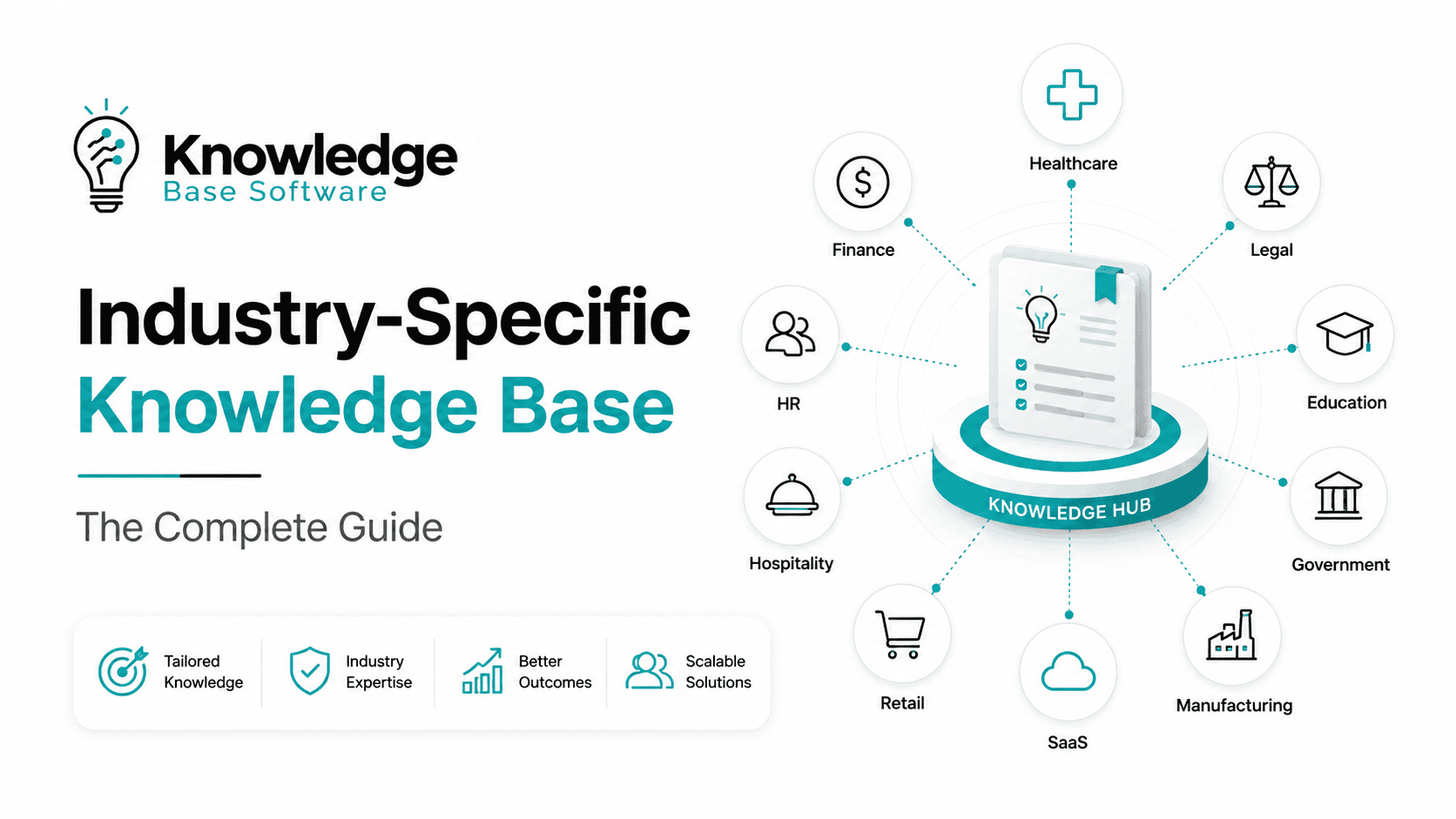
Industry-Specific Knowledge Base: The Complete Guide
Industry-specific knowledge base software is a knowledge platform configured for the terminology, roles, risks, workflows, sources, and review obligations of a particular sector. The software does not have to be sold only to that industry. What matters is whether the deployed system can distinguish a current approved procedure from a plausible but wrong answer—and show that distinction to people and connected AI tools.
Quick answer
Choose an industry-specific configuration when a wrong answer can expose sensitive information, cause a safety or financial error, violate a retention or disclosure rule, or send a user into the wrong jurisdictional workflow. Require role-based access, approval status, source attribution, version history, review dates, audit evidence, sector synonyms, and a safe escalation outcome. A generic searchable wiki can be sufficient for low-risk team notes; it is not automatically sufficient for governed operational knowledge.
Important: this guide is a software and content-governance framework, not legal, clinical, financial, safety, or compliance advice. Requirements vary by organization, activity, contract, and jurisdiction. Have qualified specialists validate your controls and content.
Contents
- What “industry-specific” actually means
- When a generic knowledge base is not enough
- Original six-industry lab benchmark
- Requirements by sector
- A durable content and metadata model
- Decision and trial framework
- Implementation plan
- AI and retrieval governance
- Frequently asked questions
What “industry-specific” actually means
A knowledge base becomes industry-specific through its operating model, not its homepage label. It represents the real entities people work with—patient request, brokerage communication, machine energy source, legal matter, education record, or payment account data—and connects each answer to the correct role, place, status, version, and authority.
That can be delivered in three ways:
- Vertical product: software designed around one sector’s workflows and integrations.
- Configurable general platform: a flexible knowledge base with fields, permissions, workflows, audit logs, and APIs configured for the sector.
- Composable system: a publishing layer connected to identity, records, document control, search, analytics, and AI services.
A vertical tool may reduce setup work, but a general platform can be the better fit if it passes the organization’s required controls. Conversely, familiar editing is not enough when the platform cannot enforce visibility, approval, retention, or traceability. For a broad starting point, see our knowledge base software comparison.
When is an industry-specific knowledge base necessary?
Use a risk-based test. If “mostly right” is acceptable and the content contains no sensitive or controlled information, a straightforward wiki may be enough. Industry configuration becomes more valuable as the cost of wrong retrieval rises.
| Question | If the answer is yes |
|---|---|
| Could the wrong procedure injure someone or damage equipment? | Require approved status, equipment or context matching, version control, and a stop/escalate path. |
| Does content contain protected, privileged, financial, student, or payment information? | Require identity-aware access, least privilege, logging, and content-classification rules. |
| Do different jurisdictions or contracts require different answers? | Model applicability explicitly; do not hide regional differences in prose. |
| Must the organization prove what guidance was active at a past date? | Require immutable history, effective dates, approval evidence, and reliable export. |
| Will an AI assistant retrieve or summarize the content? | Provide approved sources, status and scope metadata, evaluation cases, and abstention behavior. |
| Do frontline or field users work under time pressure? | Test mobile access, offline or degraded-mode needs, short checklists, and unambiguous escalation. |
If the primary material is controlled procedures, also compare a knowledge base with SOP software. If users need to discover information across many systems without moving it, the relevant comparison may be knowledge base versus enterprise search.
Original lab benchmark: terminology alone was not enough
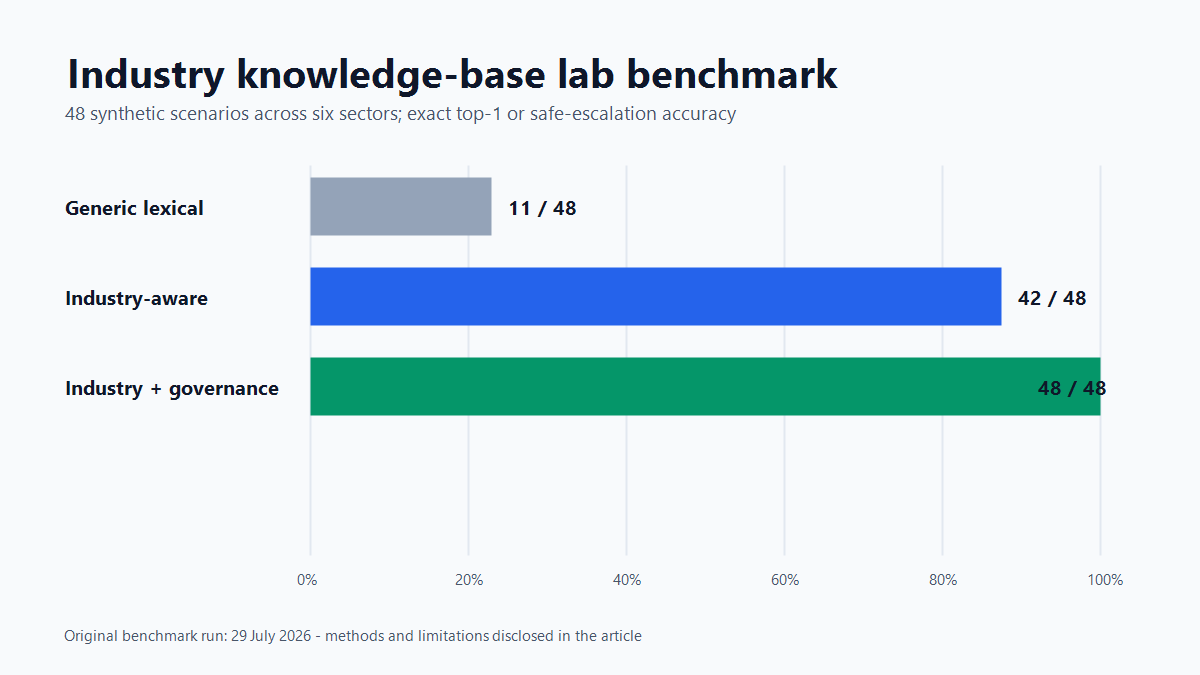
We created a fixed-seed laboratory benchmark to isolate three mechanisms: lexical matching, sector vocabulary, and governance filters. It used no customer or production data. The result does not rank commercial vendors; it shows how the same synthetic cases behave when context and governance signals are added.
How the test was run
- We defined six sector profiles: healthcare, financial services, manufacturing, legal services, education, and hospitality.
- Each sector received eight synthetic scenarios: exact terminology, a colloquial synonym, role context, jurisdiction context, authoritative source, version choice, a stale exact-match distractor, and an urgent unapproved answer that should escalate.
- Seed
20260729fixed the order of the three candidate documents in every scenario. - The generic system used unexpanded token overlap in title and body. The industry-aware system added a sector glossary plus role and jurisdiction metadata. The governed system also required approved/current content, used source and version signals, and returned
ESCALATEfor the unsafe unapproved case. - A result counted only when the top choice exactly matched the predeclared current document or the predeclared escalation outcome.
| Configuration | Correct top result | Safe escalations on 6 unsafe cases |
|---|---|---|
| Generic lexical | 11/48 (22.9%) | 0/6 |
| Industry-aware | 42/48 (87.5%) | 0/6 |
| Industry-aware + governance | 48/48 (100%) | 6/6 |
Observed data versus interpretation
The observed numbers are the output of this defined synthetic dataset and scoring code. Our interpretation is narrower: synonym, role, and jurisdiction signals helped retrieval; approval, review date, source, version, and escalation rules were necessary for the deliberately unsafe cases. The 100% governed score proves that those rules worked on cases designed to exercise them. It does not prove that any product, taxonomy, or AI system will be perfect with real content.
Limitations
This was an adversarial mechanism test, not user research. The synthetic queries, documents, expected answers, metadata, and scoring rules were created together, which favors systems that use the declared fields. The corpus was tiny; it did not model ambiguous policies, multilingual users, permissions failures, semantic embeddings, OCR, long documents, real click behavior, or professional judgment. Reproduce the pattern with your own de-identified questions and independently approved answers before making a purchase or safety decision.
Knowledge base requirements by industry
The following matrix translates sector risk into software and content controls. It is a discovery checklist, not a universal compliance specification.
| Industry | High-value knowledge | Controls to test first | Common search vocabulary problem |
|---|---|---|---|
| Healthcare | Patient-access workflows, privacy procedures, clinical system downtime, billing operations | Identity and role access, source authority, approval, audit, emergency escalation | Patients and staff use everyday terms that differ from policy language |
| Financial services | Customer communication, supervision, recordkeeping, account operations, incident response | Retention, time-stamped history, legal hold, supervision, reliable export | Product, regulatory, and customer terms overlap but carry different obligations |
| Manufacturing | Equipment procedures, maintenance, quality checks, safety response, shift handover | Asset and site scope, version/effective date, mobile usability, sign-off, stop-work path | Local machine names may not match engineering or safety terminology |
| Legal services | Matter procedures, research playbooks, client intake, templates, conflicts and confidentiality guidance | Matter-level permissions, ethical walls, provenance, jurisdiction, privileged-content handling | Similar legal terms can require different answers by court, client, or jurisdiction |
| Education | Student services, records requests, teaching systems, accessibility, faculty and staff procedures | Student-record access, audience separation, accessibility, academic-calendar review | Students, parents, faculty, and registrars describe the same process differently |
| Hospitality | Property operations, guest service, payment handling, incident response, brand standards | Property/role scope, mobile access, multilingual content, payment-data boundaries, escalation | Brand, property, and local phrases compete with corporate terminology |
Healthcare
Do not place protected health information in general articles merely because the platform has a login. Separate reusable guidance from case or patient records, apply least-privilege access, and log sensitive administrative actions. The U.S. Department of Health and Human Services publishes HIPAA Security Rule guidance addressing administrative, physical, and technical safeguards for electronic protected health information. Use the applicable rule text and qualified advice to define your controls.
Financial services
“We have version history” is not the same as satisfying a recordkeeping obligation. Determine which communications and records are in scope, how long each must be preserved, whether an audit-trail or other format is required, and how records are produced. For one U.S. example, the SEC’s summary of amendments to broker-dealer electronic recordkeeping requirements describes WORM and audit-trail alternatives under Rule 17a-4. That example does not apply to every financial organization.
Manufacturing
A procedure must match the machine, energy sources, location, role, and effective version. Make safety-critical instructions easy to identify and hard to confuse with training summaries. OSHA’s lockout/tagout guidance says energy-control procedures must identify relevant machinery and the type and magnitude of hazardous energy, and outline sequential control steps. Review the official OSHA energy-control procedure guidance with your safety specialists.
Legal services
Permission design must follow matters and ethical boundaries, not only departments. Search results, previews, analytics, exports, and AI prompts can all reveal content, so test the entire retrieval path. The American Bar Association’s Model Rule 1.6 addresses confidentiality and reasonable efforts to prevent unauthorized disclosure or access; local professional rules and client terms may differ.
Education
Separate public student guidance from restricted records and internal decisions. Map permissions for students, eligible students, parents, faculty, advisors, registrars, and vendors. The U.S. Department of Education’s FERPA resources are an authoritative starting point for covered U.S. education records. Also test the public knowledge experience against WCAG 2.2; accessibility should be a release criterion, not an optional theme feature. For more sector detail, use our education knowledge base software guide.
Hospitality
Frontline guidance needs property, shift, language, device, and role context. Keep payment account data out of general operating articles and prevent search snippets from exposing restricted content. The PCI Security Standards Council describes PCI DSS as a baseline of technical and operational requirements to protect payment account data. Validate your scope with qualified experts rather than treating a knowledge-base feature as a compliance certificate.
A durable industry content model
Every controlled article should carry enough structured context for a reader, reviewer, search engine, and authorized AI system to decide whether it applies. The fields below can be visible labels, system metadata, or both.
| Field | Example question it answers |
|---|---|
| Audience and permission class | May this reader see the full article and its search preview? |
| Industry process and task | Which real workflow does this answer support? |
| Role and competency | Who may perform the procedure, and what training is assumed? |
| Location, asset, product, or matter | Where and to what does the instruction apply? |
| Jurisdiction and contractual scope | Which legal, policy, or client boundary applies? |
| Status and effective date | Is this approved and currently in force? |
| Owner and approver | Who verifies accuracy and authorizes publication? |
| Source and evidence | What policy, standard, test, or authority supports the claim? |
| Review trigger and due date | What change should cause immediate review? |
| Version, supersedes, and archive relation | What changed, and which prior answer must not be used? |
| Escalation boundary | When must a reader stop and ask a qualified person? |
Templates make these fields consistent. They do not make the underlying decisions for you. Start with the patterns in our knowledge base templates and examples, then add the sector-specific controls identified by your risk owners.
Decision framework for selecting software
Separate mandatory gates from weighted preferences. A platform that fails a mandatory confidentiality or audit requirement should not win because its editor is easier to use.
Stage 1: pass/fail gates
- Identity integration and permission model can express the required audiences.
- Search results and previews obey the same permissions as full articles.
- Approval, version, effective date, rollback, and export meet evidence needs.
- Data hosting, processing, encryption, backup, deletion, and vendor terms pass review.
- The platform can preserve or integrate with the required system of record.
- Accessibility and required device contexts can be tested successfully.
Stage 2: weighted operational test
| Dimension | Suggested weight | Trial evidence |
|---|---|---|
| Retrieval quality and sector vocabulary | 20% | Fixed de-identified query set with exact expected answers and abstentions |
| Permissions and privacy | 20% | Role matrix tested for pages, snippets, APIs, exports, analytics, and AI |
| Governance and auditability | 20% | Draft-to-approval workflow, history, due review, rollback, and audit export |
| Author and reviewer workflow | 15% | Timed creation and controlled change using real templates |
| Integration and portability | 10% | Identity, ticketing, records, import, full export, and redirect test |
| User experience and accessibility | 10% | Representative tasks on desktop, mobile, keyboard, zoom, and assistive technology |
| Total cost and administration | 5% | Three-year cost model including setup, migration, support, and maintenance |
Weights are a starting point, not a standard. A hospital may move permissions and governance higher; a field-service manufacturer may increase mobile and offline requirements. Record the rationale before vendor demonstrations so scoring does not drift toward the best presentation.
Questions a polished demo may not answer
- Can a search suggestion reveal the title of an article the user cannot open?
- What happens when the best lexical match is expired or still in draft?
- Can reviewers compare versions and see the source behind a changed claim?
- Can one article have different applicability without duplicating the full text?
- Does a complete export preserve media, metadata, relationships, permissions, and history?
- Can AI be limited to approved, in-scope sources and return “I cannot answer safely”?
Implementation plan: from policy shelf to working system
1. Define audiences and risk boundaries
List who asks questions, who may answer, which data must never enter an article, and which decisions always require a qualified person. Include customers, employees, contractors, partners, regulators, and public visitors where applicable.
2. Inventory and classify the corpus
Collect current articles, PDFs, shared drives, portals, SOPs, training materials, canned replies, and unofficial notes. For each item, record authority, owner, audience, sensitivity, status, effective date, format, duplicate relationship, and migration decision. Do not connect an AI assistant to the unreviewed dump.
3. Model real terminology
Build a glossary from de-identified searches, tickets, forms, training questions, and practitioner review. Connect colloquial terms to approved concepts, preserve acronyms, and mark terms that change meaning by jurisdiction or role. Search tuning should help a user reach the right controlled answer without rewriting the controlled wording itself.
4. Configure permissions before migration
Create the audience and role model first, then test positive and negative access cases. Check full pages, attachments, search snippets, related-article widgets, notifications, APIs, exports, caches, and connected AI. “Access denied” on the article page is insufficient if the title or excerpt leaked earlier.
5. Migrate by controlled workflow
Move a representative high-risk process before the entire corpus. Validate import fidelity, metadata, links, media, approvals, and export. For every old item, decide keep, rewrite, merge, restrict, archive, or destroy under the applicable policy. Public pages with equivalent replacements should receive specific redirects.
6. Test with tasks and failure cases
Ask representative users to find and apply answers without coaching. Include synonyms, wrong-role queries, expired documents, drafts, regional variants, and a case with no approved answer. Record first-result accuracy, completion, unsafe action, time, escalation, accessibility issues, and the evidence a reviewer used.
7. Launch with ownership coverage
Do not launch priority controlled content without owners and review triggers. Monitor failed searches and repeated escalations, but investigate before creating new pages: the fix may be a synonym, clearer applicability, permission repair, merge, or product/process change. Use the knowledge base UX guide to test the delivery layer as well as the content.
AI and retrieval governance
An AI interface raises the importance of scope metadata because a fluent answer can hide a wrong source. Restrict retrieval to the caller’s permissions, expose citations, prefer approved current sources, and make abstention measurable. The NIST AI Resource Center provides resources for testing, evaluation, verification, and validation under the AI Risk Management Framework; adapt the ideas to your risk context.
- Maintain a fixed evaluation set with common, ambiguous, adversarial, and no-answer cases.
- Score source correctness separately from prose quality.
- Test permission leakage in retrieved passages, citations, conversation history, and logs.
- Version the model, retrieval configuration, corpus snapshot, prompt, and expected answers.
- Route high-risk uncertainty to a named role with the query and evidence preserved.
- Re-run relevant cases after policy, product, taxonomy, or model changes.
Metrics for an industry knowledge base
Combine findability with control effectiveness. Page views alone cannot tell whether people used the right version or whether restricted knowledge leaked.
| Metric | What it should reveal |
|---|---|
| Approved-answer top-1 rate | Whether the first result is the prevalidated current answer |
| Safe escalation rate | Whether no-answer and unapproved-answer cases stop instead of guessing |
| Permission test pass rate | Whether positive and negative access cases work across every surface |
| Review compliance | Whether priority content is verified within its defined window |
| Stale-result exposure | How often expired or superseded content appears in search or AI retrieval |
| Source coverage | Share of controlled claims linked to an approved authority or test |
| Task completion | Whether authorized users complete the intended workflow correctly |
| Repeat incident or contact | Whether the guidance solves the issue without recurrence |
Frequently asked questions
Does industry-specific knowledge base software guarantee compliance?
No. Software can support controls, evidence, and consistent workflows, but compliance depends on applicable requirements, configuration, content, people, contracts, and ongoing operation. Validate the full system with qualified specialists.
Do we need a vendor dedicated to our industry?
Not necessarily. A configurable platform may satisfy the same requirements. Use mandatory gates and scenario testing to compare the deployed control, not the vendor’s market label.
Can one knowledge base serve several industries or business units?
Yes, if it can separate audiences, vocabularies, sources, approvals, jurisdictions, and analytics without accidental cross-exposure. Separate spaces may be safer when governance models or legal entities differ materially.
What should we test in a proof of concept?
Use a representative controlled process, real permission roles, current and stale versions, an unapproved draft, sector synonyms, a no-answer case, complete export, mobile and accessibility checks, and an audit-evidence request. Predetermine the expected outcome for every case.
How often should controlled content be reviewed?
Set intervals by risk and rate of change, then add event triggers for law, policy, equipment, product, contract, incident, and organizational changes. “Last edited” is not the same as “last verified.”
Should archived articles remain searchable?
Not in ordinary current-answer search. Authorized users may need an archive for audit or historical reconstruction, but status should be unmistakable and current systems should not retrieve an archived answer as active guidance.
The practical standard
An industry-specific knowledge base succeeds when the right person can find the right approved answer for the right context—and the system refuses to improvise when that answer does not exist. Start with risk boundaries and representative scenarios, then choose and configure the software that can make those decisions visible, testable, and maintainable.