Independent knowledge base software guide Evidence-led Updated 2026

Knowledge base data residency: data-flow worksheet and buyer guide
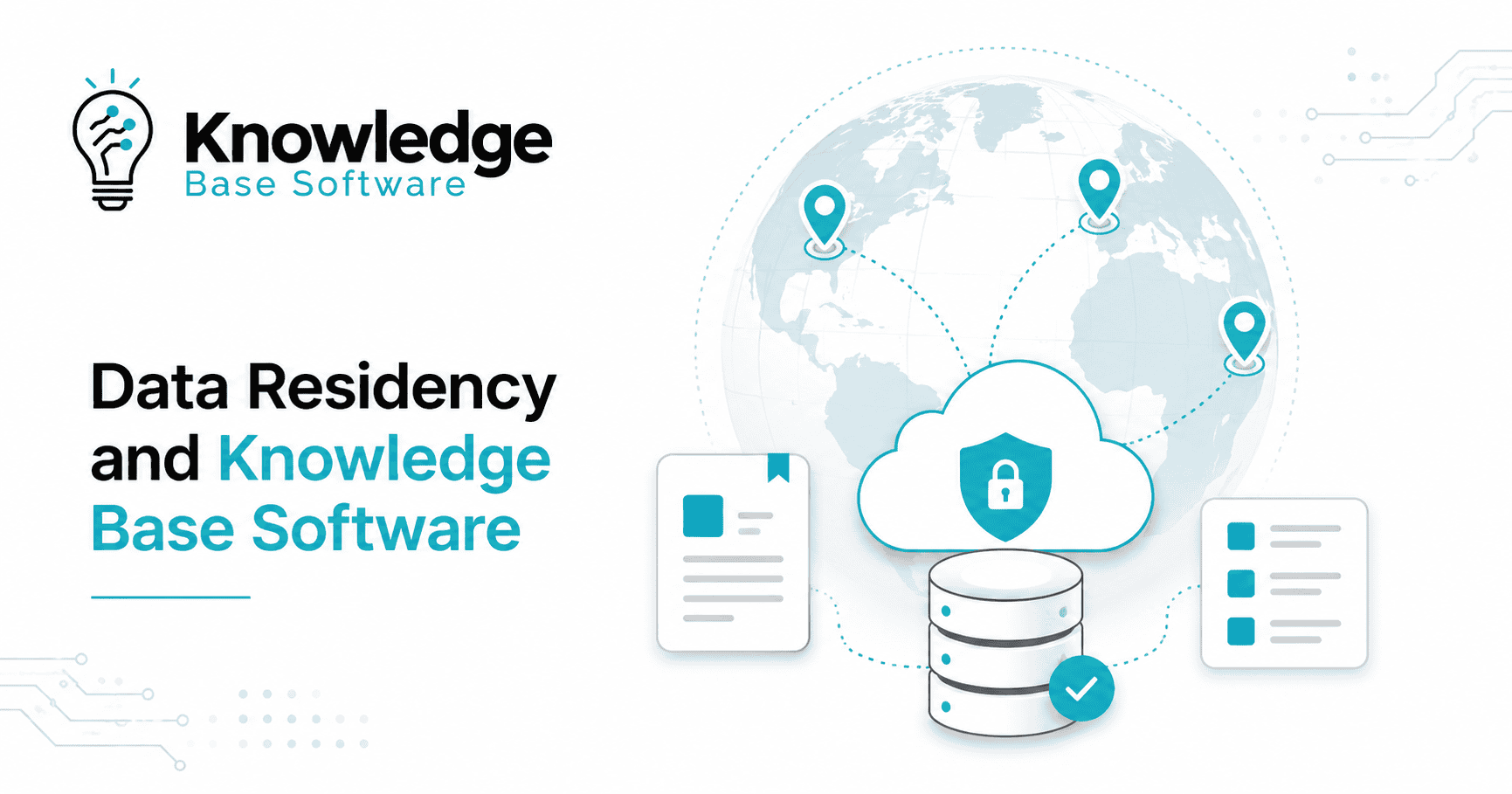
Knowledge base data residency is the documented location where defined data is stored. A useful residency decision goes beyond the primary article database: it maps search indexes, attachments, identity records, logs, analytics, backups, disaster-recovery replicas, integrations, translation payloads, AI prompts, generated answers, and vector embeddings. If a vendor only names its main hosting region, the evaluation is incomplete.
Last tested: July 31, 2026.
Scope: This is a buyer’s data-flow and evidence framework. It is not legal advice, a vendor certification, or a statement that a region setting makes a deployment compliant. Pair it with your legal, privacy, security, and procurement review.
Data residency, sovereignty, and localization are different
| Term | Practical meaning for a buyer | Question it does not answer |
|---|---|---|
| Data residency | Where defined data is stored or pinned | Whether every data type, copy, or access path is included |
| Data sovereignty | Which legal authority may apply to data or a provider | Whether a particular transfer or processing activity is lawful |
| Data localization | A requirement to keep specified data or processing within a jurisdiction | Whether the vendor’s advertised region satisfies your exact obligation |
Do not use the terms as substitutes. “EU hosting,” for example, might cover in-scope article content at rest while excluding account data, analytics, an AI feature, a marketplace app, or older backups. Atlassian’s current data residency documentation explicitly distinguishes data that can be pinned from data outside that scope. That distinction is a useful evaluation pattern even when you assess another platform.
Start with a data-flow inventory
Write the requirement before comparing vendors. The NIST Privacy Framework treats inventory and the wider data-processing ecosystem as inputs to privacy-risk management. For a knowledge base, make one row for every artifact and processing path:
- public and restricted articles, attachments, reusable snippets, and comments;
- user profiles, groups, permissions, SSO attributes, and administrative records;
- search indexes, query logs, article feedback, analytics, and support-contact events;
- exports, backups, recovery replicas, deletion queues, and archived versions;
- CRM, help desk, chat, identity, translation, and automation payloads;
- AI prompts, responses, citations, evaluation logs, embeddings, and vector indexes.
Classify the data, set the required region, and record the business reason. A public article and an employee procedure containing personal data should not inherit the same requirement without analysis.
How we tested
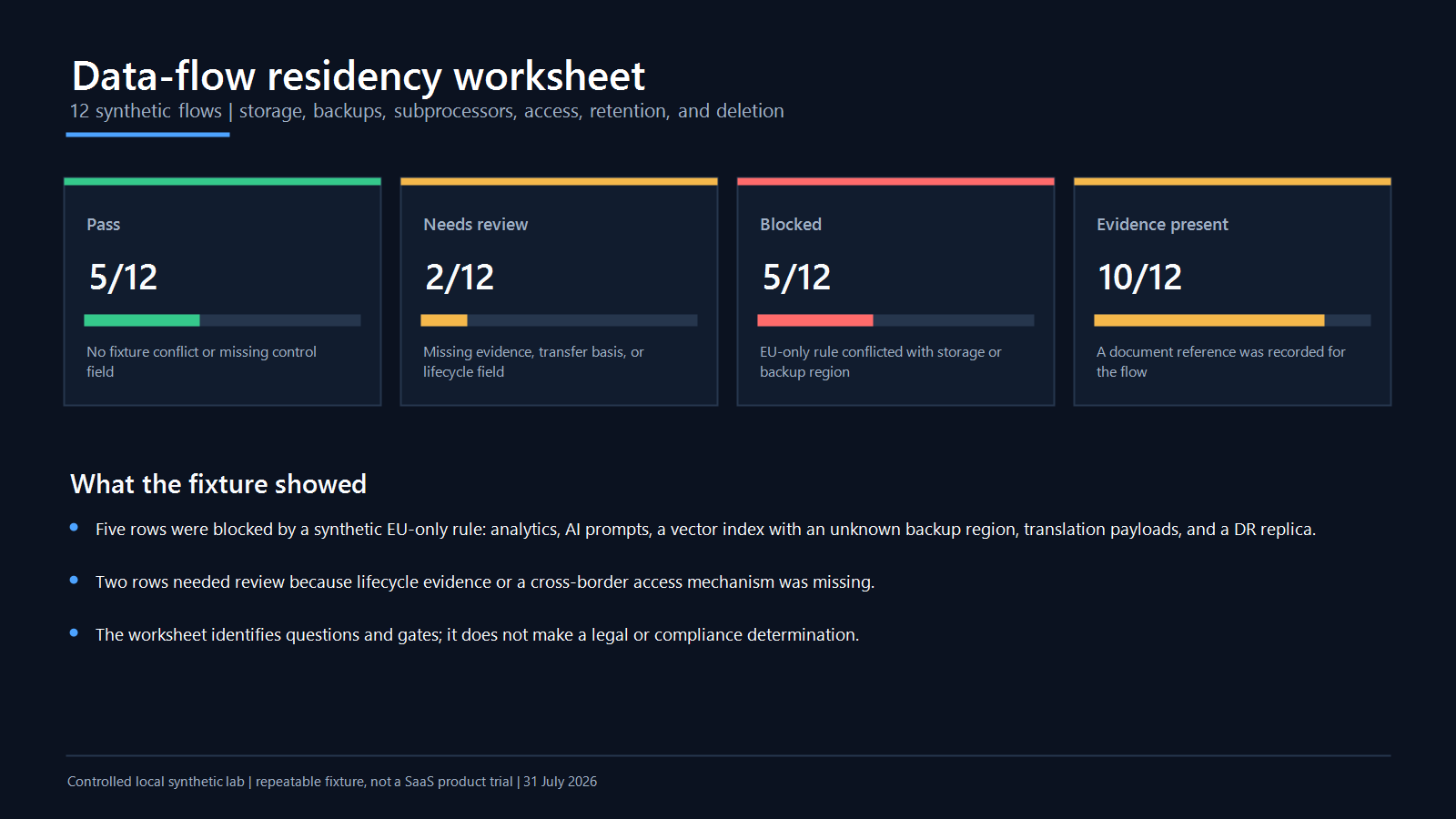
We built a local synthetic worksheet with 12 fictional knowledge base data flows. Each row recorded classification, required region, primary and backup regions, processor, transfer mechanism, retention, deletion service level, administrative access regions, and an evidence reference.
The deterministic rule returned Block when an EU-only fixture stored production or backup data outside the EU. It returned Review when a required field was blank or unknown, or when cross-border administrative access lacked a recorded mechanism. All other rows passed the worksheet rule.
| Worksheet result | Rows | Interpretation |
|---|---|---|
| Pass | 5 of 12 | No conflict or missing field under the synthetic rule |
| Needs review | 2 of 12 | Missing lifecycle evidence or transfer mechanism |
| Blocked | 5 of 12 | Storage or backup conflicted with the fixture’s EU-only requirement |
| Evidence reference present | 10 of 12 | A document was named; its accuracy was not independently verified |
Limitations
The lab used fictional flows and an authored EU-only rule. It did not inspect a vendor environment, contract, network path, support session, subprocessor, transfer impact assessment, or deletion job. A “Pass” means only that a synthetic row satisfied the script’s fields. Counsel and technical reviewers must confirm the applicable law, current documentation, contractual language, and implementation.
Turn the inventory into a residency worksheet
| Field | Evidence to request | Buyer test |
|---|---|---|
| Data artifact and classification | Data dictionary and feature data sheet | Can the vendor map your named artifact, not just “customer data”? |
| Primary storage and search | Architecture and residency scope | Are content and search indexes in the required boundary? |
| Backups and recovery | Backup-region and restoration documentation | Does a restore preserve the residency requirement? |
| Subprocessors and support access | Subprocessor list, access policy, and audit evidence | Who can access data, from where, and under what control? |
| AI and translation | Feature-specific data-flow terms | Do prompts, outputs, embeddings, and translation payloads follow the same scope? |
| Retention and deletion | Retention schedule and deletion commitments | Does deletion propagate to indexes, logs, backups, and subprocessors? |
| Exit | Export format and deletion certificate process | Can you retrieve content, metadata, relationships, and audit records? |
Record the document name, version, retrieval date, contract clause, plan, and reviewer. A link alone is weak evidence because vendor scope can change. Recheck it at renewal and whenever you enable a new integration or AI capability.
Define every worksheet column
Ambiguous columns create false passes. Define storage region as the location of the active copy for the named artifact, not the vendor’s headquarters. Define backup region to include snapshots, archives, recovery replicas, and temporary restore copies. Define administrative access to include vendor support, incident response, engineering, and subprocessors—not only your own administrators.
For retention, record the normal period, the event that starts the clock, legal holds, and the maximum deletion time after a customer request or contract end. For evidence, name the exact architecture page, contract schedule, DPA annex, audit report section, or test result. “Vendor says EU” is not a verifiable field value.
- Artifact: a specific object such as article body, attachment, query log, prompt, embedding, or backup.
- Processor chain: the platform, infrastructure provider, feature provider, and downstream service that handles it.
- Purpose: why the artifact is created and which feature depends on it.
- Data path: collection, transmission, active storage, derived copies, support access, export, and deletion.
- Acceptance test: the observable evidence required to mark the row pass, review, or block.
Use an evidence hierarchy
Prefer binding and implementation-specific evidence over general marketing language. A practical hierarchy is: signed order form and negotiated term; DPA and service-specific schedule; current architecture, residency, backup, and subprocessor documentation; independent assurance material within its stated scope; administrative screenshots or exports; and a written vendor answer that identifies the product, plan, feature, region, and date.
Resolve contradictions explicitly. A public page may describe a newer feature than the contract, while a sales answer may omit a documented exception. Record the discrepancy, the vendor owner, the controlling document, and the approval decision. Do not average conflicting answers into a partial score.
During a trial, use synthetic content and inspect the available region setting, audit log, export, deletion workflow, AI controls, and integration configuration. A settings screenshot proves only what the interface displayed for that account. It does not prove the physical path of every copy, so connect it to architecture and contractual evidence.
Map the hidden copies
Search, analytics, and logs
Search terms, failed queries, feedback text, IP-derived fields, and account identifiers can create separate datasets. Ask whether they are covered by the selected region and whether analytics can be disabled or configured. Link the decision to your knowledge base security and compliance controls.
Backups and disaster recovery
Confirm new backups, historical backups, replicas, support snapshots, and the recovery destination. Test a restoration scenario on paper: which region receives the restored copy, who authorizes it, and when is the temporary copy deleted? The knowledge base disaster recovery guide covers the wider continuity plan.
Integrations and marketplace apps
A regional knowledge base can send data to a globally hosted CRM, help desk, automation service, or translation provider. Follow every outbound and inbound field. The data boundary is the complete workflow, not the product whose logo appears on the portal. Use the knowledge base integrations architecture guide to document retries, queues, logs, and failure paths.
AI prompts, outputs, and embeddings
Evaluate AI as a separate processing path. Ask which model and retrieval services receive content, whether prompts or responses are retained, where embeddings and evaluation logs reside, whether permissions are enforced before retrieval, and how deletion reaches derived artifacts. Do not assume the article database’s region automatically covers these systems.
Apply the legal framework carefully
Residency is a technical and contractual fact; lawfulness depends on context. The GDPR addresses processing and transfers of personal data, while the European Data Protection Board explains international transfer mechanisms and standard contractual clauses. A storage region does not by itself resolve access from another country, government requests, controller and processor roles, purpose limitation, retention, or security.
For global deployments, maintain a jurisdiction register owned by counsel. Record the applicable obligation, data type, effective date, exception, transfer mechanism, responsible owner, and review date. Do not compress several countries into one generic “international compliance” checklist.
Use pass, review, and block gates
- Pass: scope, regions, lifecycle, access, evidence, and contract meet the written requirement.
- Review: the design may be acceptable, but a field, document, transfer mechanism, plan limit, or counsel decision is unresolved.
- Block: a mandatory region or data-handling requirement conflicts with the proposed design.
Keep a mandatory gate separate from a weighted feature score. A platform should not compensate for a failed residency requirement with better search or lower cost. Add the worksheet and evidence request to your knowledge base software RFP.
Buyer verification sequence
- Define artifacts, classifications, regions, and mandatory gates.
- Draw production, backup, support, integration, AI, and deletion flows.
- Request feature-specific, plan-specific, dated evidence.
- Reconcile public documentation with the DPA, order form, and security materials.
- Test administrative settings and exports in a trial using synthetic content.
- Review cross-border access and transfers with counsel.
- Record exceptions, owners, renewal dates, and change triggers.
- Repeat the assessment before enabling a new subprocessor, integration, or AI feature.
Set a revalidation cadence
Assign one owner to maintain the data-flow map and separate approvers for legal, privacy, security, procurement, and the business system. Revalidate mandatory rows before renewal and after a plan change, new region, acquisition, subprocessor notice, integration, AI feature, backup redesign, incident, or material regulatory change.
For each review, compare the current worksheet with the prior version, retest unresolved rows, and record what changed. Expire evidence on a defined date rather than treating a document retrieved years ago as permanently current. If a mandatory row becomes unknown, move it back to Review or Block until evidence is restored.
Frequently asked questions
Does EU hosting mean all knowledge base data stays in the EU?
Not necessarily. Confirm the documented scope for articles, attachments, profiles, indexes, logs, analytics, backups, support access, integrations, and AI artifacts.
Is data residency the same as GDPR compliance?
No. Residency can support a requirement, but GDPR compliance also depends on roles, lawful basis, transparency, rights, minimization, security, retention, contracts, and transfer conditions.
Is self-hosting automatically safer?
No. Self-hosting gives an organization more infrastructure control and more operational responsibility. Backup placement, administrator access, monitoring, patching, recovery, and subprocessors still need evidence. Compare the trade-offs in the cloud versus on-premise guide.
How often should residency evidence be reviewed?
At procurement and renewal, and whenever the vendor, plan, hosting region, subprocessor, integration, backup design, AI feature, or applicable requirement changes.