Independent knowledge base software guide Evidence-led Updated 2026

Ticket-to-article workflow: from repeated cases to safe knowledge
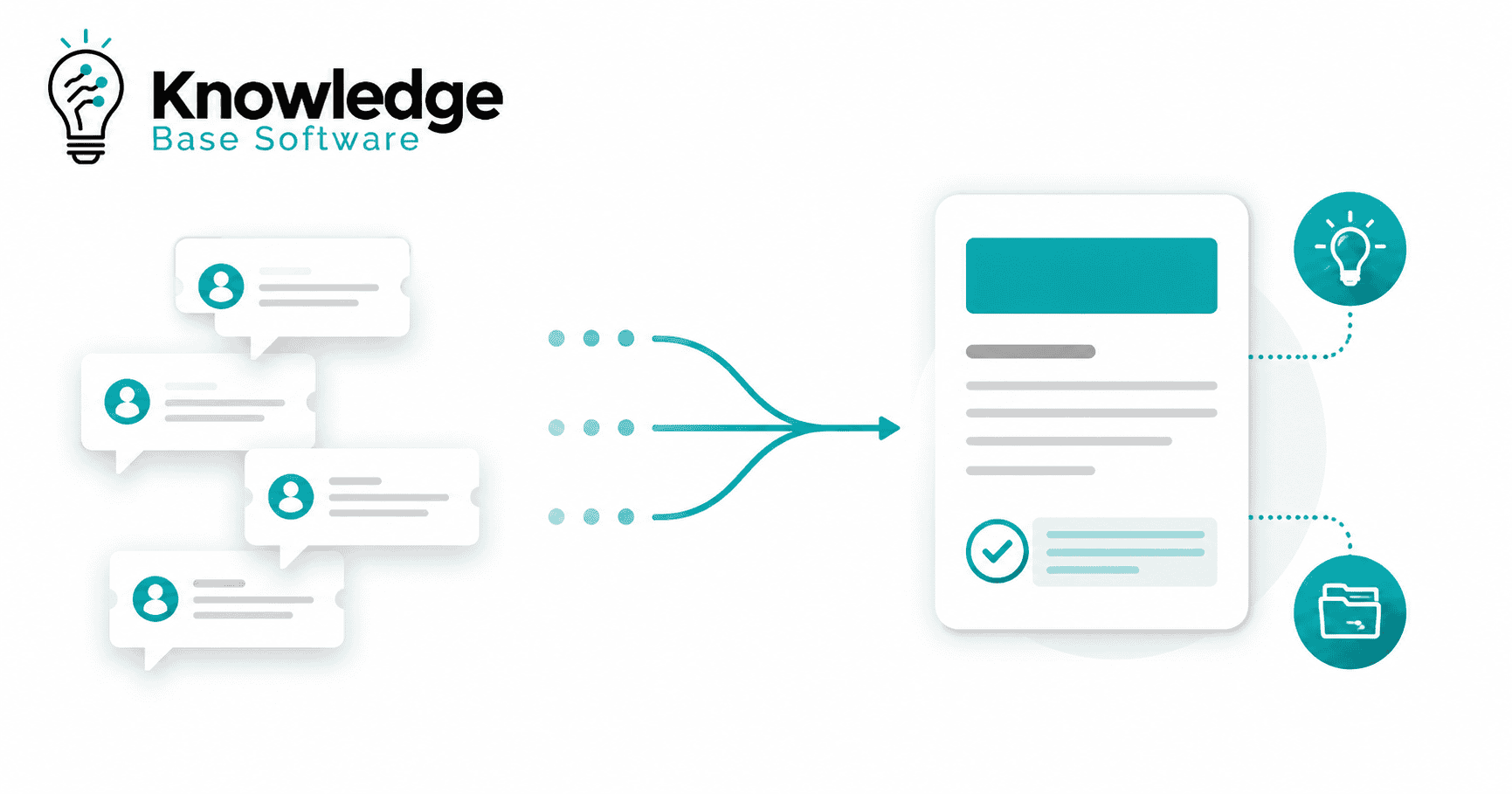
A ticket-to-article workflow turns repeated support demand into one reviewed, reusable answer without copying customer data into the knowledge base. The workflow should search before creating, consolidate duplicates, remove sensitive details, preserve only reusable context, route risk-specific reviews, and measure whether the published article is found and helps readers complete the task.
The output is not a cleaned-up conversation transcript. It is a standalone article that a different reader can understand without access to the original case. Tickets provide demand evidence and diagnostic language; the approved product, policy, security, billing, or operations source provides authority.
Use demand to improve knowledge, not multiply drafts
Start by searching the existing knowledge base. If an accurate article already solves the issue, link and improve it instead of creating another page. If a partial answer exists, add the missing environment, symptom, exception, or validation step. Create a new article only when there is a genuine knowledge gap and a reusable resolution.
This aligns with the current Knowledge-Centered Success Practices Guide, which organizes the Solve Loop around reuse, improve, capture, and structure and says new articles are created on demand. The Consortium renamed the methodology from Knowledge-Centered Service to Knowledge-Centered Success; use the current name unless discussing legacy KCS v6 material. KCS® is a service mark of the Consortium for Service Innovation.
Choose the right ticket signals
| Signal | What it can support | What it cannot prove |
|---|---|---|
| Repeated issue cluster | Several cases may share one reusable problem and resolution | Every case belongs to the same root cause |
| Unsuccessful search | Readers used terms the corpus may not cover | No relevant article exists; the query may be ambiguous |
| Agent-created workaround | A missing operational path deserves review | The workaround is safe, current, or approved |
| Escalation or long handle time | The task may need clearer prerequisites or diagnostics | Documentation alone caused the delay |
| Article flag or negative rating | A reader reported a problem worth investigating | The article failed or the issue remained unresolved |
| No assisted contact after a view | A journey did not lead to contact under a stated event rule and time window | The article prevented a ticket or solved the task |
Prioritize clusters using frequency, user impact, business risk, resolution stability, and confidence that documentation can help. A rare security issue may outrank a frequent cosmetic question. A high-volume issue with no stable resolution belongs in product or incident management, not a speculative article.
The ticket-to-article workflow
1. Search and record reuse
Search with the customer’s words, the product term, error code, and likely task. Record which article was reused, improved, or found insufficient. Search should happen inside the support workflow where possible, but the decision record should not expose private ticket content to the public index.
2. Capture a knowledge-gap candidate
Create a lightweight candidate with the issue statement, environment, verified resolution, source ticket IDs, proposed audience, risk class, and owner. Do not create a publishable draft automatically from every closed ticket. Zendesk’s current documentation, for example, lets agents create or request an article while working on a ticket and notes that ticket information is not automatically populated into the article. See Creating and requesting articles while working on tickets.
3. Redact and minimize
Remove names, email addresses, phone numbers, account and order identifiers, IP addresses, authentication data, access tokens, secrets, payment data, health data, private attachments, internal notes, and unnecessary conversation history. Replace a specific identity with a reusable role only when the role matters to the resolution.
Automated detection is a first pass, not a guarantee. Contextual identifiers, free-form secrets, screenshots, filenames, URLs, and combinations of otherwise ordinary details can still identify a person or system. Apply human review and keep source-ticket access restricted. GDPR’s official text includes purpose limitation and data minimization among its principles; assess the laws and contracts that apply to your data.
4. Cluster by issue and resolution
Group tickets only when they share the same user goal, relevant environment, root cause or decision path, and verified resolution. Similar vocabulary is not enough. “Cannot sign in” can represent a forgotten password, SSO configuration, suspended account, regional outage, or compromised credential—each needs a different path.
- Retain ticket IDs as restricted provenance, not as public content.
- Assign a cluster confidence and send uncertain cases to triage.
- Split clusters when prerequisites or outcomes differ materially.
- Merge candidates when one canonical article can cover variations without confusion.
- Link related issues instead of duplicating shared setup steps.
5. Verify the resolution against authority
A successful ticket outcome is evidence that something worked once; it is not automatically policy. Verify steps against the current product, runbook, policy owner, release state, and intended audience. Resolve contradictions before drafting. If the source is temporary incident guidance, set an expiry or archive trigger.
6. Draft with a reusable template
| Field | Purpose |
|---|---|
| Task or symptom title | Match the reader’s goal or observable problem |
| Applies to | State product, version, plan, role, locale, or environment |
| Before you begin | List permissions, backups, dependencies, and risks |
| Resolution | Give one action per numbered step with expected results |
| Verify | Tell the reader how to confirm success |
| If it still fails | Provide safe diagnostics and an escalation path |
| Ownership metadata | Owner, approvers, effective date, review date, and source IDs |
Write in the reader’s vocabulary, then introduce the product term. Keep steps short, ordered, and testable. Google’s maintained procedure guidance recommends one action per step where practical and clear introductory context. Use the site’s effective knowledge base article guide for the complete editorial standard.
7. Route review by risk
Every candidate needs content review; higher-risk topics need domain approval. Define the matrix before automation so a workflow cannot interpret “agent resolved the ticket” as approval to publish.
- Support or knowledge owner: reproducibility, clarity, findability, and audience.
- Product or engineering: behavior, versions, limitations, and technical safety.
- Security: authentication, authorization, secrets, incident steps, and abuse risk.
- Privacy or legal: personal data, regulated topics, rights, retention, and jurisdictional claims.
- Billing or finance: prices, refunds, tax, credits, and financial controls.
- Localization owner: locale-specific correctness when content is translated or adapted.
8. Publish, connect, and observe
Publish one canonical article to the correct audience. Link the source tickets to it, update related articles, add redirects for duplicates, and ensure search and AI indexes respect the publishing state and permissions. Give the article an owner and review trigger. Feed new reuse, flags, failed searches, escalations, and product changes back into the content lifecycle.
Automate decisions, not accountability
| Automation | Safe default | Human checkpoint |
|---|---|---|
| PII and secret detection | Mask known patterns and flag uncertain content | Reviewer checks text, images, links, and attachments |
| Issue clustering | Suggest groups with confidence and evidence | Triage confirms shared cause and resolution |
| Draft generation | Use approved sources and a fixed template | Owner verifies every material claim and step |
| Duplicate detection | Suggest canonical and related articles | Owner decides merge, split, redirect, or link |
| Review routing | Apply a predeclared risk matrix | Named approvers sign off; automation cannot self-approve |
| Publishing | Block when required evidence or approval is missing | Authorized publisher confirms audience and lifecycle metadata |
Log candidate creation, redaction decisions, source ticket IDs, cluster changes, reviewer decisions, article revision, and publication result. Store the minimum evidence required and restrict it by role. OWASP’s Logging Cheat Sheet advises excluding or masking access tokens, passwords, encryption keys, sensitive personal data, and other secrets from application logs.
How we tested
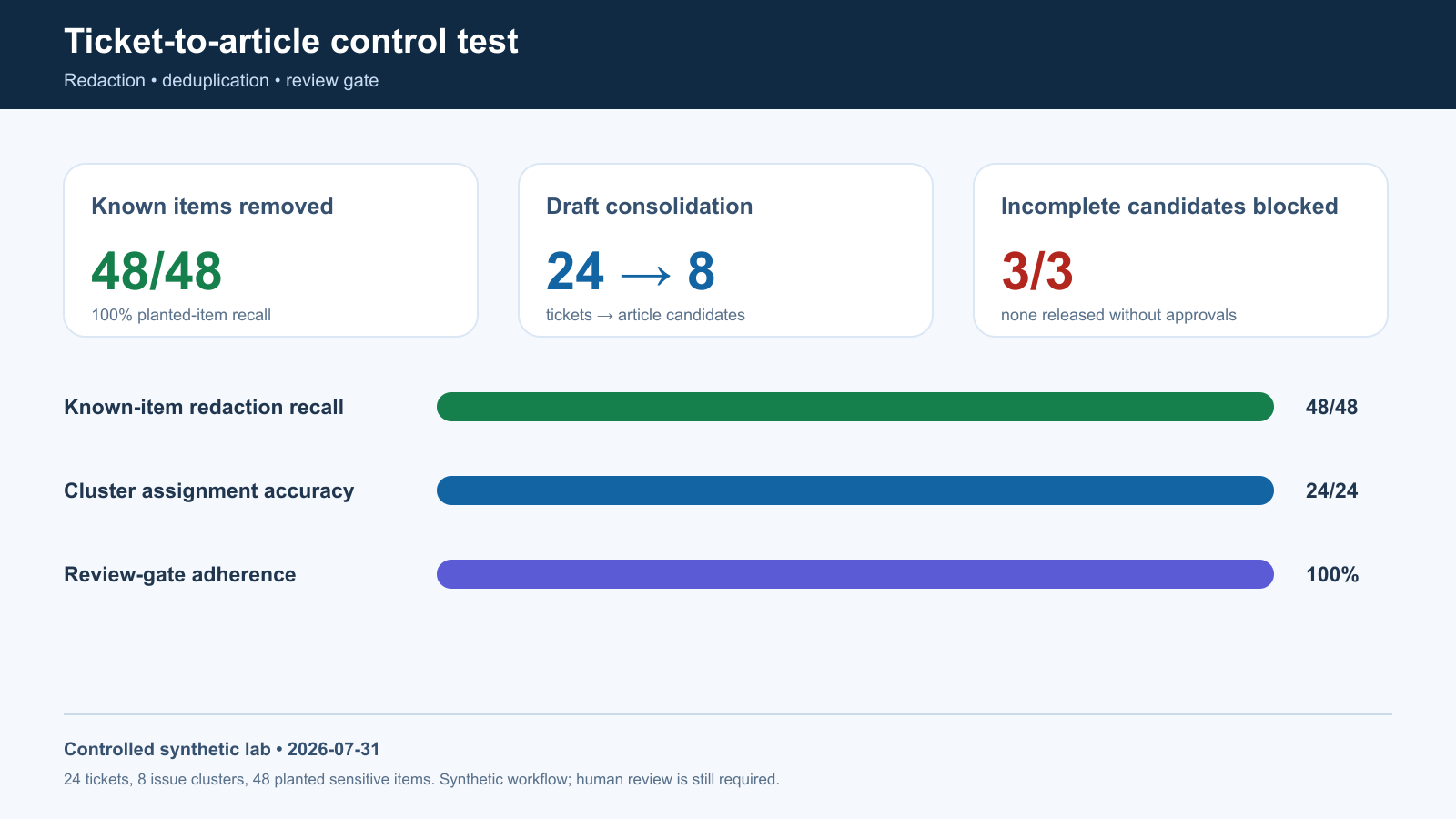
We ran a deterministic controlled synthetic lab on July 31, 2026. The sample contained 24 invented tickets across 8 known issue clusters, with 3 wording variants per issue. We planted 48 known sensitive items: every ticket had an email address plus a phone number, order reference, API-key-like string, or IP address. Eight article candidates had predeclared issue-specific approval requirements.
The workflow applied five explicit redaction patterns, removed redaction placeholders before classification, and assigned each ticket to the issue whose keyword stems had the highest overlap. It consolidated tickets by predicted issue. For the review test, five candidates had all required approvals and three intentionally lacked one required approval. The publication gate compared supplied approvals with the matrix and blocked any incomplete candidate.
We measured recall against the 48 planted values, residual known items, ticket-to-cluster accuracy, reduction from raw drafts to consolidated candidates, and whether any incomplete candidate was released. Data, method, decision-level results, and the executable test are retained with the evidence dashboard.
| Measure | Result |
|---|---|
| Known sensitive items removed | 48/48 (100%) |
| Residual planted sensitive items | 0 |
| Issue-cluster assignments | 24/24 correct (100%) |
| Consolidation | 24 ticket drafts → 8 article candidates |
| Incomplete candidates blocked | 3/3 |
| Incomplete candidates published | 0 |
The result demonstrates deterministic control behavior, not production readiness. In particular, perfect planted-item recall is possible because the patterns and ground truth were known. Real tickets contain names, screenshots, voice transcripts, arbitrary credentials, customer-specific URLs, indirect identifiers, and regulated data that simple patterns miss.
Limitations
This was a controlled synthetic lab, not a test of a ticketing system, knowledge-base SaaS product, language model, or production dataset. Tickets were English-only, grammatically clear, evenly distributed, and labeled with eight known issues. Keyword classification does not represent the ambiguity, multilingual phrasing, product overlap, or changing root causes found in live support demand.
The redaction test measured only planted values matched by five patterns. A 100% result does not prove anonymization, de-identification, or compliance. It did not test image text, file metadata, free-form secrets, names, account context, rare identifiers, re-identification through combinations, or whether the remaining text was necessary for the article. Human privacy and security review remains required.
Correct clustering does not prove that a proposed resolution is accurate or safe. The review gate tested whether approval names were present, not reviewer competence, independence, evidence quality, or the substance of approval. Production validation should sample real redacted cases under appropriate authority, use a manually adjudicated benchmark, measure false merges and false splits, test reviewer bypass and workflow failure, and audit published articles for residual sensitive data and factual errors.
Measure the workflow without overstating outcomes
- Reuse rate: candidates resolved by improving or linking an existing article instead of creating a duplicate.
- Time to reviewed knowledge: elapsed time from verified gap to approved publication, segmented by risk.
- Duplicate rate: candidates later merged or redirected because canonicalization failed.
- Redaction exceptions: sensitive items found after automated processing or publication.
- Review-gate adherence: candidates published with every required approval and evidence field.
- Findability: whether the canonical article appears for representative reader language.
- Task success: an explicit completion or solved signal where the workflow can collect one responsibly.
- Ticket-deflection signal: journeys that did not lead to assisted contact under a defined event rule and time window; do not call them prevented tickets without an explicit success signal or causal comparison.
Use the content audit guide to inspect published outputs and the AI answer quality guide if articles feed automated answers. Reuse data should inform improvement, not reward raw article volume.
Operational checklist
- Search before creating and record reuse or the verified gap.
- Keep source ticket IDs as restricted provenance.
- Redact and minimize before clustering, drafting, or sending data to another service.
- Group by shared task, environment, cause, and resolution—not vocabulary alone.
- Verify the resolution against the current authoritative source.
- Use one reusable template with audience and lifecycle metadata.
- Route domain reviews from a predeclared risk matrix.
- Block publication when evidence, ownership, or approval is missing.
- Publish one canonical article and connect duplicates with links or redirects.
- Measure findability, explicit task success, privacy exceptions, and review adherence.
- Feed article corrections and new demand back into the governed workflow.
Frequently asked questions
Should every closed ticket create an article?
No. Reuse or improve existing knowledge first. Create a new article when the resolution is verified, reusable, appropriate for a defined audience, and not already covered by a canonical source.
Can AI publish a ticket-derived article automatically?
It can assist with redaction, clustering, and drafting, but automatic publication is unsafe when facts, privacy, permissions, or policy require judgment. Keep risk-based human approval and an authorized publishing action.
How many repeated tickets justify an article?
There is no universal threshold. Use frequency with impact, risk, stability, and reusability. One high-impact security or safety issue can justify controlled documentation; many tickets with an unstable resolution may not.
Does redaction make ticket text safe to publish?
No. Pattern-based redaction can miss contextual and indirect identifiers, secrets, images, and unnecessary private details. Minimize, rewrite for a reusable audience, and require human review.
Last tested: July 31, 2026. Product workflows and privacy requirements change; verify current official documentation, your data-processing rules, and your review matrix before implementation.