Independent knowledge base software guide Evidence-led Updated 2026

Best Knowledge Base Software for Small Businesses (2026): 7 Options Compared
Knowledge base software for small businesses should remove repeated questions without creating another system that a lean team cannot afford or maintain. The best choice is not the product with the longest feature list. It is the least complex product that serves the right readers, stays inside a verified annual budget, and has a named person responsible for keeping the content accurate.
Quick answer: choose Help Scout or Freshdesk when customer knowledge must sit beside support conversations. Compare Slite, Confluence, and Notion for internal knowledge. Consider Document360 when documentation is a product asset, and BookStack when self-hosting is a requirement and a technical owner exists. Treat Zendesk as a graduation benchmark for a more complex service operation, not as an eighth default winner.
Research disclosure: we checked the official pricing and support documentation linked throughout this page on July 29, 2026. We also completed an original public buying-evidence audit. That audit measures what a buyer can verify in public vendor documentation without logging in. It is not an administrator-product test and does not claim results for editor usability, search quality, AI accuracy, implementation time, permissions with real users, or vendor support.
Independent disclosure: Knowledge Base Software is an independent editorial site and is not owned or operated by any vendor in this comparison. “Best” means the clearest documented fit for a defined small-business scenario, not a universal performance ranking.
Choose Your Small-Business Route First
| Primary job | Start with | Do not overlook |
|---|---|---|
| Customer help center plus support conversations | Help Scout or Freshdesk | Count paid users or agents, AI usage, and the limits of the entry plan. |
| Internal SOPs, onboarding, and operating knowledge | Slite, Confluence, or Notion | Count every paid member and test the actual permission model. |
| Structured product, customer, or API documentation | Document360 | Define projects, editors, readers, languages, privacy, security, and migration before requesting a quote. |
| Self-hosted internal or technical documentation | BookStack | A zero license fee does not include hosting, updates, backups, security, or recovery. |
| Growing omnichannel service operation | Zendesk benchmark | The first public Zendesk card explicitly listing Knowledge Base is Suite Team, not the cheaper Support Team card. |
A customer help center and an employee wiki are different systems even when both contain articles. If employees are the main readers, use our deeper internal knowledge base software comparison. If the first requirement is simply a $0 entry path, compare the restrictions in the free knowledge base software guide.
Seven Knowledge Base Options for Small Businesses
| Product | Best fit | Verified entry path | Reference annual scenario | First material gate |
|---|---|---|---|---|
| Help Scout | Customer help center plus shared inbox | Free; Standard $25/user/month on annual billing | 3 Standard users: $900/year | Free Docs has 10 articles and 100 helped contacts per monthly cycle |
| Freshdesk | Tickets plus customer self-service | Six-month Freshdesk-only Free Program for up to 2 agents; Growth $19/agent/month annually | 3 Growth agents: $684/year | The free program is temporary and its two-agent ceiling excludes the three-agent scenario |
| Slite | Reviewed internal SOPs | Basic $10/member/month annually; 14-day no-card trial | 10 Basic members: $1,200/year | Connected-source retrieval and several controls require Pro |
| Confluence | Internal knowledge for an Atlassian team | Free for up to 10 users | 10 Free users: $0 software fee | Free permissions are not customizable and anonymous access is unavailable |
| Notion | Flexible internal wiki and operating workspace | Free; Plus $10/member/month annually | 10 Plus members: $1,200/year | Team collaboration limits and plan-gated governance can force an upgrade |
| Document360 | Structured product, customer, or API documentation | Customized quote; 14-day trial | Not responsibly calculable from public pricing | Configuration determines the quote from the start |
| BookStack | Technically owned self-hosted documentation | $0 software license; public resettable demo | Operating cost cannot be inferred from the license price | The business owns infrastructure and administration |
These prices are not directly comparable. Support platforms charge agents or users, internal workspaces can charge every member, Document360 uses a tailored quote, and BookStack replaces a subscription with infrastructure and staff responsibility. The arithmetic above uses public annual rates and fixed scenarios; it is not a quote or savings claim.
Original Public Buying-Evidence Audit
Small teams often cannot spend days reconstructing a plan from marketing cards, support articles, and checkout screens. We therefore audited the public buying evidence for each shortlisted product and the Zendesk benchmark. Starting from the official pricing page—or the official project homepage for BookStack—we tried to establish five facts:
- The lowest viable entry path for the named use case.
- The person, tier, configuration, or operational responsibility that triggers cost.
- One material limit or upgrade trigger.
- Whether the starting path is a continuing free plan, temporary program, trial, demo, quote, or self-hosted project.
- The number of official pages required to support a defensible comparison row.
An answer counted only when the vendor or project stated it directly. We did not accept third-party reviews, search-result snippets, historical prices, inferred checkmarks, or marketing adjectives as evidence.
| Product | Official pages required in the July 29, 2026 audit | What the public evidence established | Evidence burden observed |
|---|---|---|---|
| Help Scout | 2 | Free and $25 Standard entry; paid plans use per-user billing; 10-article and 100-contact Free limits | At the July 29 capture, the headline plan was clear, but the decisive Free caps required a support article. |
| Freshdesk | 2 | Six-month two-agent program; $19 Growth; agent billing; temporary-program gate | The attractive entry path requires a second page and careful separation from Omni and the 14-day trial. |
| Slite | 1 | $10 Basic, $20 Pro, member billing, plan gate, and no-card trial | One pricing page supports the complete classification. |
| Confluence | 2 | Free for 10 users and the non-customizable permission/no-anonymous-access gate | The decisive governance warning is in plan documentation, not just the pricing surface. |
| Notion | 1 | Free, $10 Plus, $20 Business, member billing, and major entry-plan limits | One dynamic comparison page contains most evidence; its column alignment should be rechecked when purchasing. |
| Document360 | 1 for buying model; 2 for detailed trial behavior | Customized pricing factors and a 14-day trial | No exact annual amount is public. “Custom quote” is a valid result, not missing research. |
| BookStack | 1 for model; 2 for deployment gate | MIT-licensed self-hosting, $0 license, public demo, and technical prerequisites | A subscription table cannot reveal local infrastructure and labor cost. |
| Zendesk benchmark | 1 | $19 Support Team without a listed KB; $55 Suite Team with Knowledge Base; agent billing | The crucial package distinction is visible without login. |
What the audit supports: conclusions about public buying transparency and the work required to verify an entry plan. Slite, Notion, Zendesk, and BookStack expose enough core evidence on one starting page for their main classification. Help Scout, Freshdesk, and Confluence require a second official document for a decision-changing limit. Document360 publicly identifies quote factors but does not publish a responsible fixed price.
What it does not support: a product-performance ranking. One researcher performed this public lookup on one date. No account was created. We did not test editor setup, reader search, typo tolerance, AI answers, access controls with real people, imports, exports, uptime, support response, migration, or regional account eligibility. Page count is not a speed score, and official prices, currencies, taxes, and availability can change.
Best Options by Small-Business Job
1. Help Scout: Customer Help Center Plus a Shared Inbox
Help Scout is the leanest fit here when customer articles, email conversations, and an embedded help widget should operate together. Its pricing page lists Free with one shared Inbox for up to five users and one Docs site. Its Free Plan guide says the Docs site can be managed by unlimited users, while limiting it to 10 articles and the account to 100 helped contacts per monthly cycle. Standard is $25 per user/month on annual billing; AI Answers costs $0.75 per resolution. Choose it for a support-led customer help center. Skip it for a broad employee wiki or if Free cannot hold the required article set. See our deeper Help Scout review. Help Scout terms rechecked August 16, 2026.
2. Freshdesk: Ticketing and Self-Service With a Temporary Free Runway
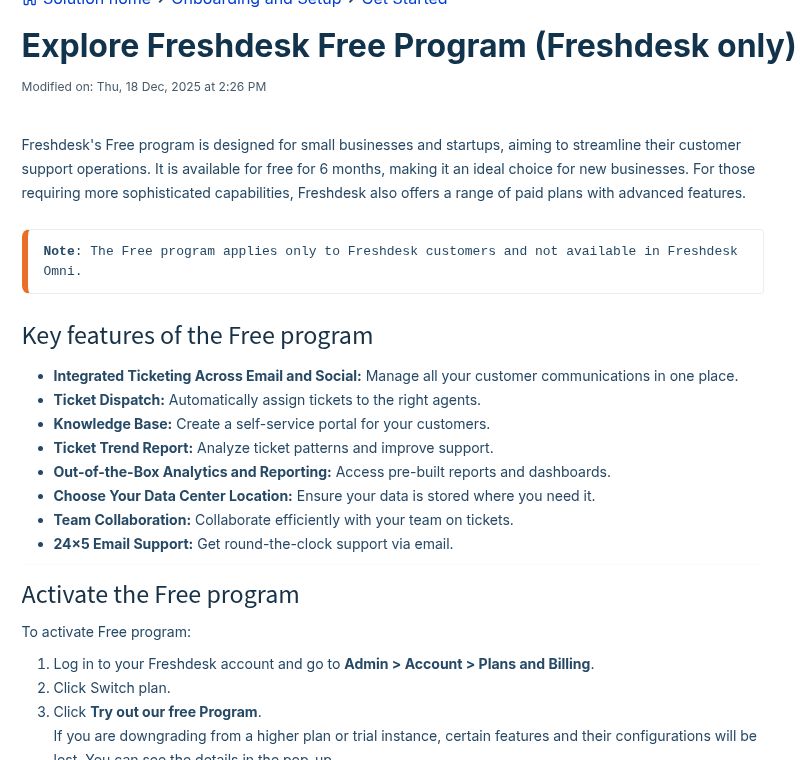
Freshdesk is the strongest starting path for a two-agent team that needs tickets and customer self-service together. Its official Free Program documentation states six months, up to two agents, and a Knowledge Base for Freshdesk only—not Freshdesk Omni. This is not a free-forever plan or the separate 14-day higher-plan trial. For paid use, Growth is $19 per agent/month on annual billing and lists a customer portal and knowledge base. Choose it when tickets are central. Skip it for a simple employee handbook or when the business requires a permanent free plan. Read the detailed Freshdesk comparison.
3. Slite: Reviewed Internal Knowledge
Slite fits a small internal team that needs an explicit review signal rather than an ungoverned collection of pages. Its pricing page lists Basic at $10 and Pro at $20 per member/month when billed yearly, with a 14-day trial that does not require a card. Basic includes unlimited documents, document verification, and the Knowledge Management Panel. Pro adds connected-tool search, suggested fact-check fixes, selected agent workflows, OpenID SSO, and a custom domain for public docs. Choose Basic when reviewed SOPs are the main job. Price Pro when connected sources or its security and publishing controls are requirements. Skip Slite when customer ticketing is the primary workflow.
4. Confluence: Internal Documentation for an Atlassian Team
Confluence is a practical internal route when Jira and Atlassian already organize the team’s work. Official Confluence Cloud plan documentation says Free supports up to 10 users, 2 GB of storage, and unlimited spaces and pages. The plan gate is more important than the $0 price: permissions are not customizable, anonymous access is unavailable, and everyone who can log in can view, add, and edit content. Choose it for a small collaborative internal wiki whose Free access model is acceptable. Skip Free for an anonymous customer help center or sensitive departmental separation. Use Atlassian’s live pricing calculator for a paid user count.
5. Notion: A Flexible Cross-Functional Workspace
Notion can combine a wiki, operating documents, projects, meeting notes, and databases in one workspace. Its official USD pricing comparison lists Free, Plus at $10 per member/month annually, Business at $20, and Enterprise by quote. Free is unlimited for an individual but block-limited when a workspace has two or more members; the page does not publish that block number. Free also lists 5 MB files, seven-day history, and 10 guests. Choose Plus for a flexible team workspace after testing structure and ownership. Price Business if private teamspaces or page verification are required. Skip it for a purpose-built ticket-side customer portal. See our Notion comparison.
6. Document360: Documentation as a Product Asset
Document360 belongs on the shortlist when customer, product, or API documentation needs dedicated structure, workflow, analytics, localization, or mixed public/private delivery. Its official pricing page uses customized quotes rather than a reusable fixed amount. Publicly named price factors include team accounts, workspaces, languages, SSO and security, privacy model, and AI Premium Suite usage. A 14-day trial is documented. Choose it only after defining the documentation architecture and asking for a written entitlement list. Skip it when the whole requirement is a small FAQ or simple handbook. Do not reuse an old fixed price from a historical review.
7. BookStack: Self-Hosted Control With an Operations Owner
BookStack is free to download, self-hosted, open source, and MIT licensed. Its shelves, books, chapters, and pages provide a predictable documentation hierarchy, but the $0 license is not a $0 operating model. The business owns the server, database, updates, backups, monitoring, email, identity integration, security, and recovery tests. The official installation guide expects knowledge of hosting a PHP application and database and says shared PHP hosting is not currently supported. Choose it when infrastructure control is required and a named technical owner accepts the work. Skip it when nobody can operate a production application. Compare more open-source knowledge base software.
When Zendesk Becomes Reasonable
Zendesk is useful as a graduation benchmark when knowledge must sit inside a broader, increasingly complex customer-service operation. On the public annual pricing cards, Support Team is $19 per agent/month but does not list Knowledge Base. Suite Team is $55 per agent/month and is the first public customer-service card that explicitly lists it. Three agents therefore equal $1,980 per year before AI usage, add-ons, tax, implementation, and services—not $684 or $900.
Choose Zendesk when channels, routing, automation, agent workflows, and knowledge justify suite administration and cost. Skip it when a small team only needs a straightforward help center or shared inbox. The regular trial lasts 14 days and defaults to Suite Professional, so do not assume every trial feature is included in Suite Team. Zendesk’s separate startup program is conditional and should not be budgeted without confirmed eligibility. See the full Zendesk knowledge base review.
Real Annual-Cost Scenarios
Use a fixed headcount before comparing features. The examples below multiply current public monthly equivalents under annual billing by 12. They exclude taxes, optional add-ons, AI usage, implementation, migration, services, and future price changes. Recalculate in checkout or a written proposal before purchase. Our knowledge base pricing-model guide explains the wider cost categories.
Customer Support: Three Paid Users or Agents
| Product and plan | Arithmetic | Annual equivalent | Important exclusion |
|---|---|---|---|
| Freshdesk Growth | 3 × $19 × 12 | $684/year | The six-month Free Program supports only two agents; add-ons and usage may add cost. |
| Help Scout Standard | 3 × $25 × 12 | $900/year | AI Answers, additional sites or inboxes, services, and tax are excluded. |
| Zendesk Suite Team benchmark | 3 × $55 × 12 | $1,980/year | AI usage, add-ons, implementation, services, and tax are excluded. |
Internal Knowledge: Ten Members
| Product and plan | Arithmetic | Annual equivalent | Decision caveat |
|---|---|---|---|
| Confluence Free | $0 for up to 10 users | $0 software fee | No customizable permissions or anonymous access on Free. |
| Slite Basic | 10 × $10 × 12 | $1,200/year | Pro is required for connected-tool retrieval and several controls. |
| Notion Plus | 10 × $10 × 12 | $1,200/year | Private teamspaces and page verification needs can move the team to Business. |
| BookStack | $0 license | Not calculable from license price | Add infrastructure, updates, backups, monitoring, security, recovery, and staff time. |
Document360 cannot be assigned a responsible annual figure from its current public site. For a documentation-first scenario, request a written quote that identifies editors, workspaces or projects, readers, languages, privacy, SSO, migration, workflow, API-documentation needs, AI usage, support, and renewal terms. “Custom quote” is more useful than an invented estimate.
Run a Seven-Day Small-Business Pilot Before Committing
The public audit above cannot replace a trial in your own account. If suitable access is available, use one fixed, small test rather than browsing features at random:
- Use 10 real questions and 10 cleaned articles; do not import an obsolete archive.
- Name one content owner and one backup owner.
- Include two reader types, such as an employee and contractor or an anonymous visitor and signed-in customer.
- Test one publish/update cycle and one deliberately expired page.
- Test one permission denial and confirm that restricted content cannot be found through search or AI.
- Export representative pages with links, images, tables, and attachments.
- Compare the observed workflow with a pre-set annual ceiling, including paid people and operational ownership.
We did not run this authenticated pilot for the products in this update, so no result is implied. Use the full knowledge base software buyer’s guide when you need a complete trial scorecard, procurement questions, security review, and migration plan.
Recommendations by Scenario
- Two-agent customer-support startup: verify the Freshdesk Free Program inside the intended account, then compare its six-month runway and basic KB limits with Help Scout Free.
- Three-agent support team: compare Freshdesk Growth at a $684 annual rate equivalent with Help Scout Standard at $900, then add expected AI usage and operational fit.
- Ten-person team already using Jira: start with Confluence Free only if its open internal editing model is acceptable; price a paid plan if governance blocks the use case.
- Ten-person cross-functional team: compare Slite Basic and Notion Plus at the same $1,200 annual rate equivalent; decide on verification, connected search, structure, and workspace breadth.
- Documentation-first SaaS company: scope Document360 before requesting a quote; do not buy a support suite solely to obtain a documentation site.
- Technical team requiring self-hosting: shortlist BookStack only after assigning infrastructure, backup, security, and recovery ownership.
- Growing omnichannel service operation: introduce Zendesk when the broader suite justifies its $55-per-agent public KB-inclusive baseline.
Frequently Asked Questions
What is the best knowledge base software for a small business?
For customer support, begin with Help Scout or Freshdesk. For internal knowledge, compare Slite, Confluence, and Notion. Document360 fits structured product documentation, while BookStack fits technically owned self-hosting. Zendesk becomes reasonable when a broader service suite is justified. The right answer depends on audience, billable people, access model, annual ceiling, and ownership.
What is the cheapest customer-facing option in this shortlist?
Help Scout has a continuing Free entry path, but Free Docs is limited to 10 articles and the account to 100 helped contacts per monthly cycle. Freshdesk documents a six-month Free Program for up to two agents; it is temporary and Freshdesk-only. For three paid agents, the public annual-rate examples are $684 for Freshdesk Growth and $900 for Help Scout Standard.
Should a small business use a wiki or a customer help center?
Use an internal wiki for employee procedures, onboarding, HR, IT, sales, and operations. Use a customer help center for setup, billing, account, returns, and troubleshooting content. If both are required, verify that permissions and ownership clearly separate the audiences, or use two integrated products rather than forcing confidential and public content into one weak structure.
Can a ten-person team use Confluence Free as a public help center?
No. Atlassian’s plan documentation says anonymous access is unavailable on Confluence Free. It can support up to 10 logged-in internal users, but permissions are not customizable and everyone who can log in can view, add, and edit content. Treat it as an internal collaboration option unless a paid plan’s access model is verified for the intended public use.
Is self-hosted knowledge base software really free?
The software license can be free while operation is not. BookStack has a $0 MIT-licensed software edition, but the business still pays for infrastructure and the people responsible for installation, updates, backups, monitoring, email, identity, security, and recovery. It is economical only when the business wants that control and already has dependable technical ownership.
When is Zendesk worth considering?
Consider Zendesk when knowledge is one part of a larger omnichannel service operation that also needs routing, automation, agent workflows, and suite administration. Its public Support Team card is cheaper but does not list Knowledge Base; Suite Team is the first public card that does, at $55 per agent/month paid yearly. Compare the complete operating model, not the $19 headline.
Primary Official Sources
- Help Scout: pricing and Free Plan limits.
- Freshdesk: Free Program and paid pricing.
- Slite: pricing and plan comparison.
- Confluence: pricing and Cloud plan limits.
- Notion: USD pricing and plan comparison.
- Document360: pricing and quote factors and trial documentation.
- BookStack: official project site and installation requirements.
- Zendesk: pricing, plan gates, and trial terms.